


Meituan (美團) reported revenue that beat estimates, showing how Beijing’s ongoing antitrust probe into the Internet giant has yet to weigh on its growth prospects.
China’s largest food delivery platform reported sales of 43.8 billion yuan (US$6.77 billion) for the April-to-June quarter, compared with the 42.4 billion yuan average of analyst’s estimates. The company posted a third straight quarterly net loss of 3.4 billion yuan.
Wang Xing’s (王興) Internet behemoth is facing fines of about US$1 billion as part of an investigation by the antitrust watchdog into alleged contraventions such as forced exclusivity arrangements, Bloomberg reported this month.
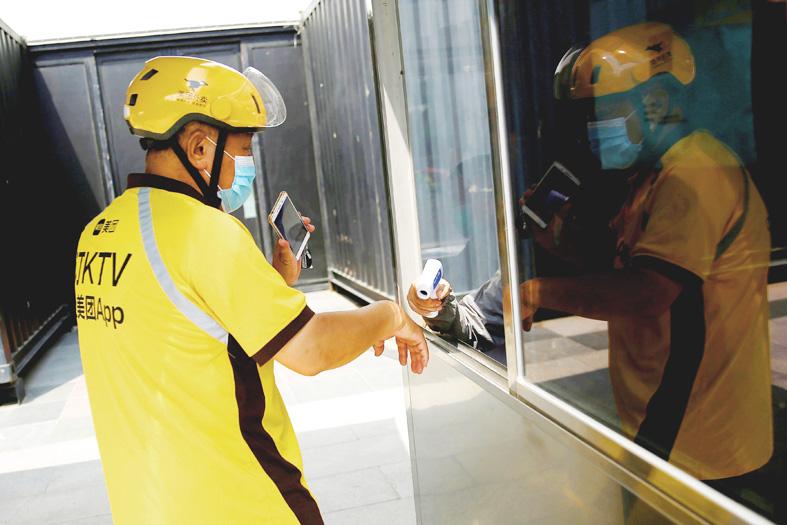
Photo: Reuters
Since then, Meituan and its peers have come under sustained fire from regulators for a slew of perceived offenses, ranging from the plight of low-income gig workers to their handling of data security.
Despite a pledge by the company earlier this year to provide insurance for its delivery force, regulators have gone even further, asking online food platforms to ensure that workers earn at least the local minimum wage, which could weigh on margins.
“Our base case scenario assumes it might take [about] 5 years to fully implement the potential increase on rider cost,” Citigroup Inc analyst Alicia Yap wrote in a note this month. “While there remain regulatory overhang and financial impacts uncertainty near term, we believe our positive thesis on Meituan for its local services super-app position remains intact and believe Meituan will navigate through the challenges and transform into a reputable and prevailing local service gateway company.”
Citigroup this month cut its share price target for Meituan by 19 percent. The stock has nearly halved since its February high, wiping out about US$160 billion in market value.
Even as regulatory scrutiny intensified, Wang’s firm has splashed out on growing newer businesses, including community commerce, an arena that took off during the COVID-19 pandemic.
The company is counting on its Meituan Select division to help it reach a target of adding about 400 million annual transacting users over the next few years to the 628.4 million it had in the second quarter.
However, competition in the community group buying industry has been stiff.
In the past few months, several smaller operators have folded or run into trouble, unable to compete with the heavy investments by giants like Meituan, Alibaba Group Holding Ltd (阿里巴巴) and Didi Global Inc (滴滴).
Meituan and its peers have announced major philanthropic projects, heeding Beijing’s call to redistribute wealth.
In the latest example, Pinduoduo Inc (拼多多), an e-commerce company known for giving significant discounts to customers when they buy produce together, said it would donate all of its first net profit since going public to support the country’s farmers and agricultural areas.

The domestic unit of the Chinese-owned, Dutch-headquartered chipmaker Nexperia BV will soon be able to produce semiconductors locally within China, according to two company sources. Nexperia is at the center of a global tug-of-war over critical semiconductor technology, with a Dutch court in February ordering a probe into alleged mismanagement at the company. The geopolitical tussle has disrupted supply chains, with some carmakers reportedly forced to cut production due to chip shortages. Local production would allow Nexperia’s domestic arm, Nexperia Semiconductors (China) Ltd (安世半導體中國), to bypass restrictions in place since October on the supply of silicon wafers — etched with tiny components to

Singapore-based ride-hailing and delivery giant Grab Holdings Ltd has applied for regulatory approval to acquire the Taiwan operations of Germany-based Delivery Hero SE's Foodpanda in a deal valued at about US$600 million. Grab submitted the filing to the Fair Trade Commission on Friday last week, with the transaction subject to regulatory review and approval, the company said in a statement yesterday. Its independent governance structure would help foster a healthy and competitive market in Taiwan if the deal is approved, Grab said. Grab, which is listed on the NASDAQ, said in the filing that US-based Uber Technologies Inc holds about 13 percent of

Taiwan is open to joining a global liquefied natural gas (LNG) program if one is created, but on the condition that countries provide delivery even in a scenario where there is a conflict with China, an energy department official said yesterday. While Taiwan’s priority is to have enough LNG at home, the nation is open to exploring potential strategic reserves in other countries such as Japan or South Korea, Energy Administration Deputy Director-General Chen Chung-hsien (陳崇憲) said. While the LNG market does not have a global reserve for emergencies like that of oil, the concept has been raised a few times —

Taiwan Semiconductor Manufacturing Co (TSMC, 台積電) yesterday received government approval to deploy its advanced 3-nanometer (3nm) process at its second fab currently under construction in Japan, the Ministry of Economic Affairs said in a news release. The ministry green-lit the plan for the facility in Kumamoto, which is scheduled to start installing equipment and come online in 2028 with a monthly production capacity of 15,000 12-inch wafers, the ministry said. The Department of Investment Review in June 2024 authorized a US$5.26 billion investment for the facility, slated to manufacture 6- to 12nm chips, significantly less advanced than 3nm process. At a meeting with


 RSS
RSS