


China Huarong Asset Management Co’s (中國華融資產管理) long-delayed results for last year showed a record loss, with leverage hitting 1,333 times and capital buffers far short of the regulatory minimum, emphasizing the difficult task ahead for the bad-debt manager that recently secured a government bailout.
Huarong reported a 102.9 billion yuan (US$15.9 billion) loss for all of last year, slashing shareholder equity by nearly 85 percent, an exchange filing showed on Sunday.
The company booked 107.8 billion yuan in impairments and suffered a 12.5 billion yuan loss on financial assets. While it returned to a small profit in the first half of this year, chairman Wang Zhanfeng (王占峰) said the firm would apply to the regulator for temporary tolerance with key capital measures below requirements as of June.
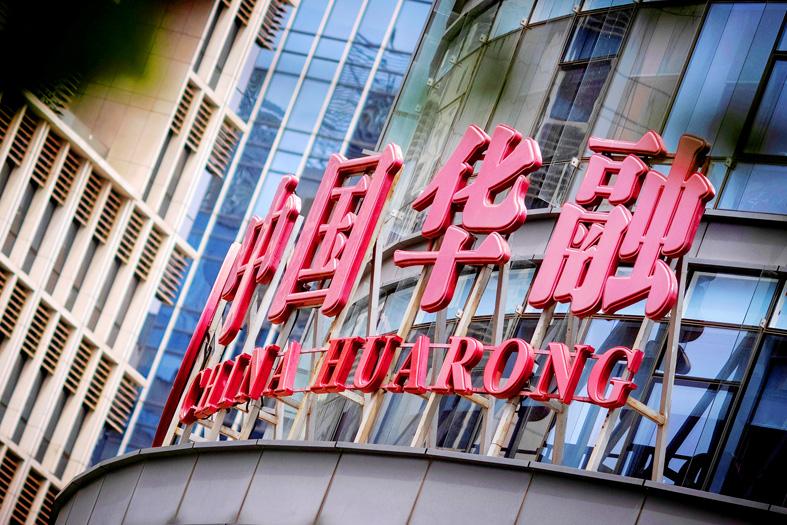
Photo: Reuters
After five months of turmoil since it delayed its earnings report in March, China’s biggest bad-debt manager this month secured a rescue package from some of the nation’s biggest financial firms.
Its plight had become the biggest test in decades of whether Beijing would still shield state-owned firms from market forces amid a renewed push by Chinese President Xi Jinping (習近平) to rein in debt growth as defaults have hit records.
Huarong said on Sunday that it plans to dispose of subsidiaries with non-core business activities in the “near future” to increase internally generated fund inflows and to replenish capital.
It cut its non-financial local and offshore units to 13 from 27 through last year.
The company is still working with its strategic investors on the details of a recapitalization, Wang said during a conference call yesterday, adding that more companies might join the original group.
He did not provide further clarity on the bailout.
State-owned investors, including Citic Group (中國中信集團), China Insurance Investment Co (中保投資) and China Life Asset Management Co (中國人壽資產管理), on Aug. 18 agreed to put fresh capital in Huarong.
The firm would receive US$7.7 billion as part of an overhaul plan with control shifting to Citic from the Chinese Ministry of Finance, although details were still being finalized and could change, people familiar with the matter have said.
A review of assets and risks last year “had a significant impact on the operating results and is a harsh lesson to be learned in the development history of the company,” Wang said in the earnings report. “What is gone is gone, but go for what to come. We will learn from the lesson and take it as valuable experience and the desire to move forward.”
The company said by implementing measures, including asset sales and a capital boost, it can ensure operations for the next 12 months.
“We will move from making quick bucks to earning slow and hard money for the long term,” Huarong president Liang Qiang (梁強) said in the conference call.
Huarong’s auditor Ernst & Young expressed reservations on the company’s income and cash flow statements for last year, as it was unable to obtain “sufficient appropriate audit evidence” to ascertain whether any of the associated gains and losses recognized by Huarong last year should have been recorded in previous years.
Moody’s Investors Service last week cut Huarong’s credit rating to “Baa2,” two levels above junk, and put it on watch for a potential further downgrade, citing deterioration of its capital and profitability.
Huarong has been effectively frozen out of the bond market since the second quarter, even as the company has been servicing its debt on time and reached agreements with state-owned banks to ensure it can meet obligations through at least the end of this month.
The firm assured investors this month that it has no plan to restructure its debt and has made preparations for future bond payments.
While defaults at state-owned Chinese companies have become more common in the past few years, none of the borrowers that missed payments have been as systemically important as Huarong. Aside from its close link to China’s central government and complex web of connections to other financial institutions, Huarong is also one of the country’s biggest issuers of offshore bonds that sit in portfolios from Hong Kong to London and New York.
If Huarong lost its investment-grade credit rating, 56 percent of surveyed fund managers that hold its US dollar bonds would be forced to sell, according to a Bank of America report dated Aug. 17.

The domestic unit of the Chinese-owned, Dutch-headquartered chipmaker Nexperia BV will soon be able to produce semiconductors locally within China, according to two company sources. Nexperia is at the center of a global tug-of-war over critical semiconductor technology, with a Dutch court in February ordering a probe into alleged mismanagement at the company. The geopolitical tussle has disrupted supply chains, with some carmakers reportedly forced to cut production due to chip shortages. Local production would allow Nexperia’s domestic arm, Nexperia Semiconductors (China) Ltd (安世半導體中國), to bypass restrictions in place since October on the supply of silicon wafers — etched with tiny components to

Singapore-based ride-hailing and delivery giant Grab Holdings Ltd has applied for regulatory approval to acquire the Taiwan operations of Germany-based Delivery Hero SE's Foodpanda in a deal valued at about US$600 million. Grab submitted the filing to the Fair Trade Commission on Friday last week, with the transaction subject to regulatory review and approval, the company said in a statement yesterday. Its independent governance structure would help foster a healthy and competitive market in Taiwan if the deal is approved, Grab said. Grab, which is listed on the NASDAQ, said in the filing that US-based Uber Technologies Inc holds about 13 percent of

Taiwan is open to joining a global liquefied natural gas (LNG) program if one is created, but on the condition that countries provide delivery even in a scenario where there is a conflict with China, an energy department official said yesterday. While Taiwan’s priority is to have enough LNG at home, the nation is open to exploring potential strategic reserves in other countries such as Japan or South Korea, Energy Administration Deputy Director-General Chen Chung-hsien (陳崇憲) said. While the LNG market does not have a global reserve for emergencies like that of oil, the concept has been raised a few times —

Taiwan Semiconductor Manufacturing Co (TSMC, 台積電) yesterday received government approval to deploy its advanced 3-nanometer (3nm) process at its second fab currently under construction in Japan, the Ministry of Economic Affairs said in a news release. The ministry green-lit the plan for the facility in Kumamoto, which is scheduled to start installing equipment and come online in 2028 with a monthly production capacity of 15,000 12-inch wafers, the ministry said. The Department of Investment Review in June 2024 authorized a US$5.26 billion investment for the facility, slated to manufacture 6- to 12nm chips, significantly less advanced than 3nm process. At a meeting with


 RSS
RSS