


The Bank of Korea (BOK) yesterday raised its policy rate for the first time in almost three years, becoming the first major Asian central bank to shift away from COVID-19-era monetary settings as ballooning consumer debt creates new threats for the South Korean economy.
BOK Governor Lee Ju-yeol maintained his hawkish tone and suggested that the bank could further tighten policy as data showed that Asia’s fourth-largest economy was overheating.
“We won’t be doing things in a hurry, but we also won’t hold off,” Lee told a news conference, responding to a question about the timing for additional tightening.
“As for timing for the further hikes, we will consider how the COVID-19 situation plays out, and changes in the Fed’s [US Federal Reserve] policy stance, which would have an important impact for us, as well as how the financial imbalances play out,” Lee said
BOK board member Joo Sang-yong was the only one of the six board members who voted to keep rates steady as the bank raised the benchmark interest rate 25 basis points to 0.75 percent, as expected by most analysts.
The central bank also pushed up its inflation projection to 2.1 percent from 1.8 percent previously, signaling that conditions are building for further policy tightening.
“If there will be another rate hike within this year, it will likely be November, given that there will be at least two to three rate hikes needed including today’s meeting to address financial imbalances risk,” said Paik Yoon-min, a fixed income analyst at Kyobo Securities.
Policymakers had been signaling higher rates since May, but expectations for an increase in the past few months were pared due to South Korea’s latest COVID-19 outbreak, which forced the economy into semi-lockdown.
Central banks around the world are laying the groundwork for a transition away from crisis-era stimulus, as what began as emergency support for collapsing growth now overheats many economies.
The BOK’s move came a day before Fed Chairman Jerome Powell is due to deliver his keynote address at the US central bank’s annual symposium in Jackson Hole, Wyoming, where he is expected to signal the future direction of US monetary policy.
Most central banks that have raised rates this year are among emerging economies, concerned about capital flight and imported inflation. In Asia, Sri Lanka raised rates last week, making it the first in the region to do so.
The BOK’s decision represents a calculated risk that South Korea’s export-driven economy, which has soared back from last year’s COVID-19 slump, is healthy enough to start trimming stimulus, especially as debt bingeing is becoming an economic issue.
That contrasts with New Zealand, which last week delayed a widely expected interest rate increase as its first COVID-19 outbreak in six months cast uncertainty over its economic recovery.
Analysts expect the BOK to raise interest rates next year, with most seeing the base rate at 1.25 percent by the end of next year, although Lee’s comments suggest that the bank remains on a hawkish footing.
The policy decision is the first rate review the central bank has had as a six-member body after board member Koh Seung-beom left the board to head the South Korean Financial Services Commission.
There are two more interest rate review meetings scheduled this year.

The domestic unit of the Chinese-owned, Dutch-headquartered chipmaker Nexperia BV will soon be able to produce semiconductors locally within China, according to two company sources. Nexperia is at the center of a global tug-of-war over critical semiconductor technology, with a Dutch court in February ordering a probe into alleged mismanagement at the company. The geopolitical tussle has disrupted supply chains, with some carmakers reportedly forced to cut production due to chip shortages. Local production would allow Nexperia’s domestic arm, Nexperia Semiconductors (China) Ltd (安世半導體中國), to bypass restrictions in place since October on the supply of silicon wafers — etched with tiny components to

Singapore-based ride-hailing and delivery giant Grab Holdings Ltd has applied for regulatory approval to acquire the Taiwan operations of Germany-based Delivery Hero SE's Foodpanda in a deal valued at about US$600 million. Grab submitted the filing to the Fair Trade Commission on Friday last week, with the transaction subject to regulatory review and approval, the company said in a statement yesterday. Its independent governance structure would help foster a healthy and competitive market in Taiwan if the deal is approved, Grab said. Grab, which is listed on the NASDAQ, said in the filing that US-based Uber Technologies Inc holds about 13 percent of
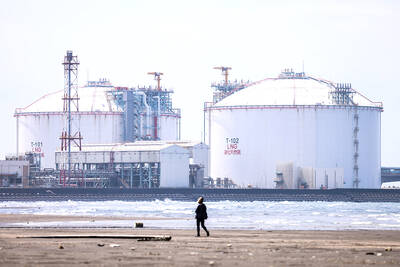
Taiwan is open to joining a global liquefied natural gas (LNG) program if one is created, but on the condition that countries provide delivery even in a scenario where there is a conflict with China, an energy department official said yesterday. While Taiwan’s priority is to have enough LNG at home, the nation is open to exploring potential strategic reserves in other countries such as Japan or South Korea, Energy Administration Deputy Director-General Chen Chung-hsien (陳崇憲) said. While the LNG market does not have a global reserve for emergencies like that of oil, the concept has been raised a few times —
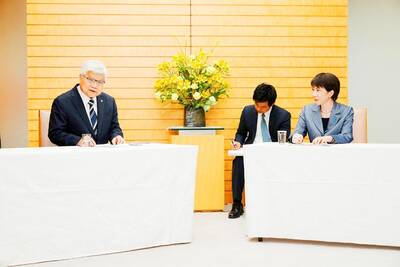
Taiwan Semiconductor Manufacturing Co (TSMC, 台積電) yesterday received government approval to deploy its advanced 3-nanometer (3nm) process at its second fab currently under construction in Japan, the Ministry of Economic Affairs said in a news release. The ministry green-lit the plan for the facility in Kumamoto, which is scheduled to start installing equipment and come online in 2028 with a monthly production capacity of 15,000 12-inch wafers, the ministry said. The Department of Investment Review in June 2024 authorized a US$5.26 billion investment for the facility, slated to manufacture 6- to 12nm chips, significantly less advanced than 3nm process. At a meeting with


 RSS
RSS