


Three former Netflix Inc software engineers and two close associates were sued by US federal regulators for profiting US$3 million by trading on confidential information about the company’s subscriber growth.
Sung Mo “Jay” Jun, 49, while employed at the streaming provider in 2016 and 2017, repeatedly tipped non-public subscriber information to his brother, Joon Mo Jun, and his close friend, Junwoo Chon, who both used it to trade in advance of multiple Netflix earnings announcements, a Wednesday complaint from the US Securities and Exchange Commission (SEC) showed.
After Sung Mo Jun left Netflix in 2017, he obtained the same subscriber growth information from another Netflix insider, Ayden Lee, the SEC said.
Photo: AP
“We allege that a Netflix employee and his close associates engaged in a long-running, multimillion-dollar scheme to profit from valuable, misappropriated company information,” SEC San Francisco office head Erin Schneider said.
Sung Mo Jun, his brother and friend Chon all allegedly used encrypted messaging applications to discuss their trading in an attempt to evade detection. Another former colleague tipped the insider trading ring of the subscriber growth numbers in July 2019. In all, members of the group traded ahead of 13 Netflix quarter earnings announcements from July 2016 to July 2019, the SEC said.
Federal prosecutors in Seattle filed criminal securities fraud charges against four of the five defendants named in the SEC complaint. The criminal case was filed in a charging document called an information, which is typically used when defendants have already agreed to plead guilty.
The criminal charges rely on the same conduct alleged in the SEC complaint, alleging the subscriber data gleaned through their work as Netflix software engineers was used to inform trades in the company stock from 2016 to 2019 that netted millions in illicit gains.
An attorney for Sung Mo Jun did not respond to a request for comment, while an attorney for Ayden Lee declined to comment.
Lawyers for Joon Mo Jun and Chon said in e-mailed statements that their clients have accepted responsibility for their actions and look forward to putting this matter behind them.
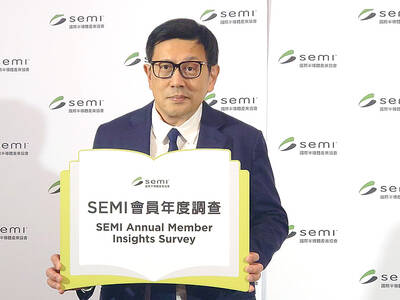
PRICE HIKES: The war in the Middle East would not significantly disrupt supply in the short term, but semiconductor companies are facing price surges for materials Taiwan’s semiconductor companies are not facing imminent supply disruptions of essential chemicals or raw materials due to the war in the Middle East, but surges in material costs loom large, industry association SEMI Taiwan said yesterday. The association’s comments came amid growing concerns that supplies of helium and other key raw materials used in semiconductor production could become a choke point after Qatar shut down its liquefied natural gas (LNG) production and helium output earlier this month due to the conflict. Qatar is the second-largest LNG supplier in the world and accounts for about 33 percent of global helium output. Helium is
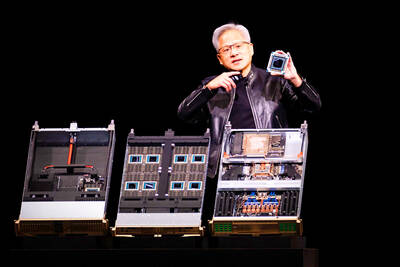
DOMESTIC COMPONENT: Huang identified several Taiwanese partners to be a key part of Nvidia’s Vera Rubin supply chain, including Asustek, Hon Hai and Wistron Nvidia Corp chief executive officer Jensen Huang (黃仁勳), addressing crowds at the company’s biggest annual event, unveiled a variety of new products while predicting that its flagship artificial intelligence (AI) processors would help generate US$1 trillion in sales through next year. During a two-and-a-half-hour keynote address, Huang announced plans to push deeper into central processing units (CPUs) — Intel Corp’s home turf — and introduced semiconductors made with technology acquired from start-up Groq Inc. The company even said it was developing chips for data centers in outer space. At the heart of Huang’s speech was the message that demand for computing power
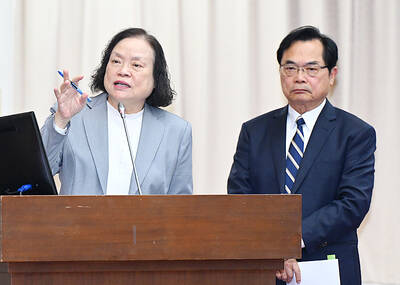
OPTIMISTIC: Inflation still has a chance of remaining below the central bank’s 2 percent alert level, as Taiwan’s economy is resilient with healthy exports, the NDC minister said Taiwan’s inflation could exceed 2 percent this year if oil prices continue to surge amid escalating tensions in the Middle East, prompting the government to reassess its economic outlook, the Directorate-General of Budget, Accounting and Statistics (DGBAS) said yesterday. DGBAS Minister Chen Shu-tzu (陳淑姿) told lawmakers at a meeting of the legislature’s Finance Committee that the agency’s earlier growth forecast of 1.68 percent in the consumer price index (CPI) and 7.71 percent for GDP this year did not account for the ongoing Middle East conflict and would need revision, if tensions persist. The previous forecast assumed an average international crude price of

ELECTRIC DREAMS: Smart cities would use ‘virtual power plants,’ which integrate idle electricity use from households, businesses and factories, Asustek said Asustek Computer Inc (華碩) yesterday showcased key components of its artificial intelligence (AI)-driven smart city initiatives at a trade show in Taipei, eyeing new business opportunities as cities develop sovereign AI infrastructure. Advances in generative, multimodal and physical AI are driving cities toward a new phase of “sovereign AI,” Asustek cochief executive officer Samson Hu (胡書賓) told reporters on the sidelines of the Smart City Summit and Expo at Taipei Nangang Exhibition Center’s Hall 2. The company showcased its “AI City” framework, which comprises three layers — computing infrastructure centered on AI servers, AI models and a platform layer for data processing


 RSS
RSS