


A wave of selling in China’s bellwether technology stocks continued for a fifth day, following Beijing’s latest moves to tighten its grip on the nation’s Internet giants.
The Hang Seng Tech Index dropped as much as 3.7 percent after the Chinese State Administration for Market Regulation issued draft rules banning unfair competition among the nation’s online platform operators.
The benchmark Hang Seng Index slumped more than 2 percent.
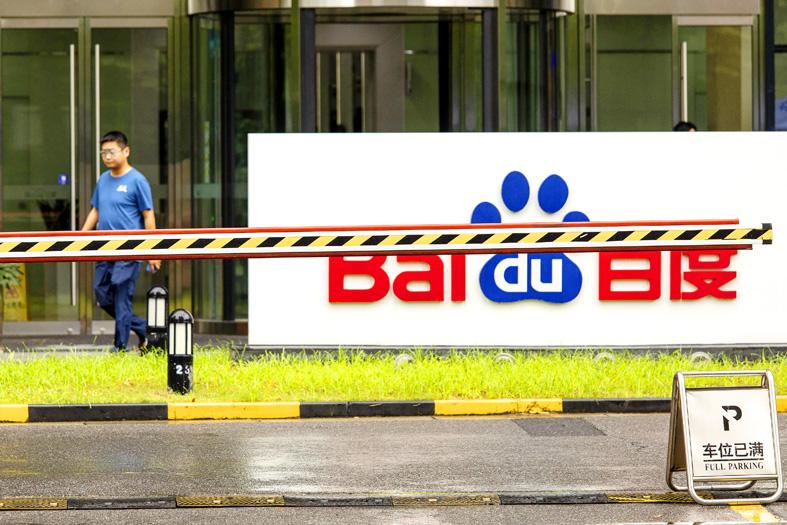
Photo: Bloomberg
Losses accelerated in afternoon trade as China issued separate rules to protect key network facilities and information systems, effective next month.
Baidu Inc (百度) and NetEase Inc (網易) fell more than 5 percent, while Alibaba Group Holding Ltd (阿里巴巴) and Tencent Holdings Ltd (騰訊) dropped by at least 4 percent.
That followed Monday’s selloff in Chinese online game firms in the wake of state media criticism of the sector, which spilled over into US trading overnight as the US Securities and Exchange Commission warned about the risks of investing in Chinese stocks.
The wide-ranging proposals released yesterday come after the Chinese Ministry of Industry and Information Technology last month launched a campaign aimed at rooting out a raft of problematic behavior.
It follows moves by Beijing to rein in the country’s Internet leaders in areas from antitrust to data security and ride-hailing.
The draft covers protections for intellectual property and brand reputation, as well as a ban on using algorithms or fake reviews to promote goods and services.
Alongside expressly prohibited behaviors such as forced exclusivity arrangements, companies will also not be permitted to use technical means to interfere with the operations of rival platforms or maliciously render those services incompatible with their own.
The latter could force giants like Tencent and Alibaba to dismantle their walled-off ecosystems that had prevented users from accessing one company’s services from the other’s platforms.
“Investors are concerned that regulatory reform is far from over and that policies will continue to be introduced,” Zhongtai Financial International Ltd (中泰金融國際) analyst Alvin Ngan said. “With risk appetite low, investors are thinking ‘sell it first.’”
On mainland markets, the CSI 300 Index fell 2.1 percent, with declines led by healthcare and consumer sectors.
In the weeks following a ban on profits in China’s tutoring sector, stocks have gyrated on state media warnings on everything from gaming addiction, alcohol and e-cigarettes to over-marketing of infant formula.
Investors in mainland China dumped another HK$4.1 billion (US$532 million) of Hong Kong stocks, the fourth consecutive day of net selling of the territory’s shares, data compiled by Bloomberg showed.
The HSI Volatility Index jumped nearly 14 percent, the most in three weeks.
The Hong Kong dollar traded at its weakest level in 17 months.
China’s uncertain regulatory environment continues to cast a shadow on the tech sector.
US filings showed that other funds joined George Soros’ investment firm in dumping China-based companies with listings in the US in the second quarter.

The domestic unit of the Chinese-owned, Dutch-headquartered chipmaker Nexperia BV will soon be able to produce semiconductors locally within China, according to two company sources. Nexperia is at the center of a global tug-of-war over critical semiconductor technology, with a Dutch court in February ordering a probe into alleged mismanagement at the company. The geopolitical tussle has disrupted supply chains, with some carmakers reportedly forced to cut production due to chip shortages. Local production would allow Nexperia’s domestic arm, Nexperia Semiconductors (China) Ltd (安世半導體中國), to bypass restrictions in place since October on the supply of silicon wafers — etched with tiny components to

Singapore-based ride-hailing and delivery giant Grab Holdings Ltd has applied for regulatory approval to acquire the Taiwan operations of Germany-based Delivery Hero SE's Foodpanda in a deal valued at about US$600 million. Grab submitted the filing to the Fair Trade Commission on Friday last week, with the transaction subject to regulatory review and approval, the company said in a statement yesterday. Its independent governance structure would help foster a healthy and competitive market in Taiwan if the deal is approved, Grab said. Grab, which is listed on the NASDAQ, said in the filing that US-based Uber Technologies Inc holds about 13 percent of

Taiwan is open to joining a global liquefied natural gas (LNG) program if one is created, but on the condition that countries provide delivery even in a scenario where there is a conflict with China, an energy department official said yesterday. While Taiwan’s priority is to have enough LNG at home, the nation is open to exploring potential strategic reserves in other countries such as Japan or South Korea, Energy Administration Deputy Director-General Chen Chung-hsien (陳崇憲) said. While the LNG market does not have a global reserve for emergencies like that of oil, the concept has been raised a few times —

Taiwan Semiconductor Manufacturing Co (TSMC, 台積電) yesterday received government approval to deploy its advanced 3-nanometer (3nm) process at its second fab currently under construction in Japan, the Ministry of Economic Affairs said in a news release. The ministry green-lit the plan for the facility in Kumamoto, which is scheduled to start installing equipment and come online in 2028 with a monthly production capacity of 15,000 12-inch wafers, the ministry said. The Department of Investment Review in June 2024 authorized a US$5.26 billion investment for the facility, slated to manufacture 6- to 12nm chips, significantly less advanced than 3nm process. At a meeting with


 RSS
RSS