


CTBC Financial Holding Co (中信金控) on Friday said that its net profit last month halved from a year earlier to NT$3.71 billion (US$133.33 million) as income from cash dividends was delayed after the nation’s listed companies were ordered to postpone their annual shareholders’ meetings due to a COVID-19 outbreak, the company said.
The financial conglomerate’s life insurance arm, Taiwan Life Insurance Co (台灣人壽), saw its net profit decline 55 percent from NT$5 billion a year earlier to NT$2.25 billion last month.
Cash dividends usually make up a large portion of life insurance companies’ net income in the third quarter, when many listed firms distribute cash dividends.
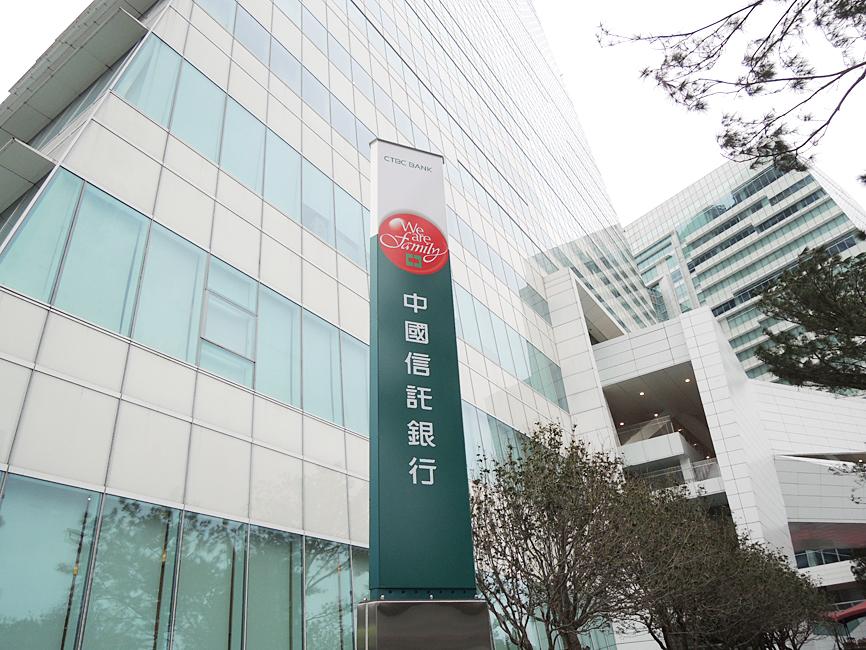
Photo: Lee Chin-hui, Taipei Times
The Financial Supervisory Commission required listed firms to postpone their shareholders’ meetings from June to last month or this month, CTBC said.
CTBC Bank’s (中國信託銀行) net profit declined 8.8 percent annually to NT$2.42 billion last month, also weighing on its parent company’s bottom line.
In the first seven months of this year, Taiwan Life’s net profit totaled NT$18.82 billion, up 43 percent year-on-year, and CTBC Bank’s net profit reached NT$17.3 billion, up 7 percent from a year earlier, company data showed.
From January to last month, fee income from CTBC Bank’s wealth management operations rose by double-digit percentages due to its diverse products and digital services, while the first-year premiums generated by Taiwan Life grew more than 30 percent from a year earlier, CTBC Financial said.
Overall, the financial conglomerate’ net profit rose 40 percent annually to NT$37.1 billion during the period, it said.
CTBC Financial’s earnings per share were NT$1.85 in the first seven months.
Taishin Financial Holding Co (台新金控) yesterday reported that its net profit grew 4 percent annually to NT$1.72 billion last month, while its banking unit, Taishin International Bank (台新銀行), reported a 5 percent gain in net profit to NT$1.38 billion, it said.
The bank maintained good loan quality amid the COVID-19 pandemic, with its non-performing loan ratio standing at 0.12 perfect, the company said.
Its newly acquired life insurance unit, Prudential Life Insurance Co of Taiwan (保德信人壽), which is to be renamed Taishin Life Insurance Co (台新人壽), made a net profit of NT$300 million, up 15 percent from a year earlier, it said.
Meanwhile, SinoPac Financial Holdings Co (永豐金控) said its net profit expanded 22 percent annually to NT$1.72 billion last month, when Bank SinoPac (永豐銀行) and SinoPac Securities Co (永豐金證券) both reported growth in net profit.
In the first seven months, SinoPac Financial’s cumulative net profit totaled NT$10.3 billion, up 45 percent from a year earlier, it said.


ENERGY ISSUES: The TSIA urged the government to increase natural gas and helium reserves to reduce the impact of the Middle East war on semiconductor supply stability Chip testing and packaging service provider ASE Technology Holding Co (日月光投控) yesterday said it planned to invest more than NT$100 billion (US$3.15 billion) in building a new advanced chip testing facility in Kaohsiung to keep up with customer demand driven by the artificial intelligence (AI) boom. That would be included in the company’s capital expenditure budget next year, ASE said. There is also room to raise this year’s capital spending budget from a record-high US$7 billion estimated three months ago, it added. ASE would have six factories under construction this year, another record-breaking number, ASE chief operating officer Tien Wu

The EU and US are nearing an agreement to coordinate on producing and securing critical minerals, part of a push to break reliance on Chinese supplies. The potential deal would create incentives, such as minimum prices, that could advantage non-Chinese suppliers, according to a draft of an “action plan” seen by Bloomberg. The EU and US would also cooperate on standards, investments and joint projects, as well as coordinate on any supply disruptions by countries like China. The two sides are additionally seeking other “like-minded partners” to join a multicountry accord to help create these new critical mineral supply chains, which feed into

For weeks now, the global tech industry has been waiting for a major artificial intelligence (AI) launch from DeepSeek (深度求索), seen as a benchmark for China’s progress in the fast-moving field. More than a year has passed since the start-up put Chinese AI on the map in early last year with a low-cost chatbot that performed at a similar level to US rivals. However, despite reports and rumors about its imminent release, DeepSeek’s next-generation “V4” model is nowhere in sight. Speculation is also swirling over the geopolitical implications of which computer chips were chosen to train and power the new
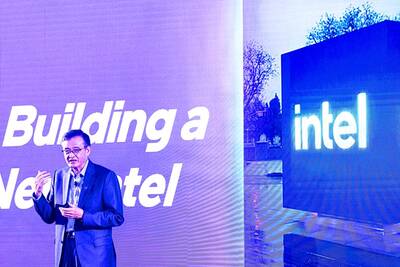
Intel Corp is joining Elon Musk’s long-shot effort to develop semiconductors for Tesla Inc, Space Exploration Technologies Corp and xAI, marking a surprising twist in the chipmaker’s comeback bid. Intel would help the Terafab project “refactor” the technology in a chip factory, the company said on Tuesday in a post on X, Musk’s social media platform. That is a stage in the development process that typically helps make chips more powerful or reliable. The chipmaker’s shares jumped 4.2 percent to US$52.91 in New York trading on Tuesday. The Terafab project is a grand plan by Musk to eventually manufacture his own chips for


 RSS
RSS