


First-year premiums (FYP) of spillover insurance policies surged 261 percent from a year earlier to NT$3.08 billion (US$110.13 million) from NT$834 million in the first six months of the year, with the number of policies sold expanding 507 percent to 323,950 as consumers boosted their heath coverage amid the COVID-19 pandemic, data released by the Financial Supervisory Commission on Tuesday showed.
Cathay Life Insurance Co (國泰人壽), Nan Shan Life Insurance (南山人壽) and Shin Kong Life Insurance Co (新光人壽) ranked first, second and third respectively in sales of spillover insurance during this period, the data showed.
Spillover insurance, named after the “spillover effect” that occurs when events in one sector affect events in another, incentivizes policyholders to improve their health or exercise regularly, with rewards such as premium cuts or bonuses.
Walker-type policies that give policyholders bonuses for implementing a walking regimen continued to dominate, with FYPs surging 94 percent annually to NT$1.44 billion from NT$741 million, for a 46 percent share of the spillover insurance market, the data showed.
The nation’s six major life insurers, which offered 33 types of walker policies, sold a total of 44,636 such policies from January to last month, up 11.5 percent from a year earlier, the data showed.
“Health-check-type” policies registered the fastest growth in the first half of the year, with their combined FYPs jumping almost 10 times from NT$8.9 million a year earlier to NT$861 million, which equaled a market share of 28.6 percent, the data showed.
Unlike the walker-type insurance, the health-check-type insurance does not reward policyholders for walking regularly, but for showing satisfactory health examination results, life insurers’ data showed.
Taking the most hot-selling health-check-type policy offered by Nan Shan Life for example, rewards are given for waist measurements of less than 80cm for women and less than 90cm for men, systolic and diastolic blood pressures of under 130/85mm of mercury, and fasting blood sugar levels of less than 100mg per deciliter (mg/dL), the insurer’s data showed.
The six major insurers offered 23 types of health-check insurance, selling 50,187 policies in the first half compared with 13,165 in the same period a year earlier, the data showed.
The rapid growth could be attributed to Nan Shan Life launching five new policies with cash-back rewards in August last year, the data showed.

The domestic unit of the Chinese-owned, Dutch-headquartered chipmaker Nexperia BV will soon be able to produce semiconductors locally within China, according to two company sources. Nexperia is at the center of a global tug-of-war over critical semiconductor technology, with a Dutch court in February ordering a probe into alleged mismanagement at the company. The geopolitical tussle has disrupted supply chains, with some carmakers reportedly forced to cut production due to chip shortages. Local production would allow Nexperia’s domestic arm, Nexperia Semiconductors (China) Ltd (安世半導體中國), to bypass restrictions in place since October on the supply of silicon wafers — etched with tiny components to

Singapore-based ride-hailing and delivery giant Grab Holdings Ltd has applied for regulatory approval to acquire the Taiwan operations of Germany-based Delivery Hero SE's Foodpanda in a deal valued at about US$600 million. Grab submitted the filing to the Fair Trade Commission on Friday last week, with the transaction subject to regulatory review and approval, the company said in a statement yesterday. Its independent governance structure would help foster a healthy and competitive market in Taiwan if the deal is approved, Grab said. Grab, which is listed on the NASDAQ, said in the filing that US-based Uber Technologies Inc holds about 13 percent of

Taiwan Semiconductor Manufacturing Co (TSMC, 台積電) yesterday received government approval to deploy its advanced 3-nanometer (3nm) process at its second fab currently under construction in Japan, the Ministry of Economic Affairs said in a news release. The ministry green-lit the plan for the facility in Kumamoto, which is scheduled to start installing equipment and come online in 2028 with a monthly production capacity of 15,000 12-inch wafers, the ministry said. The Department of Investment Review in June 2024 authorized a US$5.26 billion investment for the facility, slated to manufacture 6- to 12nm chips, significantly less advanced than 3nm process. At a meeting with
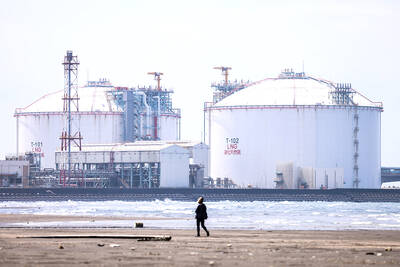
Taiwan is open to joining a global liquefied natural gas (LNG) program if one is created, but on the condition that countries provide delivery even in a scenario where there is a conflict with China, an energy department official said yesterday. While Taiwan’s priority is to have enough LNG at home, the nation is open to exploring potential strategic reserves in other countries such as Japan or South Korea, Energy Administration Deputy Director-General Chen Chung-hsien (陳崇憲) said. While the LNG market does not have a global reserve for emergencies like that of oil, the concept has been raised a few times —


 RSS
RSS