


After the COVID-19 pandemic shut offices and put Mumbai’s renowned lunchbox deliverymen out of work, the 130-year-old dabbawala network has tied up with a trendy restaurant chain to take on India’s billion-dollar start-ups.
For two decades, neither terror attacks nor monsoon deluges could stop Kailash Shinde from delivering hot lunches to Mumbai office workers, until lockdowns put the father-of-two on a forced hiatus for a whole year.
“It’s been very difficult,” the 42-year-old said. “I had to sell what I could and work odd jobs to get by.”
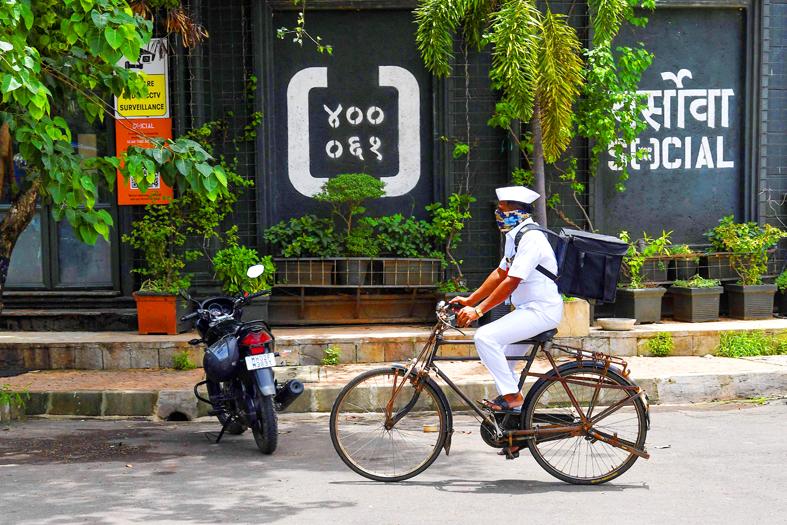
Photo: AFP
Instantly recognizable in his traditional Gandhi cap and white Indian attire, Shinde is one of 5,000 dabbawalas — or “lunchbox men” in Hindi — who have gained global recognition for delivering home-cooked food with clockwork precision.
An intricate system of alphanumeric codes helps the largely semi-literate or illiterate workforce collect, sort and distribute 200,000 meals across Mumbai each day via bicycles, hand carts and a sprawling local train network.
Their work has been studied as a “model of service excellence” at Harvard Business School, and inspired personal visits from Richard Branson, Prince Charles and executives from global delivery giants FedEx Corp and Amazon.com Inc, among others.
However, with extended lockdowns forcing millions of Mumbai’s white-collar professionals to work from home, many dabbawalas have been struggling to feed their own families since April last year.
“Our members have had to work as security guards and laborers, in addition to seeking jobs as deliverymen for restaurants,” said Ulhas Muke of the Nutan Mumbai Tiffin Box Suppliers Charity Trust, which represents the workforce.
However, delivery jobs are harder to come by in a space now increasingly dominated by mobile apps, especially for people like 39-year-old Pandurang Jadhav, who cannot read or write.
Unemployed for the first time since becoming a dabbawala aged 17, Jadhav moved to his ancestral village and spent the past year farming rice.
The earnings were meager and he desperately missed Mumbai, where he managed 30 men.
“I used to love working as a dabbawala,” he told reporters, describing it as “the best job.”
Help arrived in May in the form of a tie-up with some of Mumbai’s most popular eateries, allowing Jadhav and 30 others to return to work.
Instead of handling home-cooked meals packed in stainless steel tiffin boxes, he is now delivering restaurant staples from nachos to spaghetti carbonara to time-starved professionals as they continue working from home for a second year.
The scheme offers restaurateurs an alternative to the prevailing local duopoly of delivery giants Zomato Ltd and Swiggy, whose steep discounts and razor-thin margins have slashed their profits.
“We are trying to find a way out of the tyranny of the aggregators,” said Riyaaz Amlani, the owner of Impresario Restaurants, which operates 57 outlets across more than a dozen Indian cities.
“Of course we want to help the dabbawalas. They are the original deliverymen of Mumbai,” he told reporters.
Amlani plans to expand his partnership with the dabbawalas, but analysts say that alone might not be enough to help the famed deliverymen survive the pandemic.
“It is paramount for them to be flexible at this point,” said Sreedevi R, an assistant professor at Mumbai’s SP Jain Institute of Management and Research.
“The dabbawalas could become delivery agents for last-mile delivery not just for restaurants, but also for any e-commerce business,” she told reporters.
However, a lack of literacy means many of them are reluctant to take on work that requires tech-savvy skills.
Muke is instead finalizing plans to set up a commercial kitchen of their own, delivering inexpensive meals across Mumbai.
He has already secured millions of dollars in donations, including a hefty US$2 million contribution from banking giant HSBC Holdings PLC, with the kitchen due to open in the next few weeks.
“My grandfather was a dabbawala, and then my uncle and now I am,” Muke said. “This is the work that I like doing. I want to keep delivering food to people.”

The domestic unit of the Chinese-owned, Dutch-headquartered chipmaker Nexperia BV will soon be able to produce semiconductors locally within China, according to two company sources. Nexperia is at the center of a global tug-of-war over critical semiconductor technology, with a Dutch court in February ordering a probe into alleged mismanagement at the company. The geopolitical tussle has disrupted supply chains, with some carmakers reportedly forced to cut production due to chip shortages. Local production would allow Nexperia’s domestic arm, Nexperia Semiconductors (China) Ltd (安世半導體中國), to bypass restrictions in place since October on the supply of silicon wafers — etched with tiny components to

Singapore-based ride-hailing and delivery giant Grab Holdings Ltd has applied for regulatory approval to acquire the Taiwan operations of Germany-based Delivery Hero SE's Foodpanda in a deal valued at about US$600 million. Grab submitted the filing to the Fair Trade Commission on Friday last week, with the transaction subject to regulatory review and approval, the company said in a statement yesterday. Its independent governance structure would help foster a healthy and competitive market in Taiwan if the deal is approved, Grab said. Grab, which is listed on the NASDAQ, said in the filing that US-based Uber Technologies Inc holds about 13 percent of

Taiwan Semiconductor Manufacturing Co (TSMC, 台積電) yesterday received government approval to deploy its advanced 3-nanometer (3nm) process at its second fab currently under construction in Japan, the Ministry of Economic Affairs said in a news release. The ministry green-lit the plan for the facility in Kumamoto, which is scheduled to start installing equipment and come online in 2028 with a monthly production capacity of 15,000 12-inch wafers, the ministry said. The Department of Investment Review in June 2024 authorized a US$5.26 billion investment for the facility, slated to manufacture 6- to 12nm chips, significantly less advanced than 3nm process. At a meeting with

Taiwan is open to joining a global liquefied natural gas (LNG) program if one is created, but on the condition that countries provide delivery even in a scenario where there is a conflict with China, an energy department official said yesterday. While Taiwan’s priority is to have enough LNG at home, the nation is open to exploring potential strategic reserves in other countries such as Japan or South Korea, Energy Administration Deputy Director-General Chen Chung-hsien (陳崇憲) said. While the LNG market does not have a global reserve for emergencies like that of oil, the concept has been raised a few times —


 RSS
RSS