


EVA Airways Corp (長榮航空) is planning to increase its weekly passenger flights from Taiwan to North America next month after demand rose substantially this month.
“So far, the number of reservations for round-trip flights between Taiwan and North America has grown 27 percent from June, and the passenger load factor is nearly 100 percent for both the business class and the premium economy class,” EVA chairman Steve Lin (林寶水) said at the company’s annual general meeting in Taipei on Friday.
From next month, the airline would offer five round-trip flights from Taiwan Taoyuan International Airport to Seattle per week, as well as four to New York, two each to Chicago and Vancouver, and one each to Toronto and Houston, the company said.
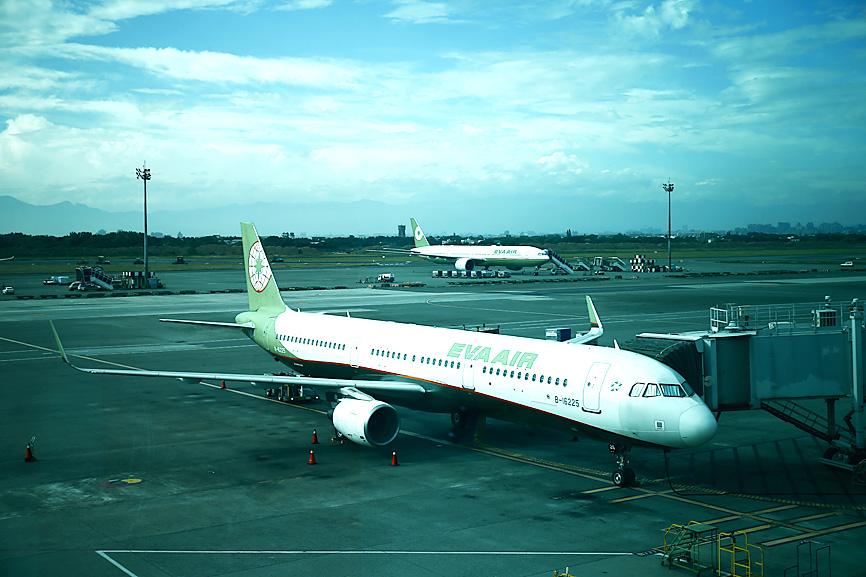
Photo: Tony Yao, Taipei Times
EVA would continue to offer seven flights a week to Los Angeles, it added.
Overall, its weekly flights from Taiwan to North America would rise to 30, it said.
While demand for passenger flights to North American is expected to grow due to more people being vaccinated in the US and relaxed vaccination policies, the airline still expects a tough road ahead as market uncertainty remains due to the global spread of the more transmissible Delta variant of SARS-CoV-2, Lin said.
Nevertheless, Lin said that the company would closely monitor the market situation and make adjustments to its operations if necessary.
The airline said that an increase in operational costs due to disease prevention measures might be taken into account when it considers adjusting ticket prices.
As EVA operates much fewer passenger flights than it did before the COVID-19 pandemic, rising fuel prices would not affect its passenger business as much as before, it said.
Meanwhile, EVA would take delivery of its first new Boeing 777F cargo jet in October, with another two cargo planes slated to arrive in November and December, Lin said.
The airline holds an upbeat outlook for its cargo business in the fourth quarter, expecting cargo rates to remain comparatively high given robust demand for cargo space from Asia to Europe.
The fourth quarter is traditionally a peak season for the cargo business, as many consumer electronic products, such as smartphones, are usually launched during the quarter, EVA said.


Taiwanese firms have increased investment in the Philippines in recent years as Manila’s ties with Washington deepen and global supply chains continue to shift away from China, an expert at the Chung-Hua Institution for Economic Research (CIER, 中華經濟研究院) said yesterday. The Philippines had not been among Taiwanese investors’ top choices in Southeast Asia, CIER Taiwan ASEAN Studies Center director Kristy Hsu (徐遵慈) said at a seminar in Taipei. However, Taiwan’s investment in the country has grown significantly since the COVID-19 pandemic, reaching US $257 million last year, a high in recent years, she said. Although Taiwan’s total investment in the Philippines still lags

Intel Corp regards Taiwan Semiconductor Manufacturing Co (TSMC, 台積電) as a longstanding partner, as the US chipmaker would continue outsourcing production of advanced chips to TSMC, Intel chief executive officer Lip-Bu Tan (陳立武) said yesterday. “I don’t look at people as competitors. I look at the collaboration... Nvidia is also, you know, a good friend,” Tan told a news conference following his keynote speech at the Computex trade show in Taipei. “It’s a very trusted partnership for us... We are a big, top customer for them, and we’re going to continue doing that,” he said, referring to TSMC, the world’s largest foundry

Hon Hai Precision Industry Co (鴻海精密) yesterday said it would work with US chipmaker Intel Corp to jointly develop and deploy next-generation artificial intelligence (AI) infrastructure and intelligent computing platforms in a move to capture booming demand for AI computing systems. Hon Hai, also known as Foxconn Technology Group (富士康), said in a statement that the partnership would combine its global manufacturing scale, system integration expertise and AI data center deployment capabilities with Intel’s strengths in processor architecture, silicon technologies and software ecosystem. The companies said they plan to work on equipment used in AI data centers, including server racks powered by

Artificial intelligence (AI) agents would supplant smartphones as the center of people’s digital lives, fundamentally reshaping personal devices and driving a major computing upgrade cycle, Qualcomm Inc CEO Cristiano Amon said yesterday. In his keynote speech for this year’s Computex trade show in Taipei, Amon said that the rise of "agentic AI" — AI systems capable of reasoning, planning and carrying out tasks autonomously — would transform how people interact with technology across phones, PCs, vehicles and wearable devices. Describing the technology as the next major evolution in computing, Amon said that "2026 is the year of agents.” For decades, smartphones have sat


 RSS
RSS