


Standard Chartered Bank Taiwan (渣打台灣銀行) yesterday raised its forecast for the nation’s GDP growth this year from 4.4 percent to 5 percent, as local firms continue to benefit from strong demand for technology products amid an improving global economy.
The upward revision came despite consumer spending taking a hit from social distancing measures implemented to combat a COVID-19 outbreak, the bank said.
“The level 3 alert nationwide wreaks havoc on service providers, but has little impact on the manufacturing industry,” the backbone of exports, Taipei-based economist Tony Phoo (符銘財) said in a report.
Photo: Lee Chin-hui, Taipei Times
Phoo said he is upbeat that the upcoming release of new smartphones by global technology brands — particularly Apple Inc — would increase production at local suppliers.
Taiwan is home to the world’s top contract makers of chips, camera lenses, battery packs, flat panels and other critical components used in smartphones, laptops, tablets, wearable devices and peripherals.
Inventory demand explained why the sole chip supplier for the iPhone, Taiwan Semiconductor Manufacturing Co (台積電), posted record-high revenue of NT$148.47 billion (US$5.3 billion) for last month and is expected to give an upbeat guidance at an earnings conference today.
New product launches, as well as digital transformation by global corporations and organizations, have led to chip shortages and an influx of export orders, Phoo said, adding that there are risks of overbooking and order cancelations.
Domestically, the COVID-19 outbreak is driving up unemployment and consumer confidence would remain weak until vaccination rates reach safe levels, he said.
The government is seeking to mitigate the pain by introducing assorted relief measures and is increasingly gaining the upper hand in curbing the outbreak, he added.
The bank expects the consumer price index to increase 1.6 percent this year, driven mainly by a sharp increase in transportation costs.
Airfares and fuel prices have soared by double-digit percentage points for several consecutive months, government data showed.
In related news, the Taiwan Research Institute (台灣綜合研究院) yesterday forecast GDP growth of 5.12 percent for this year.
Major economies are emerging from the COVID-19 pandemic, a trend that bodes well for global trade and the nation’s exports, the institute said.
Private consumption, while sluggish at present, still has a chance of staging a comeback next quarter and finishing the year with a 2.39 percent increase if authorities can end the COVID-19 outbreak later this quarter, the institute added.

The domestic unit of the Chinese-owned, Dutch-headquartered chipmaker Nexperia BV will soon be able to produce semiconductors locally within China, according to two company sources. Nexperia is at the center of a global tug-of-war over critical semiconductor technology, with a Dutch court in February ordering a probe into alleged mismanagement at the company. The geopolitical tussle has disrupted supply chains, with some carmakers reportedly forced to cut production due to chip shortages. Local production would allow Nexperia’s domestic arm, Nexperia Semiconductors (China) Ltd (安世半導體中國), to bypass restrictions in place since October on the supply of silicon wafers — etched with tiny components to

Singapore-based ride-hailing and delivery giant Grab Holdings Ltd has applied for regulatory approval to acquire the Taiwan operations of Germany-based Delivery Hero SE's Foodpanda in a deal valued at about US$600 million. Grab submitted the filing to the Fair Trade Commission on Friday last week, with the transaction subject to regulatory review and approval, the company said in a statement yesterday. Its independent governance structure would help foster a healthy and competitive market in Taiwan if the deal is approved, Grab said. Grab, which is listed on the NASDAQ, said in the filing that US-based Uber Technologies Inc holds about 13 percent of
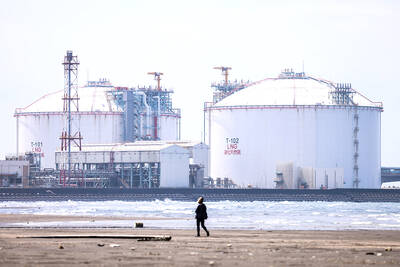
Taiwan is open to joining a global liquefied natural gas (LNG) program if one is created, but on the condition that countries provide delivery even in a scenario where there is a conflict with China, an energy department official said yesterday. While Taiwan’s priority is to have enough LNG at home, the nation is open to exploring potential strategic reserves in other countries such as Japan or South Korea, Energy Administration Deputy Director-General Chen Chung-hsien (陳崇憲) said. While the LNG market does not have a global reserve for emergencies like that of oil, the concept has been raised a few times —

Taiwan Semiconductor Manufacturing Co (TSMC, 台積電) yesterday received government approval to deploy its advanced 3-nanometer (3nm) process at its second fab currently under construction in Japan, the Ministry of Economic Affairs said in a news release. The ministry green-lit the plan for the facility in Kumamoto, which is scheduled to start installing equipment and come online in 2028 with a monthly production capacity of 15,000 12-inch wafers, the ministry said. The Department of Investment Review in June 2024 authorized a US$5.26 billion investment for the facility, slated to manufacture 6- to 12nm chips, significantly less advanced than 3nm process. At a meeting with


 RSS
RSS