


Hon Hai Precision Industry Co (鴻海精密), known internationally as Foxconn Technology Group (富士康科技集團), on Friday announced that it had been holding talks on building electric vehicles (EVs) in Wisconsin, but said that plans had yet to be finalized.
“Foxconn has engaged the Wisconsin Economic Development Corp (WEDC) to discuss the company’s plans for electric vehicle manufacturing,” the company said in a statement.
“Foxconn is optimistic about our partnership with the WEDC and looks forward to ongoing discussions,” it said, adding that a final decision and a firm timetable had yet to be reached.
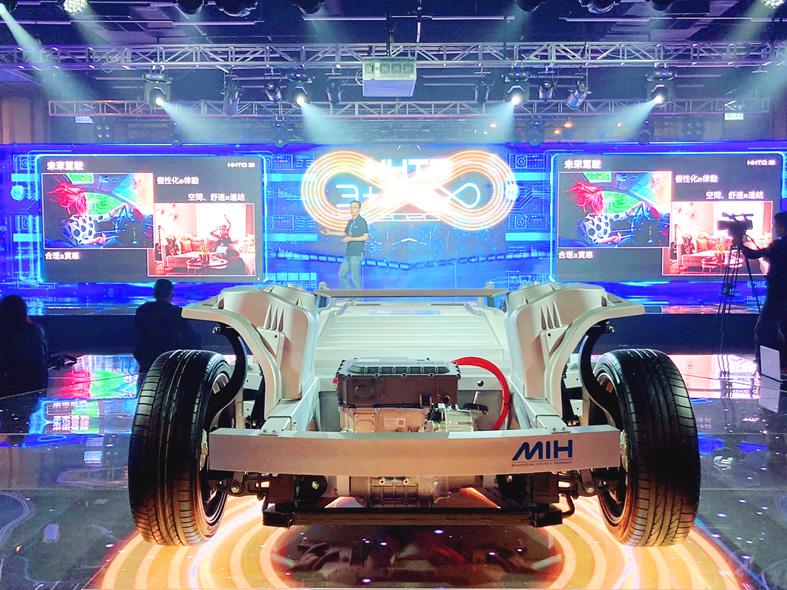
Photo: Chen Rou-chen, Taipei Times
Meanwhile, in a statement to the Milwaukee Journal Sentinel on Thursday, the company said that it and its partner, the California-based EV maker Fisker Inc, had held talks with the WEDC “as part of the site selection process.”
Hon Hai and Fisker in May signed a framework agreement to establish an EV production site in the US, while stipulating that the sides would use Hon Hai’s MIH Open Platform to develop vehicles to be sold under the Fisker brand.
The project — called the Personal Electric Automotive Revolution — anticipates that the first joint EV model would enter mass production in the fourth quarter of 2023 and would have a price tag of less than US$30,000, not including subsidies, the companies said.
Many have speculated that the project would be based in Wisconsin, where Hon Hai had previously planned a US$10 billion factory to make flat panels, before massively scaling it back earlier this year.
However, the company has said that it was evaluating other potential production sites, with the goal of manufacturing about 250,000 EVs annually.
Separately, Hon Hai’s expansion into EVs through its partnership with Byton Ltd (拜騰) has hit a snag, with one of the Chinese automaker’s biggest creditors taking control of the company’s management, people familiar with the matter said.
China FAW Group Co (中國一汽集團) last week installed one of its officials, Zhang Ying (張影), as chairman of Byton, the people said.
Hon Hai, which in January struck a strategic cooperation deal with Byton to make EVs, is withdrawing personnel, with some of the workers that it dispatched to the automaker’s Nanjing plant being pulled out, one of the people said.
That has raised questions over whether Byton can meet its goal of starting mass production early next year, and whether the automaker can achieve its plan to list through a merger with a special-purpose acquisition company, or SPAC, the people said.
Byton was earlier this year in talks with blank-check firms over a listing, Reuters reported in February.
FAW has been unwilling to convert its debt into stock to pave the way for a share sale, some of the people said.
Foxconn spokesman Jimmy Huang (黃欽旻) said that the “future collaboration of the two sides will be decided after Byton completes its organizational restructuring.”
A Byton spokesperson did not address the board changes, but said that the company is “actively pushing forward” with the mass production of its first model.
The spokesperson added that “core stakeholder” FAW and “partner” Foxconn would collaborate in sending executives to Byton to support production and operations.
A FAW representative did not immediately respond to requests for comment.

The domestic unit of the Chinese-owned, Dutch-headquartered chipmaker Nexperia BV will soon be able to produce semiconductors locally within China, according to two company sources. Nexperia is at the center of a global tug-of-war over critical semiconductor technology, with a Dutch court in February ordering a probe into alleged mismanagement at the company. The geopolitical tussle has disrupted supply chains, with some carmakers reportedly forced to cut production due to chip shortages. Local production would allow Nexperia’s domestic arm, Nexperia Semiconductors (China) Ltd (安世半導體中國), to bypass restrictions in place since October on the supply of silicon wafers — etched with tiny components to

Singapore-based ride-hailing and delivery giant Grab Holdings Ltd has applied for regulatory approval to acquire the Taiwan operations of Germany-based Delivery Hero SE's Foodpanda in a deal valued at about US$600 million. Grab submitted the filing to the Fair Trade Commission on Friday last week, with the transaction subject to regulatory review and approval, the company said in a statement yesterday. Its independent governance structure would help foster a healthy and competitive market in Taiwan if the deal is approved, Grab said. Grab, which is listed on the NASDAQ, said in the filing that US-based Uber Technologies Inc holds about 13 percent of

Taiwan is open to joining a global liquefied natural gas (LNG) program if one is created, but on the condition that countries provide delivery even in a scenario where there is a conflict with China, an energy department official said yesterday. While Taiwan’s priority is to have enough LNG at home, the nation is open to exploring potential strategic reserves in other countries such as Japan or South Korea, Energy Administration Deputy Director-General Chen Chung-hsien (陳崇憲) said. While the LNG market does not have a global reserve for emergencies like that of oil, the concept has been raised a few times —

Taiwan Semiconductor Manufacturing Co (TSMC, 台積電) yesterday received government approval to deploy its advanced 3-nanometer (3nm) process at its second fab currently under construction in Japan, the Ministry of Economic Affairs said in a news release. The ministry green-lit the plan for the facility in Kumamoto, which is scheduled to start installing equipment and come online in 2028 with a monthly production capacity of 15,000 12-inch wafers, the ministry said. The Department of Investment Review in June 2024 authorized a US$5.26 billion investment for the facility, slated to manufacture 6- to 12nm chips, significantly less advanced than 3nm process. At a meeting with


 RSS
RSS