


CTBC Financial Holding Co (中信金控) has disclosed its financed emissions after completing an inventory using the industry-leading Partnership for Carbon Accounting Financials (PCAF) methodology, becoming the first company in Asia to do so.
The results, released last week in CTBC’s 2020 Sustainability Report, detail the emissions financed through the investment and financing portfolios of the Taipei-headquartered company’s banking, insurance and securities subsidiaries.
“Although the financial sector has relatively low energy consumption, greenhouse gas (GHG) emissions and pollution compared with the manufacturing sector, the emissions generated through its investment and financing are significant,” CTBC president Daniel Wu (吳一揆) said on Wednesday.
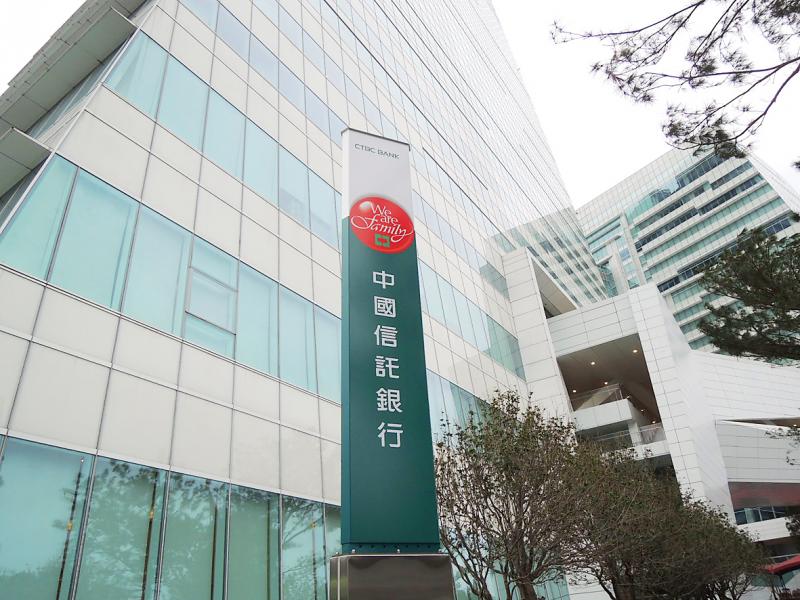
Photo: Lee Chin-hui, Taipei Times
Addressing climate change directly by assessing the emissions of financial instruments and moving toward a low-carbon economy jointly with customers is critical to achieving the global goal of net-zero GHG emissions by 2050, Wu said.
“Financial institutions like us need to use our influence to make this low-carbon transition happen,” he added. “Companies cannot effectively set action plans and emission reduction targets unless they track their GHG emissions accurately — which is what the PCAF methodology has allowed us to do.”
The preliminary inventory results in the report showed that CTBC’s financed emissions last year included an equivalent of 9,916,890 tonnes of carbon dioxide. The figure is equal to 11 percent of the annual emissions of Taiwan Power Co (台電), the nation’s largest emitter.
The inventory covers the investment portfolios of CTBC’s major subsidiaries, including investment in stocks and bonds of bank, insurance and securities (excluding subjects relating to sovereign countries, derivatives, and holdings for short-term trading as PCAF has not yet developed methodologies for these).
The inventory additionally covers industries of high GHG emissions in CTBC’s credit business and large GHG emission accounts defined by the Environmental Protection Administration (accounting for about 10 percent of the total credit balance).
The company will continue to track the GHG emissions of each financial business line and conduct more comprehensive assessments and disclosures, it said.
PCAF was established in Europe in 2015 and was launched globally in 2019. In November last year, PCAF published the first edition of The Global GHG Accounting and Reporting Standard for the Financial Industry.
CTBC became the first company in Taiwan to commit to PCAF when it joined in October last year.
The methodology has been adopted by the Science Based Targets initiative as a standardized calculation method for financial institutions to disclose their financed GHG emissions and has been endorsed by the Greenhouse Gas Protocol, the world’s leading setter of greenhouse gas inventory standards. It is also being considered for adoption by the Task Force on Climate-Related Financial Disclosures.
To date, 138 financial institutions worldwide with assets totaling more than US$42 trillion have joined PCAF.
CTBC was in February elected as PCAF’s regional chair for the Asia-Pacific region. It was then selected to become a member of the Global Core Team in March, joining 21 other global financial institutions, including Bank of America Corp, Morgan Stanley and Barclays PLC, in developing the second edition of the PCAF Standard.

The domestic unit of the Chinese-owned, Dutch-headquartered chipmaker Nexperia BV will soon be able to produce semiconductors locally within China, according to two company sources. Nexperia is at the center of a global tug-of-war over critical semiconductor technology, with a Dutch court in February ordering a probe into alleged mismanagement at the company. The geopolitical tussle has disrupted supply chains, with some carmakers reportedly forced to cut production due to chip shortages. Local production would allow Nexperia’s domestic arm, Nexperia Semiconductors (China) Ltd (安世半導體中國), to bypass restrictions in place since October on the supply of silicon wafers — etched with tiny components to

Singapore-based ride-hailing and delivery giant Grab Holdings Ltd has applied for regulatory approval to acquire the Taiwan operations of Germany-based Delivery Hero SE's Foodpanda in a deal valued at about US$600 million. Grab submitted the filing to the Fair Trade Commission on Friday last week, with the transaction subject to regulatory review and approval, the company said in a statement yesterday. Its independent governance structure would help foster a healthy and competitive market in Taiwan if the deal is approved, Grab said. Grab, which is listed on the NASDAQ, said in the filing that US-based Uber Technologies Inc holds about 13 percent of
Taiwan is open to joining a global liquefied natural gas (LNG) program if one is created, but on the condition that countries provide delivery even in a scenario where there is a conflict with China, an energy department official said yesterday. While Taiwan’s priority is to have enough LNG at home, the nation is open to exploring potential strategic reserves in other countries such as Japan or South Korea, Energy Administration Deputy Director-General Chen Chung-hsien (陳崇憲) said. While the LNG market does not have a global reserve for emergencies like that of oil, the concept has been raised a few times —

Taiwan Semiconductor Manufacturing Co (TSMC, 台積電) yesterday received government approval to deploy its advanced 3-nanometer (3nm) process at its second fab currently under construction in Japan, the Ministry of Economic Affairs said in a news release. The ministry green-lit the plan for the facility in Kumamoto, which is scheduled to start installing equipment and come online in 2028 with a monthly production capacity of 15,000 12-inch wafers, the ministry said. The Department of Investment Review in June 2024 authorized a US$5.26 billion investment for the facility, slated to manufacture 6- to 12nm chips, significantly less advanced than 3nm process. At a meeting with


 RSS
RSS