


Wilson Lang’at has over the past year made a steady profit from his farm in Koiyet village, managing to obtain the seeds and fertilizer he needs, planning ahead for droughts and floods, and borrowing money to diversify his crops — all through his phone.
His experience is not the norm, as most farmers across Kenya have struggled with the double hit of extreme weather shrinking their yields and COVID-19 lockdowns and curfews choking off access to supplies and demand for their produce.
Until two years ago, the 46-year-old father of six traded cows while growing corn on the side at his 2.5 hectare farm in Kenya’s Rift Valley. Then he started using the DigiFarm app to access farming inputs, weather reports and financing.
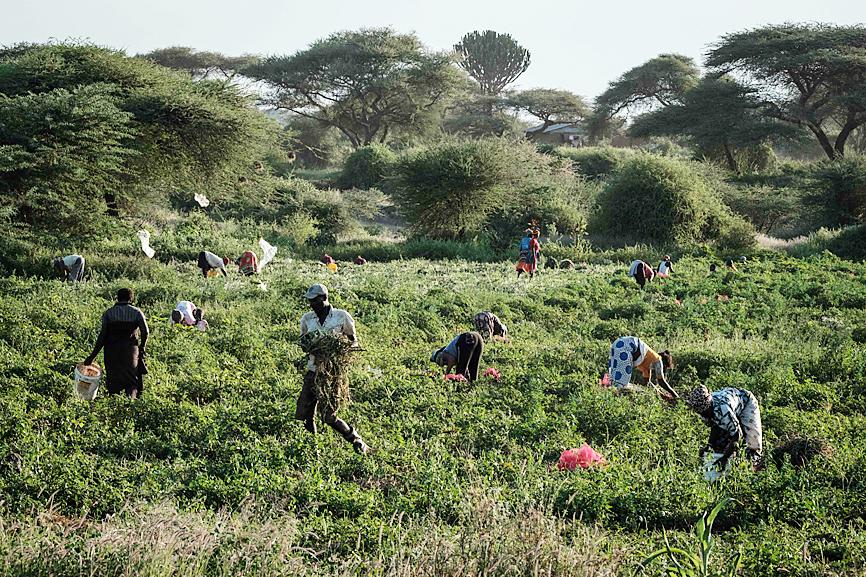
Photo: AFP
Lang’at said he went from producing 219kg of corn per hectare to about 728kg per hectare, as well as beans, potatoes and tomatoes — and quickly earned enough that he could drop the bovine arm of his business.
“Since the start of the COVID-19 pandemic, I have never stopped farming. Farming has become more profitable [than cows], and now it’s my full-time job,” he said.
In Africa, experts say agricultural technology, or agri-tech, such as DigiFarm is increasingly playing a crucial role in cushioning small-scale farmers against the crop-damaging effects of climate change and the economic pain of the pandemic.
There are about 4.5 million small-scale farmers in Kenya and their collective output accounts for more than 60 percent of the country’s food, government figures showed.
DigiFarm, a free service from telecoms giant Safaricom, was launched in 2017 — but the bulk of its 1.4 million users signed up after the pandemic hit, DigiFarm customer experience lead Elizabeth Mudogo said.
Daniel Langat, a DigiFarm village adviser in Bomet County, where Koiyet is located, said the app saves farmers time and money.
After ordering through the app, farmers receive short message service notifications when their goods are ready for collection at a local depot — the company has nearly 30 in Bomet alone — and they can get store credit and discounts, Langat said.
DigiFarm also helps farmers prepare for more erratic weather patterns by sending them information on best practices and tips to reduce crop loss, along with historical weather reports and forecasts.
“This app has brought farmers together in our area,” Langat said. “As all the farmers plant at the same time since they get weather updates at the same time, this helps in disease control and decisionmaking.”
In case farmers do still suffer unexpected crop losses, DigiFarm offers insurance and loans through popular mobile money platform M-Pesa.
During the pandemic, Lang’at borrowed 1,300 Kenyan shillings (US$12) through the app to buy tomato seeds. He earned more than 50 times that selling the produce, which enabled him to pay one of his children’s college fees.
“Planning is easier. [For example] when I receive updates of low rainfall, I plant beans, which do well with shorter rains,” he said.
TURNING TO TECH
An April report from the Netherlands-based Technical Centre for Agricultural and Rural Cooperation said that Africa’s digital agricultural services sector has grown nearly 45 percent annually in terms of farmers reached over the past three years.
Since the start of the pandemic, Kenyan company Twiga Foods Ltd has seen a jump in the number of farmers using its digital platform Soko Yetu (Our Market) to reach customers without going through expensive brokers, Twiga chief technology officer Caine Wanjau said.
Twiga, which launched in 2014, harvests and buys produce from its member farms, then takes the goods to collection centers for processing and packaging, he said.
When vendors order something through the app, the company delivers it to their stores.
Originally operating only in Nairobi, the platform expanded to five other major towns in Kenya during the pandemic and recently announced a new expansion into Uganda, Wanjau said.
The app now covers more than 17,000 farmers and 35,000 vendors, he added.
Ann Waithera signed up to Twiga a year ago to help her keep running her general store on the outskirts of Nairobi.
Instead of going to markets to buy goods, she places her order from home and it is delivered the following morning.
“Nowadays, the market is on my phone. I save over 500 shillings [every day], which would have been used for transport, and I no longer wake up at 4am to go to the market in Nairobi, so now I can be with my kids,” she said.
LOW-INCOME FARMERS
A January report by consultancy McKinsey & Co said that farmers across sub-Saharan Africa are using more than 400 apps and digital platforms for everything from accessing financial services and planting advice to supply chain management.
However, uptake of these apps is limited by tech challenges such as lack of Internet access for farmers, with 3G networks covering only about 40 percent of sub-Saharan Africa’s rural areas, while half of the region has no grid electricity, it said.
Still, David J. Spielman, a senior researcher at the Washington-based International Food Policy Research Institute, said agri-tech apps are already helping build the climate resilience of small-scale farmers.
“Crop and livestock yields and production are edging upwards in Africa — the larger issue is that this rate of growth has to increase,” he wrote in an e-mail.
To do that, he urged developers to focus more on tools for poorer and other marginalized communities, so that platforms can address their specific needs.
For example, some technologies provide weather information when the real constraint facing farmers in a particular area might be access to credit and finance.
“There is significant potential growth of digital innovation across the region if developers and providers can figure out how to genuinely target and benefit people in low-income groups,” Spielman said.

Elon Musk’s lieutenants have reached out to chip industry suppliers, including Applied Materials Inc, Tokyo Electron Ltd and Lam Research Corp, for his envisioned Terafab, early steps in an audacious and likely arduous attempt to break into the production of cutting-edge chips. Staff working for the joint venture between Tesla Inc and Space Exploration Technologies Corp (SpaceX) have sought price quotes and delivery times for an array of chipmaking gear, people familiar with the matter said. In past weeks, they’ve contacted makers of photomasks, substrates, etchers, depositors, cleaning devices, testers and other tools, according to the people, who asked not to

Taichung reported the steepest fall in completed home prices among the six special municipalities in the first quarter of this year, data compiled by Taiwan Realty Co (台灣房屋) showed yesterday. From January through last month, the average transaction price for completed homes in Taichung fell 8 percent from a year earlier to NT$299,000 (US$9,483) per ping (3.3m²), said Taiwan Realty, which compiled the data based on the government’s price registration platform. The decline could be attributed to many home buyers choosing relatively affordable used homes to live in themselves, instead of newly built homes in the city’s prime property market, Taiwan Realty

JET JUICE: The war on Iran’s secondary effects have seen fuel prices skyrocket, knocking flight schedules down to earth in return as airlines struggle with costs Airline passengers should brace for more irritation in the next few months as carriers worldwide cancel flights and ground planes to cope with stratospheric increases in jet-fuel prices. Dutch flag carrier KLM is the latest company to cut its schedule, saying on Thursday that it would scrap 80 return flights at Amsterdam’s Schiphol Airport in the coming month. That puts it in the same league as United Airlines Holdings Inc, Deutsche Lufthansa AG and Cathay Pacific Airways Ltd, which have all pruned itineraries to mitigate costs. Global capacity for next month has been reduced by about 3 percentage points, with all

Taiwan is attracting a growing number of foreign jobseekers as companies increasingly recruit overseas talent to ease labor shortages and expand global reach, recruitment platform 104 Job Bank (104人力銀行) said yesterday. More than 40,000 foreign nationals searched for jobs in Taiwan through the platform last year, a 28 percent increase from a year earlier, the company said. Malaysians accounted for the largest share of overseas jobseekers at 12.2 percent, followed by Indonesians at 11.9 percent and Vietnamese at 10.8 percent. Indonesian applicants surged more than 50 percent year-on-year, while Vietnamese jobseekers rose by more than 30 percent. Applicants from the


 RSS
RSS