


United Airlines Holdings Inc yesterday announced a huge new plane order with Boeing Co and Airbus SE in the biggest bet thus far by a major carrier on a travel industry recovery after the COVID-19 pandemic.
The US carrier plans to acquire 270 new planes consisting of 200 Boeing aircraft and 70 Airbus jets.
The order would be valued at US$35.4 billion based on the listed price of the jets, although airlines often end up paying much less than the list price.
Photo: AFP
United Airlines executives described the order — the biggest in the airline’s history — as a landmark moment symbolizing the radically improved outlook for travel due to vaccines.
Still, United Airlines and other major airlines are expected to report another quarterly loss for the April-to-June period when they release their earnings reports next month, reflecting the continued drag of a travel crisis that has devastated revenue for more than a year.
United Airlines’ business travel volumes are still down 60 percent, with international travel off even more, United chief executive Scott Kirby said.
“We’re not back to 100 percent,” Kirby said on a conference call with reporters in which he outlined how the company leaders had strategized on its needs early in the pandemic.
“Because we accurately mapped out the trajectory of the crisis in March and April of last year, it’s really allowed us to be prepared and make the right short and long-term decisions,” he said.
The biggest component of the order is to be 150 of Boeing’s new 737 MAX 10s, a model that is still undergoing tests in a process closely monitored by US regulators.
The announcement is a victory for Boeing’s jet, which was grounded for 20 months following two deadly crashes.
The other two components are 50 Boeing 737 MAX 8s and 70 Airbus A321neos.
All three models are narrow-body jets, making them well-suited for domestic and shorter-distance trips that have been among the first to see passenger numbers recover.
The Airbus model and the next-generation 737 MAX are bigger than earlier versions of the same aircraft, a feature especially beneficial for increasing capacity in New York, San Francisco and other markets where adding more flights is difficult or impossible, United Airlines officials said.
United Airlines officials said during the conference call that they have seen recent signs of an acceleration in business travel bookings, with firms eager to resume client visits as they see their competitors returning to the skies.
Executives also said they were bullish about international travel, speaking of the summer of next year as being a “record breaker” as US consumers make up for lost opportunities during the pandemic to visit Europe and Asia.

The domestic unit of the Chinese-owned, Dutch-headquartered chipmaker Nexperia BV will soon be able to produce semiconductors locally within China, according to two company sources. Nexperia is at the center of a global tug-of-war over critical semiconductor technology, with a Dutch court in February ordering a probe into alleged mismanagement at the company. The geopolitical tussle has disrupted supply chains, with some carmakers reportedly forced to cut production due to chip shortages. Local production would allow Nexperia’s domestic arm, Nexperia Semiconductors (China) Ltd (安世半導體中國), to bypass restrictions in place since October on the supply of silicon wafers — etched with tiny components to

Singapore-based ride-hailing and delivery giant Grab Holdings Ltd has applied for regulatory approval to acquire the Taiwan operations of Germany-based Delivery Hero SE's Foodpanda in a deal valued at about US$600 million. Grab submitted the filing to the Fair Trade Commission on Friday last week, with the transaction subject to regulatory review and approval, the company said in a statement yesterday. Its independent governance structure would help foster a healthy and competitive market in Taiwan if the deal is approved, Grab said. Grab, which is listed on the NASDAQ, said in the filing that US-based Uber Technologies Inc holds about 13 percent of

Taiwan Semiconductor Manufacturing Co (TSMC, 台積電) yesterday received government approval to deploy its advanced 3-nanometer (3nm) process at its second fab currently under construction in Japan, the Ministry of Economic Affairs said in a news release. The ministry green-lit the plan for the facility in Kumamoto, which is scheduled to start installing equipment and come online in 2028 with a monthly production capacity of 15,000 12-inch wafers, the ministry said. The Department of Investment Review in June 2024 authorized a US$5.26 billion investment for the facility, slated to manufacture 6- to 12nm chips, significantly less advanced than 3nm process. At a meeting with
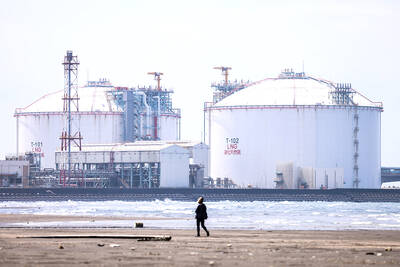
Taiwan is open to joining a global liquefied natural gas (LNG) program if one is created, but on the condition that countries provide delivery even in a scenario where there is a conflict with China, an energy department official said yesterday. While Taiwan’s priority is to have enough LNG at home, the nation is open to exploring potential strategic reserves in other countries such as Japan or South Korea, Energy Administration Deputy Director-General Chen Chung-hsien (陳崇憲) said. While the LNG market does not have a global reserve for emergencies like that of oil, the concept has been raised a few times —


 RSS
RSS