


Lina Khan, an antitrust researcher focused on big tech’s immense market power, was sworn in on Tuesday as chair of the US Federal Trade Commission (FTC), a victory for progressives seeking a clampdown on tech firms that hold a hefty share of a growing sector of the economy.
Hours earlier, the US Senate had confirmed Khan, with bipartisan support.
She recently taught at Columbia Law School. Previously, as a staffer for the US House of Representatives Committee on the Judiciary’s antitrust panel, she helped write a massive report alleging abuses of market dominance by Amazon.com Inc, Apple Inc, Facebook Inc and Google parent Alphabet Inc.
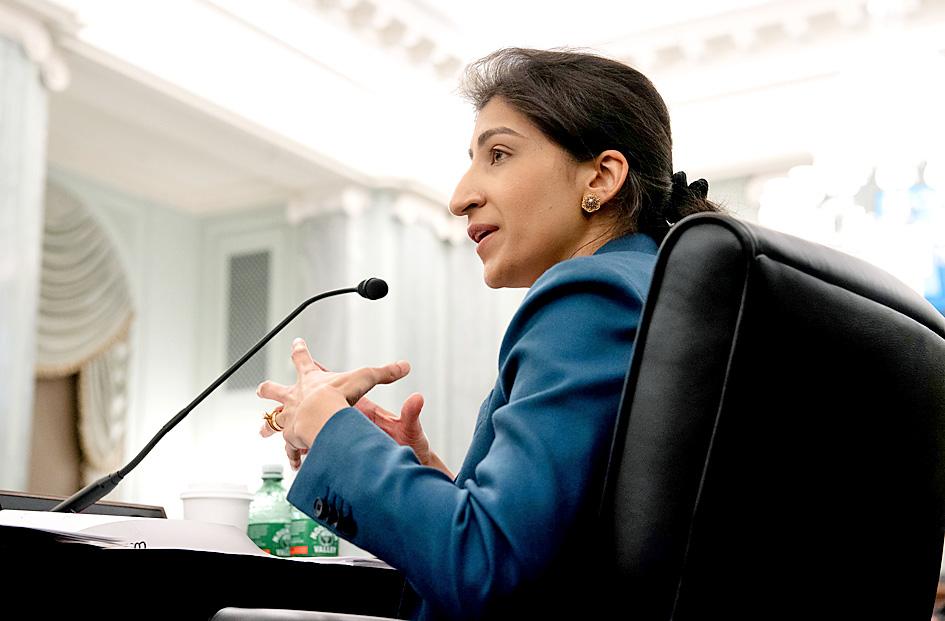
Photo: Reuters
“We applaud [US] President [Joe] Biden and the Senate for recognizing the urgent need to address runaway corporate power,” advocacy group Public Citizen said in a statement.
US Senator Elizabeth Warren wrote on Twitter that the administration’s selection of Khan was “tremendous news.”
“With Chair Khan at the helm, we have a huge opportunity to make big, structural change by reviving antitrust enforcement and fighting monopolies that threaten our economy, our society, and our democracy,” Warren said in a separate statement.
The Information Technology and Innovation Foundation, whose board includes representatives from tech companies, issued a statement warning that a “populist approach to antitrust” would “cause lasting self-inflicted damage that benefits foreign, less meritorious rivals.”
The US federal government and groups of states are pursuing various lawsuits and investigations into big tech companies. The FTC has sued Facebook and is investigating Amazon.
The US Department of Justice has sued Google.
Ahead of Khan’s appointment, Google and Amazon declined comment, while Apple and Facebook did not respond to a request for comment.
In 2017, Khan wrote a highly regarded article, “Amazon’s Antitrust Paradox,” for the Yale Law Journal. It argued that the traditional antitrust focus on price was inadequate to identify antitrust harms done by Amazon.
In addition to antitrust, the FTC investigates allegations of deceptive advertising.
On that front, Khan is to join an agency adapting to a US unanimous Supreme Court ruling from April which said the agency could not use a particular part of its statute, 13(b), to demand consumers get restitution from deceptive companies, but can only ask for an injunction. The US Congress is considering a legislative fix.
Khan previously worked at the FTC as a legal adviser to Commissioner Rohit Chopra, Biden’s pick to be director of the Consumer Financial Protection Bureau.

Cairo’s new monorail slices across the city skyline, running above the familiar chaos of blaring horns and aging buses’ exhaust fumes that mark rush hour below. The US$4.5 billion monorail, opened this month, is among Egypt’s most prominent new transport projects, part of a debt-funded infrastructure drive criticized for sapping state finances while bringing limited benefits to most of the country’s 109 million people. “It feels like you’re in a different country,” said Ramy Sayed, a restaurant manager, aboard a driverless Innovia 300 train. “No noise, no traffic, we’re not used to this.” The eastern line runs 56km from the bustling middle-class

Taiwanese firms have increased investment in the Philippines in recent years as Manila’s ties with Washington deepen and global supply chains continue to shift away from China, an expert at the Chung-Hua Institution for Economic Research (CIER, 中華經濟研究院) said yesterday. The Philippines had not been among Taiwanese investors’ top choices in Southeast Asia, CIER Taiwan ASEAN Studies Center director Kristy Hsu (徐遵慈) said at a seminar in Taipei. However, Taiwan’s investment in the country has grown significantly since the COVID-19 pandemic, reaching US $257 million last year, a high in recent years, she said. Although Taiwan’s total investment in the Philippines still lags
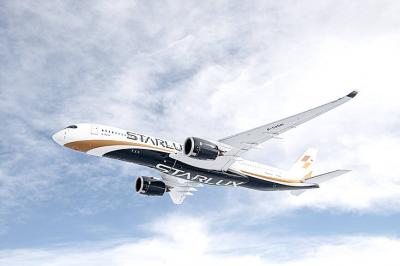
Starlux Airlines Co (星宇航空) today unveiled a long-haul network expansion plan at a shareholders’ meeting in Taipei, including direct flights to Barcelona, Spain, and Zurich, Switzerland, as well as a service connecting Taipei, Sydney and New Zealand. Starlux is to become the first Taiwanese carrier to offer non-stop services to the two European cities, while the inaugural oceanic route is expected to expand transit opportunities within the Australia-New Zealand market, Starlux said. Flight services to Chicago, Dallas, Washington and New York are under evaluation, the airline added. Prior to the shareholders’ meeting, the airline earlier this year announced that it would be

Intel Corp regards Taiwan Semiconductor Manufacturing Co (TSMC, 台積電) as a longstanding partner, as the US chipmaker would continue outsourcing production of advanced chips to TSMC, Intel chief executive officer Lip-Bu Tan (陳立武) said yesterday. “I don’t look at people as competitors. I look at the collaboration... Nvidia is also, you know, a good friend,” Tan told a news conference following his keynote speech at the Computex trade show in Taipei. “It’s a very trusted partnership for us... We are a big, top customer for them, and we’re going to continue doing that,” he said, referring to TSMC, the world’s largest foundry


 RSS
RSS