


The average annual salary of employees at publicly listed firms last year rose 4 percent year-on-year to NT$967,021 (US$34,884), beating the nation’s GDP growth of 2.98 percent, but the firm with the highest average wage offered 12.5 times more than the one with the lowest, indicating uneven salary growth in Taiwan, the Taiwan Stock Exchange (TWSE) said.
The percentage was lower than the difference of 15.8 percent recorded in 2019.
Foxconn Technology Co (鴻準精密), a subsidiary of Hon Hai Precision Industry Co (鴻海精密), registered an average annual wage of NT$4.19 million and a total of 171 employees last year, ranking it first among all 875 TWSE-listed companies and increasing 21.2 percent from its average of NT$3.45 million in 2019, the exchange said in a report on Tuesday last week.
Photo: Chen Yung-chi, Taipei Times
On the other hand, real-estate developer and leisure company Taroko Corp (大魯閣開發), with a total of 594 employees, saw its average annual wage fall 4 percent year-on-year to NT$336,000, which was the lowest among all 875 firms, TWSE data showed.
The wages included base salary, overtime pay, bonuses and remuneration, the TWSE said.
In 2019, Swancor Holding Co (上緯投控) had the highest average annual wage at NT$5.16 million and home appliance supplier Taiwan Sanyo Electric Co (台灣三洋) the lowest at NT$327,000.
Last year, papermaking conglomerate YFY Inc (永豐餘控股) was ranked second with an average wage of NT$4.15 million, up 14 percent from a year earlier, while real-estate developer JSL Construction & Development Co (愛山林建設) was ranked third with an average wage of NT$3.94 million, up 75 percent.
From fourth to eighth place were mostly chip suppliers and designers: ASMedia Technology Inc (祥碩科技) with NT$3.7 million, MediaTek Inc (聯發科) with NT$3.41 million, Novatek Microelectronics Corp (聯詠科技) with NT$3.25 million and Realtek Semiconductor Corp (瑞昱半導體) with NT$3.24 million. Global Brands Manufacture Ltd (精成科技) was the exception: The firm produces printed circuit boards and had an average wage of NT$3.46 million.
Among the top 10, MediaTek had the most employees at 9,083, followed by Realtek with 4,116 and Novatek with 2,321.
Retail conglomerate Mercuries & Associates Holding Ltd’s (三商投資控股) average wage ranked ninth at NT$3.23 million, followed by Lien Hwa Industrial Holdings Corp (聯華實業投資控股) with NT$3.2 million.
The two companies only had 11 and seven employees respectively last year, the data showed.
As for Taiwan Semiconductor Manufacturing Co (TSMC, 台積電), its average annual wage ranked 18th at NT$2.39 million, with 47,908 employees.
TSMC had the most employees among all 875 TWSE-listed companies.

The domestic unit of the Chinese-owned, Dutch-headquartered chipmaker Nexperia BV will soon be able to produce semiconductors locally within China, according to two company sources. Nexperia is at the center of a global tug-of-war over critical semiconductor technology, with a Dutch court in February ordering a probe into alleged mismanagement at the company. The geopolitical tussle has disrupted supply chains, with some carmakers reportedly forced to cut production due to chip shortages. Local production would allow Nexperia’s domestic arm, Nexperia Semiconductors (China) Ltd (安世半導體中國), to bypass restrictions in place since October on the supply of silicon wafers — etched with tiny components to

Singapore-based ride-hailing and delivery giant Grab Holdings Ltd has applied for regulatory approval to acquire the Taiwan operations of Germany-based Delivery Hero SE's Foodpanda in a deal valued at about US$600 million. Grab submitted the filing to the Fair Trade Commission on Friday last week, with the transaction subject to regulatory review and approval, the company said in a statement yesterday. Its independent governance structure would help foster a healthy and competitive market in Taiwan if the deal is approved, Grab said. Grab, which is listed on the NASDAQ, said in the filing that US-based Uber Technologies Inc holds about 13 percent of
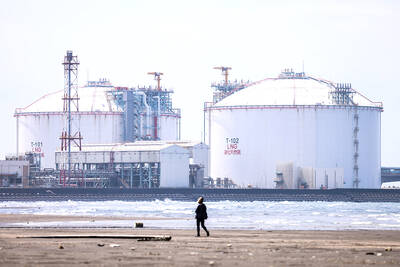
Taiwan is open to joining a global liquefied natural gas (LNG) program if one is created, but on the condition that countries provide delivery even in a scenario where there is a conflict with China, an energy department official said yesterday. While Taiwan’s priority is to have enough LNG at home, the nation is open to exploring potential strategic reserves in other countries such as Japan or South Korea, Energy Administration Deputy Director-General Chen Chung-hsien (陳崇憲) said. While the LNG market does not have a global reserve for emergencies like that of oil, the concept has been raised a few times —
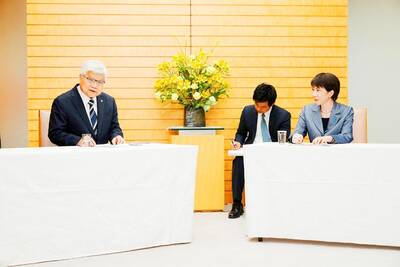
Taiwan Semiconductor Manufacturing Co (TSMC, 台積電) yesterday received government approval to deploy its advanced 3-nanometer (3nm) process at its second fab currently under construction in Japan, the Ministry of Economic Affairs said in a news release. The ministry green-lit the plan for the facility in Kumamoto, which is scheduled to start installing equipment and come online in 2028 with a monthly production capacity of 15,000 12-inch wafers, the ministry said. The Department of Investment Review in June 2024 authorized a US$5.26 billion investment for the facility, slated to manufacture 6- to 12nm chips, significantly less advanced than 3nm process. At a meeting with


 RSS
RSS