


Shares in Taiwan moved into consolidation mode yesterday, closing slightly higher after a lackluster overnight performance by US markets.
The TAIEX closed up 48.02 points, or 0.29 percent, at 16,643.69, on turnover of NT$425.761 billion (US$15.3 billion), Taiwan Stock Exchange data showed.
Foreign institutional investors bought a net NT$1.95 billion of shares after a net sell of NT$1.18 billion the previous day.
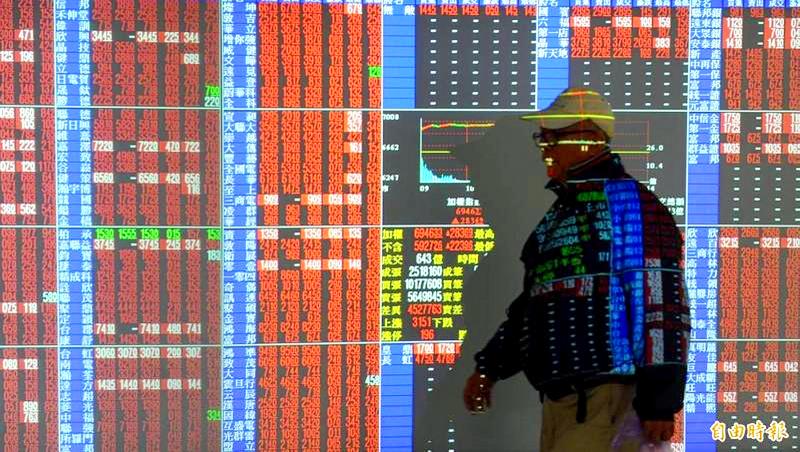
Photo: Taipei Times file photo
“Following Monday’s rally, the main board moved in a narrow range throughout the trading session, as the electronics sector turned quiet,” Cathay Futures Consultant Co (國泰證期顧問) analyst Tsai Ming-han (蔡明翰) said.
On Tuesday, the TAIEX surged 1.58 percent after the tech sector soared 2.28 percent.
“Many tech heavyweights fell into negative territory, so the electronics sector lost its status as a pillar to the broader market. It was no surprise that the TAIEX failed to make a breakthrough today,” Tsai said.
“As interest in the tech sector faded, buying rotated to old-economy stocks, in particular in the shipping and steel sectors,” he said.
However, investors should be cautious about shipping stocks as they have become targets of day trading, which is likely to cause volatility, Tsai said.
“Although the TAIEX ended above the 20-day moving average of about 16,560 points today,” the main board could test that level again, as foreign institutional investors’ attitudes remain unclear, he said.


The domestic unit of the Chinese-owned, Dutch-headquartered chipmaker Nexperia BV will soon be able to produce semiconductors locally within China, according to two company sources. Nexperia is at the center of a global tug-of-war over critical semiconductor technology, with a Dutch court in February ordering a probe into alleged mismanagement at the company. The geopolitical tussle has disrupted supply chains, with some carmakers reportedly forced to cut production due to chip shortages. Local production would allow Nexperia’s domestic arm, Nexperia Semiconductors (China) Ltd (安世半導體中國), to bypass restrictions in place since October on the supply of silicon wafers — etched with tiny components to
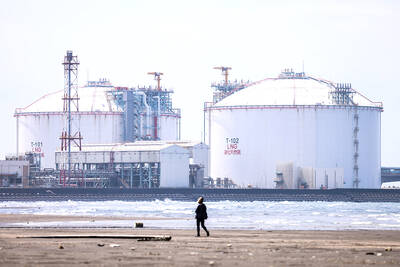
Taiwan is open to joining a global liquefied natural gas (LNG) program if one is created, but on the condition that countries provide delivery even in a scenario where there is a conflict with China, an energy department official said yesterday. While Taiwan’s priority is to have enough LNG at home, the nation is open to exploring potential strategic reserves in other countries such as Japan or South Korea, Energy Administration Deputy Director-General Chen Chung-hsien (陳崇憲) said. While the LNG market does not have a global reserve for emergencies like that of oil, the concept has been raised a few times —

Taiwan Semiconductor Manufacturing Co (TSMC, 台積電) yesterday received government approval to deploy its advanced 3-nanometer (3nm) process at its second fab currently under construction in Japan, the Ministry of Economic Affairs said in a news release. The ministry green-lit the plan for the facility in Kumamoto, which is scheduled to start installing equipment and come online in 2028 with a monthly production capacity of 15,000 12-inch wafers, the ministry said. The Department of Investment Review in June 2024 authorized a US$5.26 billion investment for the facility, slated to manufacture 6- to 12nm chips, significantly less advanced than 3nm process. At a meeting with
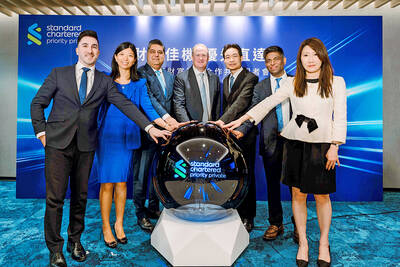
Standard Chartered Taiwan on March 26 announced that it has partnered with international fintech firm FinIQ to build an “Automated Structured Products Pricing Platform.” The bank is also introducing products from global issuers including Goldman Sachs Group Inc, Barclays PLC and BNP Paribas SA. The new platform enables an end-to-end process whereby it finds the most competitive pricing across multiple issuers in a matter of minutes, followed by automated documentation and transaction execution, which significantly shortens time-to-market and delivers a superior wealth management experience. Standard Chartered Bank Taiwan CEO Anthony Yu (游天立) said: “Standard Chartered is increasingly leveraging its wealth management


 RSS
RSS