


Prospective home buyers might have to come up with bigger down payments as local banks become increasingly conservative in issuing housing loans with the central bank warning against lax lending practices, a report by My Housing Monthly said yesterday.
New houses in northern Taiwan with loan-to-value ratios (LTVs) of 80 percent dropped to 49 percent of all cases this year, the lowest since 2018 when the property market started to improve, the report said.
Ho Shih-chang (何世昌), research manager at the Chinese-language publication, attributed the retreat in LTV ratios to the central bank’s pleas with local lenders to avoid loose housing and land financing.
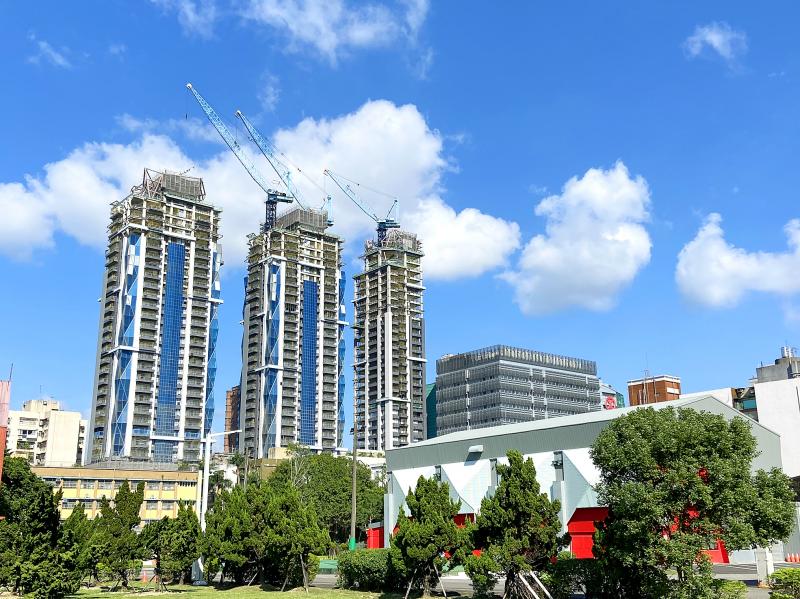
Photo: Hsu Yi-ping, Taipei Times
“The [central bank’s] moral suasion and two waves of selective credit controls appear to have worked, judging from the lending trend,” Ho said.
The findings suggest that more than 50 percent of new housing projects were unable to secure equally favorable lending terms, the analyst said.
Buyers would have to fork out more money when developers turn over ownership of completed residences, Ho said.
LTV ratios averaged 80 percent for new homes before the central bank capped them at 40 percent for corporate buyers and 50 percent for multiple homeowners.
The lending limits for luxury housing, unsold houses and land financing must not exceed 55 percent, the central bank said.
LTV ratios slumped to 21 percent in 2016, as lenders avoided housing loans as the property market languished, Ho said, adding that developers had to provide lending from their own pockets to stimulate sales.
LTV ratios rose to 80 percent as the property market picked up, accounting for more than 60 percent of new housing projects in 2019 and last year, aided by a stable economy, capital repatriation and companies returning from overseas amid a global electronics supply realignment, Ho said.
Product type matters more than location in winning high LTV ratios, with two-bedroom apartments enjoying better lending terms, My Housing said.
Small apartments have been an easy sell over the past few years, while large luxury homes have difficulty finding buyers, it said.
LTV ratios generally stand at 70 percent for people with relocation needs, Ho said, adding that first-home buyers and those purchasing a house to relocate are not subject to selective credit controls.

The domestic unit of the Chinese-owned, Dutch-headquartered chipmaker Nexperia BV will soon be able to produce semiconductors locally within China, according to two company sources. Nexperia is at the center of a global tug-of-war over critical semiconductor technology, with a Dutch court in February ordering a probe into alleged mismanagement at the company. The geopolitical tussle has disrupted supply chains, with some carmakers reportedly forced to cut production due to chip shortages. Local production would allow Nexperia’s domestic arm, Nexperia Semiconductors (China) Ltd (安世半導體中國), to bypass restrictions in place since October on the supply of silicon wafers — etched with tiny components to

Singapore-based ride-hailing and delivery giant Grab Holdings Ltd has applied for regulatory approval to acquire the Taiwan operations of Germany-based Delivery Hero SE's Foodpanda in a deal valued at about US$600 million. Grab submitted the filing to the Fair Trade Commission on Friday last week, with the transaction subject to regulatory review and approval, the company said in a statement yesterday. Its independent governance structure would help foster a healthy and competitive market in Taiwan if the deal is approved, Grab said. Grab, which is listed on the NASDAQ, said in the filing that US-based Uber Technologies Inc holds about 13 percent of

Taiwan is open to joining a global liquefied natural gas (LNG) program if one is created, but on the condition that countries provide delivery even in a scenario where there is a conflict with China, an energy department official said yesterday. While Taiwan’s priority is to have enough LNG at home, the nation is open to exploring potential strategic reserves in other countries such as Japan or South Korea, Energy Administration Deputy Director-General Chen Chung-hsien (陳崇憲) said. While the LNG market does not have a global reserve for emergencies like that of oil, the concept has been raised a few times —

Taiwan Semiconductor Manufacturing Co (TSMC, 台積電) yesterday received government approval to deploy its advanced 3-nanometer (3nm) process at its second fab currently under construction in Japan, the Ministry of Economic Affairs said in a news release. The ministry green-lit the plan for the facility in Kumamoto, which is scheduled to start installing equipment and come online in 2028 with a monthly production capacity of 15,000 12-inch wafers, the ministry said. The Department of Investment Review in June 2024 authorized a US$5.26 billion investment for the facility, slated to manufacture 6- to 12nm chips, significantly less advanced than 3nm process. At a meeting with


 RSS
RSS