


Taishin Financial Holding Co (台新金控) yesterday said it has gained Prudential Financial Inc’s approval to delay its purchase of the US company’s Taiwanese unit as it awaits the Financial Supervisory Commission’s (FSC) approval of the acquisition.
“We keep in close contact with the US company and update it about our latest communication with the FSC,” Taishin Financial president Welch Lin (林維俊) told a virtual investors’ conference in Taipei.
Lin did not reveal how much additional time Taishin Financial would be granted, saying that it was striving to obtain the FSC’s approval.
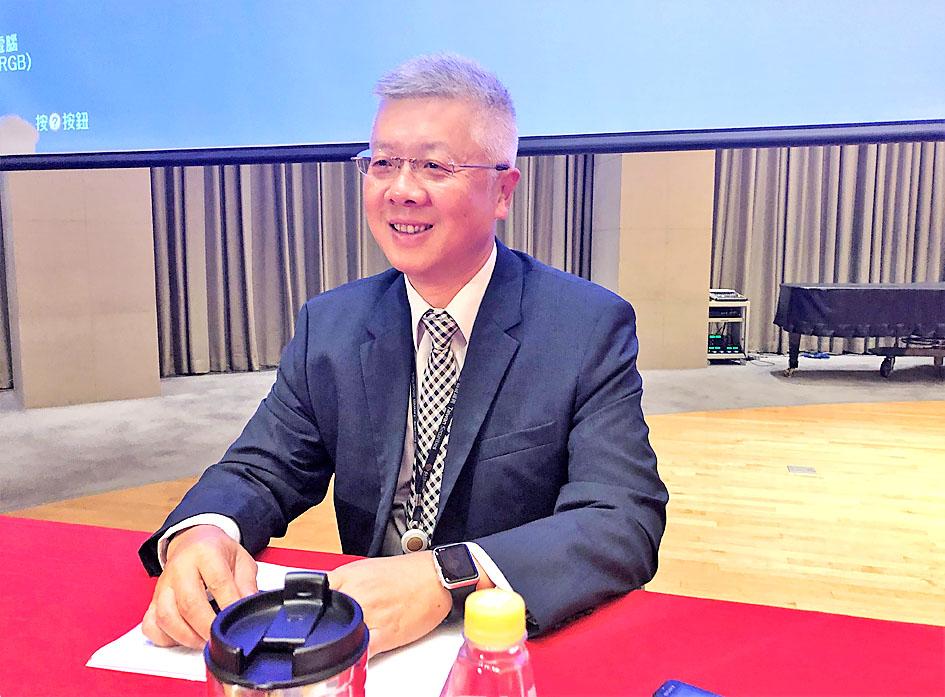
Photo: Kelson Wang, Taipei Times
Taishin Financial on Aug. 11 last year signed an agreement with Prudential Financial Inc to acquire Prudential Life Insurance Co of Taiwan (保德信人壽) for NT$5.5 billion (US$196.55 million) before Monday last week, documents released by Taishin Financial and the commission showed.
Taishin Financial expects the acquisition to boost its profit momentum, but the commission has concerns over its effect on the firm’s financial stability and whether it would have enough capital to comply with stricter solvency rules for insurers in the coming years.
Taishin Financial reported that its securities unit, Taishin Securities Co (台新證券), has become its second-largest profit contributor, accounting for 9 percent, or NT$394 million, of its total profits last quarter, after its banking arm, Taishin International Bank (台新銀行).
Net fee income totaled NT$4.2 billion last quarter, up 18 percent year-on-year and the highest in a single quarter, Taishin Financial said, attributing the gains to an annual increase of 13 percent in fees from its banking unit’s wealth management and a substantial rise of 103 percent in fees from its securities unit.
However, fees from its credit card business declined 23 percent to NT$325 million, as cardholders shopped abroad less amid the pandemic, while domestic consumption generated relatively lower fees, it said.
Taishin Bank would this year focus on collaborating with retail channels, such as department stores and online stores, to boost its fee income, the conglomerate said.
The banking unit’s net interest margin rose to 1.13 percent, one basis point lower than at the end of last year and down from 1.21 percent a year earlier, Taishin Financial data showed.


The domestic unit of the Chinese-owned, Dutch-headquartered chipmaker Nexperia BV will soon be able to produce semiconductors locally within China, according to two company sources. Nexperia is at the center of a global tug-of-war over critical semiconductor technology, with a Dutch court in February ordering a probe into alleged mismanagement at the company. The geopolitical tussle has disrupted supply chains, with some carmakers reportedly forced to cut production due to chip shortages. Local production would allow Nexperia’s domestic arm, Nexperia Semiconductors (China) Ltd (安世半導體中國), to bypass restrictions in place since October on the supply of silicon wafers — etched with tiny components to

Taiwan is open to joining a global liquefied natural gas (LNG) program if one is created, but on the condition that countries provide delivery even in a scenario where there is a conflict with China, an energy department official said yesterday. While Taiwan’s priority is to have enough LNG at home, the nation is open to exploring potential strategic reserves in other countries such as Japan or South Korea, Energy Administration Deputy Director-General Chen Chung-hsien (陳崇憲) said. While the LNG market does not have a global reserve for emergencies like that of oil, the concept has been raised a few times —

Taiwan Semiconductor Manufacturing Co (TSMC, 台積電) yesterday received government approval to deploy its advanced 3-nanometer (3nm) process at its second fab currently under construction in Japan, the Ministry of Economic Affairs said in a news release. The ministry green-lit the plan for the facility in Kumamoto, which is scheduled to start installing equipment and come online in 2028 with a monthly production capacity of 15,000 12-inch wafers, the ministry said. The Department of Investment Review in June 2024 authorized a US$5.26 billion investment for the facility, slated to manufacture 6- to 12nm chips, significantly less advanced than 3nm process. At a meeting with
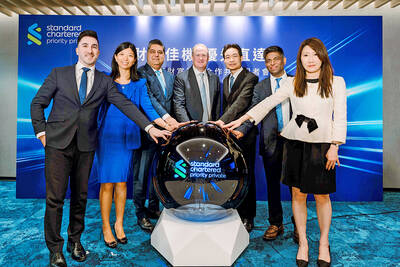
Standard Chartered Taiwan on March 26 announced that it has partnered with international fintech firm FinIQ to build an “Automated Structured Products Pricing Platform.” The bank is also introducing products from global issuers including Goldman Sachs Group Inc, Barclays PLC and BNP Paribas SA. The new platform enables an end-to-end process whereby it finds the most competitive pricing across multiple issuers in a matter of minutes, followed by automated documentation and transaction execution, which significantly shortens time-to-market and delivers a superior wealth management experience. Standard Chartered Bank Taiwan CEO Anthony Yu (游天立) said: “Standard Chartered is increasingly leveraging its wealth management


 RSS
RSS