


The Ministry of Finance on Saturday urged investors to stay calm after a spike in domestic COVID-19 infections and a global technology shares selloff unnerved the local stock market last week.
The ministry said that Taiwan’s economic fundamentals remain sound.
The Liberty Times (the Taipei Times’ sister newspaper) reported yesterday that Deputy Minister of Finance Frank Juan (阮清華) said that the government would pay close attention to the developments of the local stock market and the COVID-19 situation, adding that the National Stabilization Fund, of which Juan is the executive secretary, might hold an impromptu committee meeting on whether action is necessary.
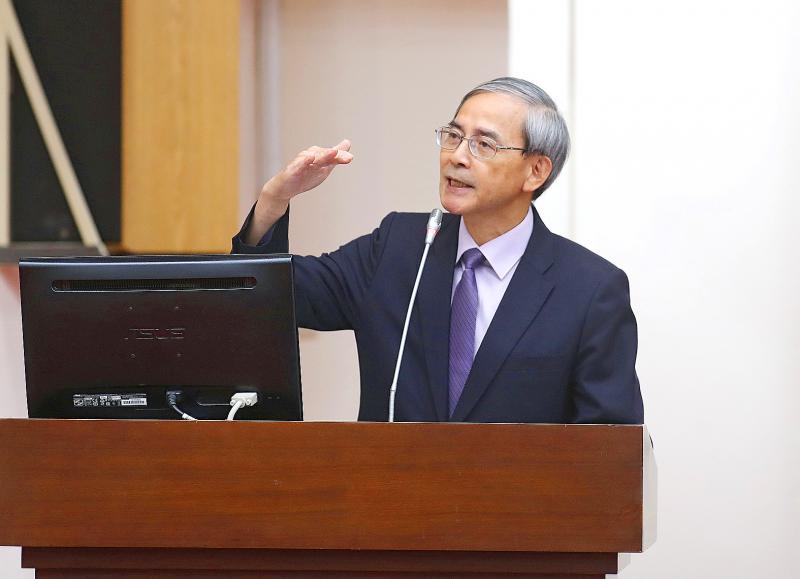
Photo: CNA
The NT$500 billion (US$17.85 billion) fund was set up by the government as a buffer against unexpected external factors disrupting the local stock market.
Juan said that government agencies would hold meetings soon to discuss necessary stock market measures, including lowering the maximum allowable daily drop in equities, to help stabilize the market.
Domestic consumption, including catering and tourism, would likely be affected in the short term due to the tighter COVID-19 restrictions, he said, but added that import and export sectors, and manufacturing would not be affected.
The nation’s tightest restrictions, in place in Taipei and New Taipei City, triggered by a level 3 COVID-19 alert there, would not apply to the chipmaking hub of Hsinchu Science Park (新竹科學園區) — home of Taiwan Semiconductor Manufacturing Co (TSMC, 台積電) and United Microelectronics Co (聯電), he said.
TSMC on Saturday said that it was closely monitoring the situation, adding that it had canceled nonessential gatherings and activities to reduce the movement of people across its facilities.
Exports are likely to be spared by the market rout, as companies in the semiconductor sector, which contribute more than 35 percent of total exports, have effective measures in place to prevent COVID-19 infections, Taishin Securities Investment Advisory Co (台新投顧) general manager Mason Li (李鎮宇) told reporters by telephone on Friday.
The TAIEX fell by 1,457.91 points, or 8.43 percent, last week to close at 15,827.09 on Friday, while the New Taiwan dollar fell 0.4 percent against the US dollar, closing at NT$28.012 on Friday.
Even though major European and US stock markets closed higher last week, a drastic surge in COVID-19 cases in the past few days has raised fears that the TAIEX would fall further when trading resumes today.
“Stocks are likely to fall tomorrow due to investor panic, as retail investors account for a large portion of the market, but the decline is not expected to be larger than last week,” Securities Investment Trust and Consulting Association chairman Jeff Chang (張錫) told reporters by telephone yesterday.
“Some investors were over-reacting last week, as we’ve seen in other markets — the US and India, where the COVID-19 situation has been bad — that their indices have not fallen.”
Separately, the Ministry of Economic Affairs on Saturday assured the public that supplies of daily life products are ample, but announced new measures to curb hoarding.
Each customer can only buy up to two items in each of the categories of toilet paper, instant noodles, rice and canned foods, the ministry said.
The ministry on Facebook posted pictures of boxes of instant noodles piled up to the ceiling of a warehouse, saying that there were equally “mountains of supply” of toilet paper and canned foods.
Additional reporting by Kao Shih-ching and agencies

The domestic unit of the Chinese-owned, Dutch-headquartered chipmaker Nexperia BV will soon be able to produce semiconductors locally within China, according to two company sources. Nexperia is at the center of a global tug-of-war over critical semiconductor technology, with a Dutch court in February ordering a probe into alleged mismanagement at the company. The geopolitical tussle has disrupted supply chains, with some carmakers reportedly forced to cut production due to chip shortages. Local production would allow Nexperia’s domestic arm, Nexperia Semiconductors (China) Ltd (安世半導體中國), to bypass restrictions in place since October on the supply of silicon wafers — etched with tiny components to

Singapore-based ride-hailing and delivery giant Grab Holdings Ltd has applied for regulatory approval to acquire the Taiwan operations of Germany-based Delivery Hero SE's Foodpanda in a deal valued at about US$600 million. Grab submitted the filing to the Fair Trade Commission on Friday last week, with the transaction subject to regulatory review and approval, the company said in a statement yesterday. Its independent governance structure would help foster a healthy and competitive market in Taiwan if the deal is approved, Grab said. Grab, which is listed on the NASDAQ, said in the filing that US-based Uber Technologies Inc holds about 13 percent of

Taiwan is open to joining a global liquefied natural gas (LNG) program if one is created, but on the condition that countries provide delivery even in a scenario where there is a conflict with China, an energy department official said yesterday. While Taiwan’s priority is to have enough LNG at home, the nation is open to exploring potential strategic reserves in other countries such as Japan or South Korea, Energy Administration Deputy Director-General Chen Chung-hsien (陳崇憲) said. While the LNG market does not have a global reserve for emergencies like that of oil, the concept has been raised a few times —

Taiwan Semiconductor Manufacturing Co (TSMC, 台積電) yesterday received government approval to deploy its advanced 3-nanometer (3nm) process at its second fab currently under construction in Japan, the Ministry of Economic Affairs said in a news release. The ministry green-lit the plan for the facility in Kumamoto, which is scheduled to start installing equipment and come online in 2028 with a monthly production capacity of 15,000 12-inch wafers, the ministry said. The Department of Investment Review in June 2024 authorized a US$5.26 billion investment for the facility, slated to manufacture 6- to 12nm chips, significantly less advanced than 3nm process. At a meeting with


 RSS
RSS