


A bidding war erupted for Crown Resorts Ltd, with rival casino operator Star Entertainment Group Ltd proposing an all-stock merger and Blackstone Group Inc sweetening its cash takeover bid.
Star said its offer would create an Australian gaming and hospitality giant with a market value of A$12 billion (US$9.4 billion) as it unveiled plans to cut costs, as well as sell and lease back property, at the enlarged group.
Minutes earlier, US private equity firm Blackstone raised its offer for Crown by 4 percent to A$8.36 billion.
Crown said it is assessing both proposals.
Bidders are circling Crown while it is cornered by regulatory investigations. A damning inquiry in February found that the company was unfit to run its new Sydney casino following years of money laundering at properties in Perth and Melbourne, which are now the subject of fresh probes.
Beyond the scrutiny from gaming watchdogs that has Crown in disarray, the company’s longer-term appeal to suitors is clear. It owns the sole licensed casinos in Melbourne and Perth, the respective state capitals of Victoria and Western Australia, and a brand new A$2.2 billion resort on Sydney’s waterfront.
While COVID-19 restrictions and border closures have dented profit during the pandemic, earnings are expected to bounce back next year.
The competing proposals also offer Crown’s largest shareholder, billionaire James Packer, differing paths forward after he failed at least twice to sell his stake.
Packer, whose influence on Crown was criticized in the regulatory report in February, has increasingly stepped back from corporate life to fight a mental health battle.
The Blackstone bid would give him a potential clean break.
Star’s proposal offers the billionaire the chance to swap at least some of his 37 percent stake in Crown for a smaller share in the merged entity.
Last month, another exit path from Crown emerged for Packer when Oaktree Capital Management LP offered to help Crown purchase the billionaire’s shares.
Shares of Star leaped 7.7 percent to A$4.21 at the close in Sydney. Crown jumped 7.3 percent to A$13, valuing the Melbourne-based company at A$8.8 billion.
The board of Crown, with the outcome of the Perth and Melbourne inquiries hanging over the company, must now weigh up the instant reward of Blackstone’s cash offer with the potential long-term benefits of a union with Star.
Star’s proposal “creates a long-term opportunity for the capital market which would not exist if Crown gets bought by an American private equity firm,” Star chief executive officer Matt Bekier said in an interview after the proposal was announced. “We have a management team that is in good standing with all the regulators in all our jurisdictions so we think we can pull this off with relatively low risk.”
Star announced a nil-premium offer of 2.68 of its shares for each Crown share — the equivalent of A$10.48 a share based on Star’s closing price on Friday. Star’s bid also includes a cash alternative of A$12.50 per share for as much as 25 percent of Crown’s issued shares.
Assuming the cash component is fully taken up, the offer equates to a value of A$7.44 billion, according to Bloomberg calculations.
That is way below Crown’s market value.
However, once savings and benefits from the merger are included, Star said its proposal implies a potential value of A$14 per Crown share.

The domestic unit of the Chinese-owned, Dutch-headquartered chipmaker Nexperia BV will soon be able to produce semiconductors locally within China, according to two company sources. Nexperia is at the center of a global tug-of-war over critical semiconductor technology, with a Dutch court in February ordering a probe into alleged mismanagement at the company. The geopolitical tussle has disrupted supply chains, with some carmakers reportedly forced to cut production due to chip shortages. Local production would allow Nexperia’s domestic arm, Nexperia Semiconductors (China) Ltd (安世半導體中國), to bypass restrictions in place since October on the supply of silicon wafers — etched with tiny components to

Singapore-based ride-hailing and delivery giant Grab Holdings Ltd has applied for regulatory approval to acquire the Taiwan operations of Germany-based Delivery Hero SE's Foodpanda in a deal valued at about US$600 million. Grab submitted the filing to the Fair Trade Commission on Friday last week, with the transaction subject to regulatory review and approval, the company said in a statement yesterday. Its independent governance structure would help foster a healthy and competitive market in Taiwan if the deal is approved, Grab said. Grab, which is listed on the NASDAQ, said in the filing that US-based Uber Technologies Inc holds about 13 percent of

Taiwan Semiconductor Manufacturing Co (TSMC, 台積電) yesterday received government approval to deploy its advanced 3-nanometer (3nm) process at its second fab currently under construction in Japan, the Ministry of Economic Affairs said in a news release. The ministry green-lit the plan for the facility in Kumamoto, which is scheduled to start installing equipment and come online in 2028 with a monthly production capacity of 15,000 12-inch wafers, the ministry said. The Department of Investment Review in June 2024 authorized a US$5.26 billion investment for the facility, slated to manufacture 6- to 12nm chips, significantly less advanced than 3nm process. At a meeting with
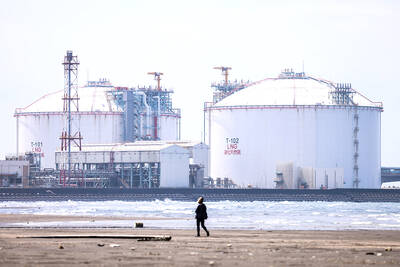
Taiwan is open to joining a global liquefied natural gas (LNG) program if one is created, but on the condition that countries provide delivery even in a scenario where there is a conflict with China, an energy department official said yesterday. While Taiwan’s priority is to have enough LNG at home, the nation is open to exploring potential strategic reserves in other countries such as Japan or South Korea, Energy Administration Deputy Director-General Chen Chung-hsien (陳崇憲) said. While the LNG market does not have a global reserve for emergencies like that of oil, the concept has been raised a few times —


 RSS
RSS