


Gudeng Precision Industrial Co (家登), the sole supplier of extreme ultraviolet (EUV) pods to Taiwan Semiconductor Manufacturing Co (TSMC, 台積電), yesterday said that it plans to invest NT$5 billion (US$179.18 million) to build a new factory to expand its EUV component capacity.
The factory is planned for New Taipei City’s Tucheng District (土城) and part of its facilities would be a manufacturing site for Gudeng’s fully owned subsidiary We Solutions Technology Co (家崎科技), which produces key components used in EUV inner pods, consumables used in the etching process and airplane components, Gudeng said.
Gudeng also supplies aircraft landing gear barrels to Airbus SE and Boeing Co.
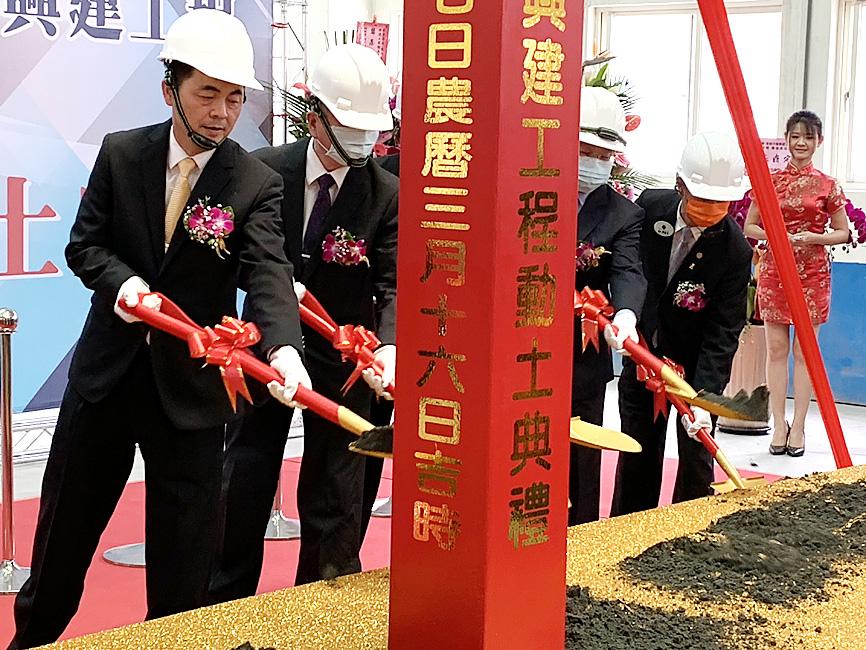
Photo: Grace Hung, Taipei Times
“The factory will become a backup manufacturing site for key EUV components, in addition to the company’s major manufacturing site in Tainan’s Tree Valley Park (樹谷園區),” Gudeng chairman Bill Chiu (邱銘乾) said at a groundbreaking ceremony.
The factory would be its research and development center when construction is completed in two-and-a-half years, the firm said.
The five-year investment plan is to create between 1,200 and 1,500 jobs, it said.
Gudeng is optimistic about this year’s revenue growth, as revenue would “be higher quarter by quarter this year,” Chiu said, citing a rising number of IC designers adopting EUV technology.
The more companies that adopt EUV technology, the more EUV pods would be used, the firm said.
Gudeng’s revenue growth is primarily driven by demand from Intel Corp and TSMC, which are accelerating uptake of EUV tools to produce new-generation chips, a company executive said.
Intel is using more EUV tools to make 7-nanometer chips to fend off growing competition from Apple Inc and Advanced Micro Devices Inc, the executive said.
TSMC is to start pilot production of 3-nanometer chips in the second half, which would boost EUV pod consumption, he said.
Gudeng has added Samsung Electronics Co to its EUV pod customer list.
TSMC, Intel and Samsung are among the few chipmakers in the world that have the technological capability to advance their technologies with the assistance of EUV tools from ASML Holding NV, the sole supplier of EUV tools.
EUV pods are to make up about 60 percent of Gudeng’s wafer pods, up from 50 percent last year, Chiu said in January.
The firm said that first-quarter revenue surged 40.39 percent to NT$638.22 million from NT$454.59 million in the same period last year.


The domestic unit of the Chinese-owned, Dutch-headquartered chipmaker Nexperia BV will soon be able to produce semiconductors locally within China, according to two company sources. Nexperia is at the center of a global tug-of-war over critical semiconductor technology, with a Dutch court in February ordering a probe into alleged mismanagement at the company. The geopolitical tussle has disrupted supply chains, with some carmakers reportedly forced to cut production due to chip shortages. Local production would allow Nexperia’s domestic arm, Nexperia Semiconductors (China) Ltd (安世半導體中國), to bypass restrictions in place since October on the supply of silicon wafers — etched with tiny components to
Taiwan is open to joining a global liquefied natural gas (LNG) program if one is created, but on the condition that countries provide delivery even in a scenario where there is a conflict with China, an energy department official said yesterday. While Taiwan’s priority is to have enough LNG at home, the nation is open to exploring potential strategic reserves in other countries such as Japan or South Korea, Energy Administration Deputy Director-General Chen Chung-hsien (陳崇憲) said. While the LNG market does not have a global reserve for emergencies like that of oil, the concept has been raised a few times —
AI-FUELED DEMAND: The company has been benefiting from the skyrocketing prices for DRAM chips amid the AI frenzy, especially its core product — DDR4 DRAM chips DRAM chipmaker Nanya Technology Corp (南亞科技) yesterday reported that its revenue for the first quarter surged 582.91 percent to NT$49.09 billion (US$1.54 billion) from NT$7.19 billion a year earlier, as the supply crunch caused chip price spikes. Last quarter’s figure is the highest on record. On a quarterly basis, revenue jumped 63.14 percent from NT$30.09 billion, the company said. In January, Nanya Technology expected global DRAM supply scarcity to continue through the first half of 2028, thanks to strong demand for artificial intelligence (AI) applications. Market researcher TrendForce Corp (集邦科技) forecast prices of standard DRAM chips would rise between 58 percent and 63

HIGHER PRICES: Given rising energy costs, CPC raised natural gas prices for generators by 41.58%, which Taipower said would raise its power generation costs by NT$10 billion State-run CPC Corp, Taiwan (CPC, 台灣中油) has activated its fourth naphtha cracker to boost ethylene supply, aiming to ease concerns over plastic material shortages amid tensions in the Middle East, the Ministry of Economic Affairs said yesterday. The move is expected to add 19,000 tonnes of supply this month and 30,000 tonnes next month, Deputy Minister of Economic Affairs Ho Chin-tsang (何晉滄) said at a meeting of the legislature’s Economics Committee in Taipei. CPC on Tuesday held talks with major polyethylene producers, including Formosa Plastics Corp (台塑), Asia Polymer Corp (亞聚) and USI Corp (台聚), and pledged to supply ethylene feedstock


 RSS
RSS