


Asian e-commerce giant Shein’s (希音) decision to set up shop in a historic Parisian department store has ruffled feathers in the fashion capital.
Anger has been boiling since Shein announced last week that it would open its first permanent physical store next month at BHV Marais, an iconic building that has stood across from Paris City Hall since 1856.
The move prompted some French brands to announce they would leave BHV Marais, but the department store had already been losing tenants over late payments.

Photo: Bloomberg
Aime cosmetics line cofounder Mathilde Lacombe, whose brand was among those that decided to leave following Shein’s announcement, said she was “deeply shocked” by the deal.
BHV trade unions also led calls on Friday for strike action to protest Shein’s arrival, warning of a “short-term threat to the survival of the department store.”
Critics fear that Shein — whose meteoric rise has been a bane for traditional retail fashion companies — would further hurt stores in France that have had to lay off staff or close.
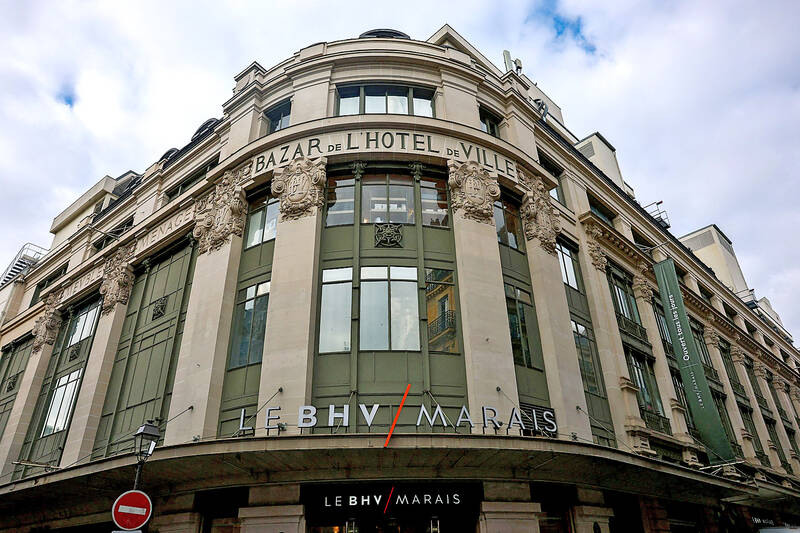
Photo: Reuters
Founded in China and now based in Singapore, the fast-fashion giant sells a wide variety of products at ultra-competitive prices.
However, it has also been under global scrutiny over its business model’s impact on the environment and labor conditions at its textile factories.
“Opposite the Paris mayor’s office, they will create a new Shein megastore that — after having destroyed dozens of French brands — could flood our market even more massively with disposable products,” said a trade association for French ready-to-wear women’s clothing companies.
The European Commission is investigating Shein over risks linked to illegal products, while EU lawmakers last month approved legislation aimed at curbing fast fashion’s environmental impact.
“Shein’s arrival goes against our convictions,” former French minister for ecological transition and cohesion of the territories Christophe Bechu said.
Shein has spun its entry into physical retail in France as a homage to the country and its central place in fashion.
“By choosing France as the place to trial physical retail, we are honoring its position as a key fashion capital and embracing its spirit of creativity and excellence,” Shein executive chairman Donald Tang said.
“It is fitting that this journey starts in Paris, at BHV — the birthplace of modern retail,” he added.
The company also plans to open shops at Galeries Lafayette department stores in the cities of Dijon, Reims, Grenoble, Angers and Limoges.
BHV Marais and the five Galeries Lafayette locations are operated by retail property group Societe des Grands Magasins (SGM).
SGM is seeking to buy the BHV Marais building from Galeries Lafayette, but the state-owned bank it hoped would help finance the purchase decided to pull out over the Shein partnership.
“The Bank of Territories learned about this partnership through the press, without any prior notification, resulting in a breakdown of trust between the two parties,” it said in a statement.
SGM denounced “political pressure” behind the move, but insisted it could still carry out its purchase of the building.
Galeries Lafayette also voiced its opposition to Shein boutiques opening in the five locations bearing its name, although it no longer operates those locations.
“Galeries Lafayette expresses its profound disagreement with this decision in light of the positioning and practices of this ultra-fast-fashion brand that are in contradiction to its own offering and values,” it said in a statement following the announcement.
SGM already had a number of luxury brands quit BHV Marais over payment delays prior to Shein’s arrival.
SGM said the multimillion-euro payment delays are temporary, blaming the rollout of a new automated accounting system, and denied any cash flow problems, saying that BHV returned to profitability last year.
Still, the effects are visible in empty shelves and sparse aisles at BHV, which directly employs 750 people, particularly in DIY and stationery departments.
French underwear firm Slip Francais said it had to launch legal proceedings against SGM over the delays in transferring revenues from sales made at BHV.
“It’s a partner in which we no longer have confidence,” Slip Francais founder Guillaume Gibault said.
The Shein deal “only confirmed that we had taken the right decision” to leave BHV Marais, he added.
After several years flying high as Asia’s best Nvidia Corp proxy, Taiwan Semiconductor Manufacturing Co (TSMC, 台積電) is increasingly vying with other artificial intelligence (AI) stocks for investor attention. Stock traders are chasing a wider array of beneficiaries as mainstream usage of AI creates demand for hardware beyond the most-advanced chips TSMC makes for Nvidia. Subthemes from the deepening memory crunch to advances in robotics are also luring bids. At the same time, investment caps on single stocks are pushing funds to diversify, while retail investors long familiar with TSMC through its US depositary receipts are being offered a broader set of

Netherlands-based semiconductor equipment supplier ASML Holding NV yesterday said that it is planning to hire an additional 1,000 people in Taiwan this year in response to growing demand from clients. ASML had previously planned to recruit 600 people this year, but that the plan has been adjusted upward, ASML vice president and ASML Taiwan general manager Grace Wang (汪佳慧) told reporters. ASML has a workforce of more than 4,500 in Taiwan, accounting for about 10 percent of its global total, Wang said. This year’s recruitment campaign would focus on adding people in the customer support, manufacturing and supply chain domains to assist ASML

UNDER MICROSCOPE: Taiwan detained three people who allegedly conspired to buy servers in Taiwan and export them using fraudulent documentation, prosecutors said Nvidia Corp chief executive officer Jensen Huang (黃仁勳) on Saturday urged Super Micro Computer Inc to tighten up on compliance after Taiwan detained three people this week for allegedly making fraudulent declarations about artificial intelligence (AI) servers made by its US partner. The development marked the nation’s first crackdown on semiconductor smuggling, which grew after the US slapped restrictions on exports of high-end chips such as Nvidia AI accelerators to China. Nvidia is “rigorous” in explaining regulations to all of its partners, Huang told reporters after arriving in Taipei. “Ultimately Super Micro has to run their own company,” he said in response to

Nvidia Corp yesterday announced that CEO Jensen Huang (黃仁勳) would attend an employee meeting in Taipei tomorrow to celebrate the launch of the company’s Taiwan headquarters project. Huang would attend a gathering at the site of Nvidia’s planned headquarters in Beitou Shilin Technology Park (北投士林科技園區), the company said in a statement. After arriving in Taiwan on Saturday last week, Huang told reporters that he plans to meet with Quanta Computer Inc (廣達) chairman Barry Lam (林百里) and Taiwan Semiconductor Manufacturing Co (TSMC, 台積電) chairman C.C. Wei (魏哲家), and would attend the groundbreaking ceremony for Nvidia’s Taiwan headquarters tomorrow. Nvidia has not yet applied


 RSS
RSS