


China next month plans to launch a series of promotional activities, including a new consumer goods expo in southern Hainan Province, to boost spending as the Chinese retail sector recovers from consumer caution induced by COVID-19.
Expanding domestic consumption is a priority in China’s “dual circulation” economic strategy first highlighted by Chinese President Xi Jinping (習近平) in May last year, which also called for a reduced dependence on foreign markets.
China’s retail sales last month surged 34.2 percent year-on-year, surpassing a 28.0 percent gain expected by analysts and more than the 33.8 percent jump in January-to-February.
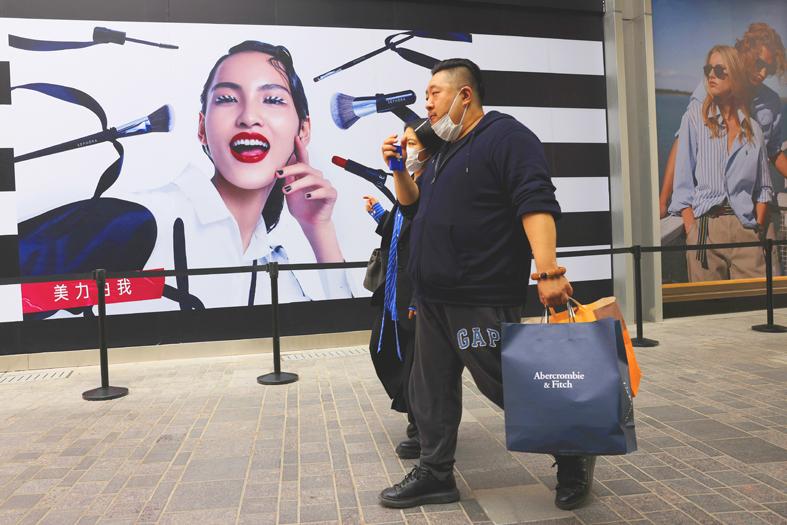
Photo: Ng Han Guan, AP
More significantly, retail revenues were 12.9 percent higher than March 2019, before the COVID-19 pandemic.
As China enters a five-day Labor Day holiday, it plans to launch the month-long spending campaign in Shanghai on Saturday with activities including an auto show, Chinese Ministry of Commerce spokesman Gao Feng (高峰) told a news conference on Sunday.
Other major cities such as Beijing, Chongqing and Suzhou are also to hold sales in May, he added.
E-commerce platforms are to offer sales on food, travel, and cultural and sporting products by “good quality brands” for half a month.
Events planned in other cities include a food fair in Yangzhou city in eastern Jiangsu Province from Thursday and a fair from May 12 in Guangzhou in southern Guangdong Province that showcases well-known brands.
The city of Haikou on the subtropical island of Hainan — positioned by Beijing as a major Chinese consumption and tourism hub — is to hold an inaugural consumer goods expo from Friday next week to May 10.
Besides domestic products, the expo is to showcase consumer brands from 69 countries and regions including Japan, the UK and the US, with more than 10,000 merchandisers and more than 200,000 visitors anticipated.
Global brands such as Swatch Group AG, Shiseido Co, Dell Technologies Inc and Tesla Inc have confirmed their participation in the expo, Chinese state media has reported.
Separately, confidence among China’s small and medium-sized enterprises (SMEs) picked up for a second month in a survey of more than 500 companies by Standard Chartered PLC, with the rise in expectations pointing to an even better performance this quarter than in the first three months of the year.
“Export-oriented SMEs continued to outperform domestically focused SMEs, with faster production and higher output price gains,” Standard Chartered economists Shen Lan (沈蘭) and Ding Shuang (丁爽) wrote in a report. “The services sector is catching up at a faster pace, driven by the transport and logistics, [information technology] and commercial services industries, while the catering and accommodation sectors remain sluggish.”
The improvement in services was due to the “removal of restrictive measures and [COVID-19] vaccine rollout. While export demand stayed resilient, domestic demand also started to pick up,” they said.
Additional reporting by Bloomberg
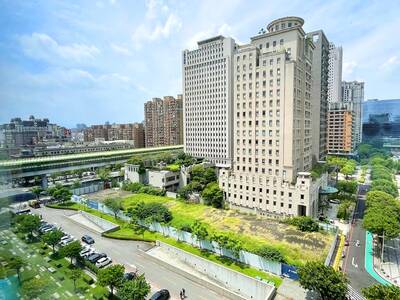
Taichung reported the steepest fall in completed home prices among the six special municipalities in the first quarter of this year, data compiled by Taiwan Realty Co (台灣房屋) showed yesterday. From January through last month, the average transaction price for completed homes in Taichung fell 8 percent from a year earlier to NT$299,000 (US$9,483) per ping (3.3m²), said Taiwan Realty, which compiled the data based on the government’s price registration platform. The decline could be attributed to many home buyers choosing relatively affordable used homes to live in themselves, instead of newly built homes in the city’s prime property market, Taiwan Realty
The government yesterday approved applications by Alphabet Inc’s Google to invest NT$27.08 billion (US$859.98 million) in Taiwan, the Ministry of Economic Affairs said in a statement. The Department of Investment Review approved two investments proposed by Google, with much of the funds to be used for data processing and electronic information supply services, as well as inventory procurement businesses in the semiconductor field, the ministry said. It marks the second consecutive year that Google has applied to increase its investment in Taiwan. Google plans to infuse NT$25.34 billion into Charter Investments Ltd (特許投資顧問) through its Singapore-based subsidiary Fructan Holdings Singapore Pte Ltd, and

JET JUICE: The war on Iran’s secondary effects have seen fuel prices skyrocket, knocking flight schedules down to earth in return as airlines struggle with costs Airline passengers should brace for more irritation in the next few months as carriers worldwide cancel flights and ground planes to cope with stratospheric increases in jet-fuel prices. Dutch flag carrier KLM is the latest company to cut its schedule, saying on Thursday that it would scrap 80 return flights at Amsterdam’s Schiphol Airport in the coming month. That puts it in the same league as United Airlines Holdings Inc, Deutsche Lufthansa AG and Cathay Pacific Airways Ltd, which have all pruned itineraries to mitigate costs. Global capacity for next month has been reduced by about 3 percentage points, with all
Micron Technology Inc is a driving force pushing the US Congress to pass legislation that would put new export restrictions on equipment its Chinese competitors use to make their chips, according to people familiar with the matter. A US House of Representatives panel yesterday was to vote on the “MATCH Act,” a bill designed to close gaps in restrictions on chipmaking equipment. It would also pressure foreign companies that sell equipment to Chinese chipmaking facilities to align with export curbs on US companies like Lam Research Corp and Applied Materials Inc. The bill targets facilities operated by China’s ChangXin Memory Technologies Inc


 RSS
RSS