


In the mountains of western Peru, a farming community is restoring a network of stone canals built more than a millennium ago, hoping the pre-Columbian technology holds the solution to its water problems.
Known locally as “amunas,” the water-retention system is thought to have been devised by ancient people who lived in what is now the Huarochiri Province about 1,400 years ago, before even the Incas, to prolong the rainy season’s bounty.
The canals that furrow the mountain slopes reroute runoff to patches of permeable soil or rock where the water seeps in, filters through and replenishes aquifers before emerging in springs downhill weeks or months later, in drier times.
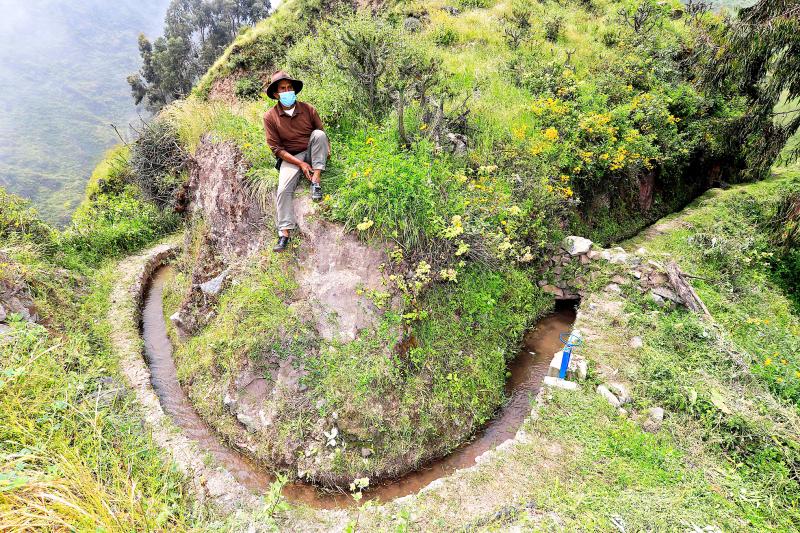
Photo: AFP / Aquafondo / Ivan Laiza
The practice is known as “sowing” water, to be harvested later, after the rainy season, when it is needed to nourish people, crops and livestock.
“We are ranchers, farmers and every drop of water ... helps our survival,” said Roosevelt Calistro Lopez, 43, one of about 900 inhabitants of rural San Pedro de Casta, about 80km from Lima, and about 3,200m above sea level.
“The amunas are not new for us, but we are improving them. There are places where they had gone dry where there is water again,” he said.
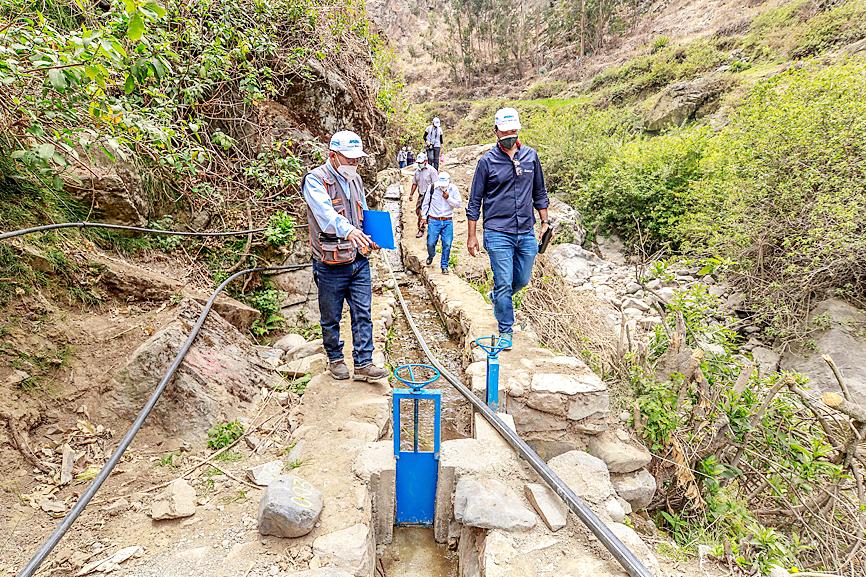
Photo: AFP / Aquafondo / Ivan Laiza
WATER FOR LIMA
“The amunas already exist. What we are doing is restoring” them, said Mariella Sanchez Guerra, director of the Aquafondo water-access initiative which started the project with the participation of local inhabitants in 2017.
“We have identified 67km of amunas” to be reclaimed by 2025, she said. “Of 67km, we have recovered 17, which means water for about 82,000 people for a whole year.”
The canals do not serve only the inhabitants of Huarochiri.
They also feed the Santa Eulalia River, a tributary of the Rimac River that provides about 80 percent of water consumed in Lima, one of the world’s biggest desert cities.
Every kilometer of amuna that is put into operation allows the transportation of 178,000m3 of water per year, and Aquafondo hopes to boost from 20 percent to 80 percent the amount of water collected by the ancient system for the thirsty capital.
NEW INCOME SOURCE
About 120 people from the community are paid by Aquafondo to carry out the rebuilding work, which is not always easy going. There is a risk of falling while working on the slopes in windy conditions, and the heavy stones have to be lifted by hand and carefully locked into place. Work can only be done from October to December, before the rainy season arrives.
The COVID-19 pandemic has complicated matters, hitting Peru’s economy with a collapse of the all-important tourism sector, and a sharp fall in prices for agricultural products that deeply affected the farmers of San Pedro de Casta.
“We mulled for days whether we should continue the work on the amunas or not, we did not want to put anyone at risk” of contracting COVID-19, “but we were also very concerned about [maintaining] the income generated for the community through their labor,” Sanchez Guerra said.
For Calistro Lopez, the project is also part of his heritage.
“When I was a boy, I heard my parents say that we had to ‘sow’ the water at the top. Now I understand it,” Lopez said. “We carry this in our blood and veins, and we do it with pride and will.”

After several years flying high as Asia’s best Nvidia Corp proxy, Taiwan Semiconductor Manufacturing Co (TSMC, 台積電) is increasingly vying with other artificial intelligence (AI) stocks for investor attention. Stock traders are chasing a wider array of beneficiaries as mainstream usage of AI creates demand for hardware beyond the most-advanced chips TSMC makes for Nvidia. Subthemes from the deepening memory crunch to advances in robotics are also luring bids. At the same time, investment caps on single stocks are pushing funds to diversify, while retail investors long familiar with TSMC through its US depositary receipts are being offered a broader set of

Netherlands-based semiconductor equipment supplier ASML Holding NV yesterday said that it is planning to hire an additional 1,000 people in Taiwan this year in response to growing demand from clients. ASML had previously planned to recruit 600 people this year, but that the plan has been adjusted upward, ASML vice president and ASML Taiwan general manager Grace Wang (汪佳慧) told reporters. ASML has a workforce of more than 4,500 in Taiwan, accounting for about 10 percent of its global total, Wang said. This year’s recruitment campaign would focus on adding people in the customer support, manufacturing and supply chain domains to assist ASML

UNDER MICROSCOPE: Taiwan detained three people who allegedly conspired to buy servers in Taiwan and export them using fraudulent documentation, prosecutors said Nvidia Corp chief executive officer Jensen Huang (黃仁勳) on Saturday urged Super Micro Computer Inc to tighten up on compliance after Taiwan detained three people this week for allegedly making fraudulent declarations about artificial intelligence (AI) servers made by its US partner. The development marked the nation’s first crackdown on semiconductor smuggling, which grew after the US slapped restrictions on exports of high-end chips such as Nvidia AI accelerators to China. Nvidia is “rigorous” in explaining regulations to all of its partners, Huang told reporters after arriving in Taipei. “Ultimately Super Micro has to run their own company,” he said in response to

Nvidia Corp yesterday announced that CEO Jensen Huang (黃仁勳) would attend an employee meeting in Taipei tomorrow to celebrate the launch of the company’s Taiwan headquarters project. Huang would attend a gathering at the site of Nvidia’s planned headquarters in Beitou Shilin Technology Park (北投士林科技園區), the company said in a statement. After arriving in Taiwan on Saturday last week, Huang told reporters that he plans to meet with Quanta Computer Inc (廣達) chairman Barry Lam (林百里) and Taiwan Semiconductor Manufacturing Co (TSMC, 台積電) chairman C.C. Wei (魏哲家), and would attend the groundbreaking ceremony for Nvidia’s Taiwan headquarters tomorrow. Nvidia has not yet applied


 RSS
RSS