


Macronix International Co (旺宏電子) yesterday said that the chip crunch could persist for two years, as the world’s major suppliers have been cautious about expanding capacity while demand for NOR flash memory chips has been mounting, especially for vehicles.
Macronix, the world’s biggest supplier of NOR flash memory chips, said its factories have been running at full capacity and are dealing with additional requests for chips.
“Our factories are all full... Our principle is to support our long-term clients. New customers have to try their luck,” Macronix chairman Miin Wu (吳敏求) told reporters. “What we need to do is make as many chips as we can.”
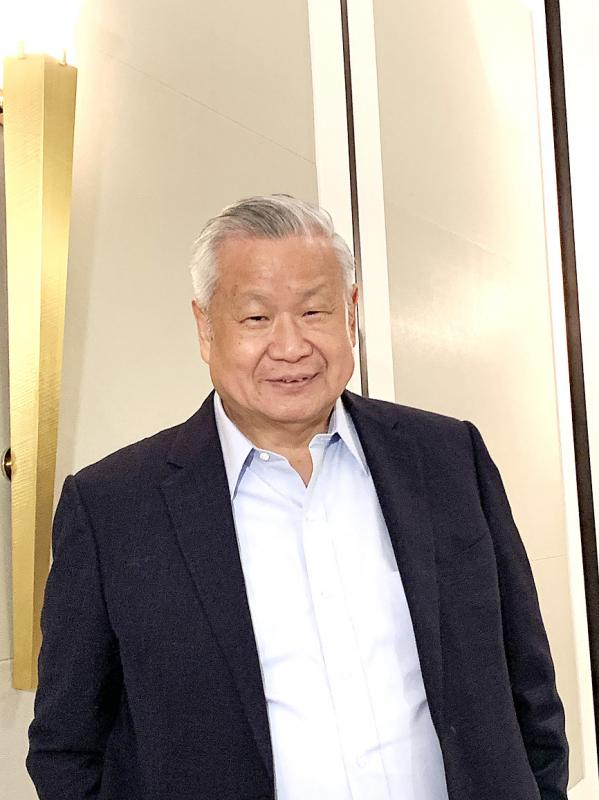
Photo: Grace Hung, Taipei Times
Wu said that there would be a longer shortage this time, compared with the one in 2017 that lasted for a year, as some of the world’s major chipmakers, such as Micron Technology Inc and Infineon, are considering scaling down production due to high volatility.
China’s GigaDevice Semiconductor (Beijing) Inc (北京兆易) is a chip designer and is reliant on capacity supply from Chinese foundries, which would be limited given healthy market demand, Wu said.
While chip demand is mounting for a wide range of applications from smart devices and vehicles to medical devices and home appliances, it would take at least two years to build a new factory to supply chips, he said.
Macronix supplies memory chips to most automakers in Germany, Japan, South Korea and the US, and an automotive chip shortage would help the company gain market share, he said.
Macronix is also bullish about its expansion in the medical segment.
The chipmaker said that it supplies chips for devices such as those used to detect blood sugar and inject medication for people with diabetes, as well as for medical patches that are used to monitor people’s heart conditions.
About 13 percent of the chipmaker’s revenue came from the automotive, industrial and medical device sectors last year, up 1 percentage point from 2019.
Macronix would not rush to expand capacity, as it would have to carefully calculate the benefits of such a significant investment, Wu said, adding that it has a spare plot of land for further expansion in Hsinchu.
Macronix is still in talks with several potential buyers to sell a 30-year-old 6-inch fab, Wu said.
“We are in the process of selling the old fab,” Wu said. “We may cut a deal next quarter.”
It has been speculated that local chipmakers Vanguard International Semiconductor Corp (世界先進) and United Microelectronics Corp (聯電) were on the short list of buyers.
Macronix declined to disclose the names of the potential buyers.
Macronix has budgeted NT$3 billion (US$105.07 million) on capital expenditure this year, the company said, adding that it would raise the figure if needed.
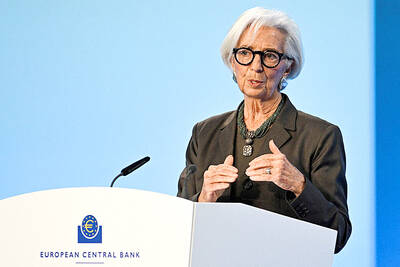
European Central Bank (ECB) President Christine Lagarde is expected to step down from her role before her eight-year term ends in October next year, the Financial Times reported. Lagarde wants to leave before the French presidential election in April next year, which would allow French President Emmanuel Macron and German Chancellor Friedrich Merz to find her replacement together, the report said, citing an unidentified person familiar with her thoughts on the matter. It is not clear yet when she might exit, the report said. “President Lagarde is totally focused on her mission and has not taken any decision regarding the end of

French President Emmanuel Macron told a global artificial intelligence (AI) summit in India yesterday he was determined to ensure safe oversight of the fast-evolving technology. The EU has led the way for global regulation with its Artificial Intelligence Act, which was adopted in 2024 and is coming into force in phases. “We are determined to continue to shape the rules of the game... with our allies such as India,” Macron said in New Delhi. “Europe is not blindly focused on regulation — Europe is a space for innovation and investment, but it is a safe space.” The AI Impact Summit is the fourth
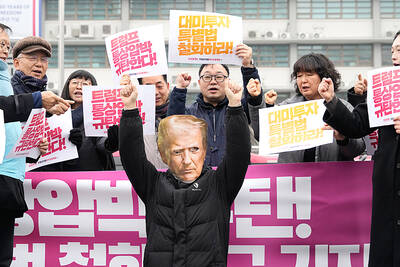
CONFUSION: Taiwan, Japan and other big exporters are cautiously monitoring the situation, while analysts said more Trump responses ate likely after his loss in court US trading partners in Asia started weighing fresh uncertainties yesterday after President Donald Trump vowed to impose a new tariff on imports, hours after the Supreme Court struck down many of the sweeping levies he used to launch a global trade war. The court’s ruling invalidated a number of tariffs that the Trump administration had imposed on Asian export powerhouses from China and South Korea to Japan and Taiwan, the world’s largest chip maker and a key player in tech supply chains. Within hours, Trump said he would impose a new 10 percent duty on US imports from all countries starting on
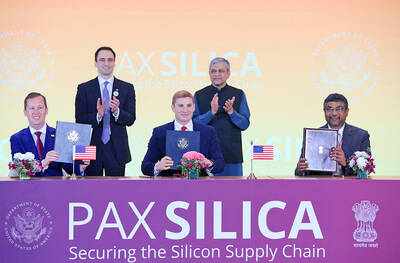
STRATEGIC ALLIANCE: The initiative is aimed at protecting semiconductor supply chain resilience to reduce dependence on China-dominated manufacturing hubs India yesterday joined a US-led initiative to strengthen technology cooperation among strategic allies in a move that underscores the nations’ warming ties after a brief strain over New Delhi’s unabated purchase of discounted Russian oil. The decision aligns India closely with Washington’s efforts to build secure supply chains for semiconductors, advanced manufacturing and critical technologies at a time when geopolitical competition with China is intensifying. It also signals a reset in relations following friction over energy trade and tariffs. Nations that have joined the Pax Silica framework include Japan, South Korea, the UK and Israel. “Pax Silica will be a group of nations


 RSS
RSS