


A revolt by junior Goldman Sachs Group Inc bankers over work weeks that can stretch to as long as 105 hours has inspired schadenfreude over discontent at the storied investment bank and wider debate about the future of work after the COVID-19 pandemic.
The erosion between office and home boundaries during the pandemic means many white-collar workers can relate on some level to the complaints, even if the plight of elite young bankers seeking riches does not inspire sympathy.
The issues underlying the Goldman Sachs controversy are “reflective of a broader problem,” said Temple University sociologist Kevin Delaney, author of Money at Work: On the Job with Priests, Poker Players and Hedge Fund Traders.
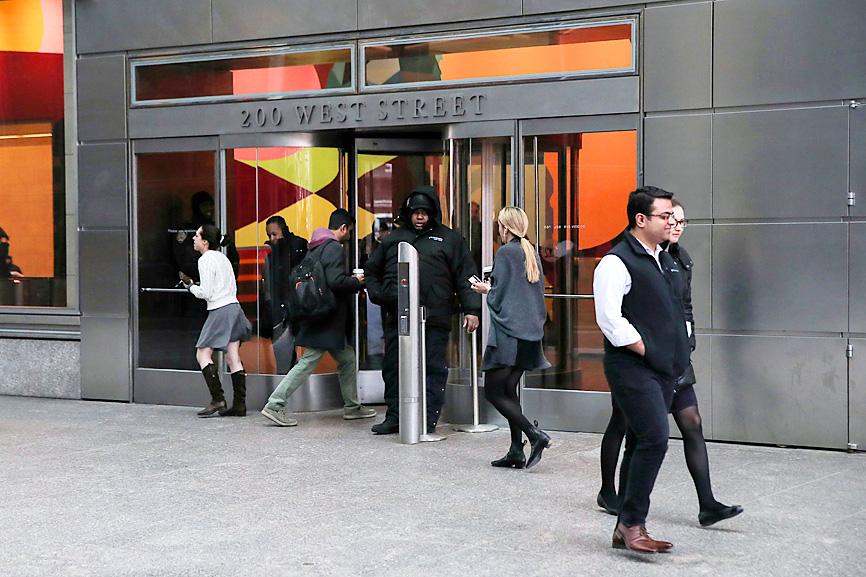
Photo: Reuters
“People feel the boundaries have disappeared between work and leisure and work and life. A lot of people are struggling with it because they are not sure when they are allowed to take time off,” he said.
In the wake of the dustup, Goldman Sachs chief executive David Solomon has urged staff to respect a firm-wide policy of not working on Saturdays, and praised the young staffers for speaking up.
The gripes were felt beyond Goldman’s corner of Lower Manhattan. Citigroup Inc chief executive Jane Fraser last week announced “Zoom-Free Fridays” and urged workers to take their vacation time, adding that she planned a few days off “knowing I will come back with a fresher brain.”
Compared with other options, being overworked could be viewed as a preferable plight during the pandemic. Government data show millions of people in the US remain out of work.
COVID-19 itself has also infected or killed many “essential” workers such as supermarket staff, transit workers, nurses and others who cannot telecommute.
Among those still with jobs, mental burnout is on the rise.
In a Harvard Business Review article published last month, Jennifer Moss, a syndicated columnist who specializes in workplace issues, said the disruption has been especially pronounced for younger staff.
One worker quoted in the story said they encountered professional roadblocks as well as negative health effects from diminished opportunities to exercise.
A survey of 1,500 workers showed 85 percent reported that their well-being had declined, and 55 percent said they felt like they had not been able to balance their home and work life, Moss wrote.
Possible steps to remedy the situation include establishing a manageable workload and a mental health resource page for staff as part of a strategy to destigmatize the issue.
Solutions must go beyond self-care steps such as yoga and meditation apps, Moss said.
“We desperately need upstream interventions, not downstream tactics,” she said.
All of the young Goldman bankers felt their work hours had negatively affected relationships with friends and family and also created unrealistic deadlines.
Most also reported feeling as though they experienced workplace abuse and were shunned in meetings, according to an 11-page presentation complete with statistics and graphs, not unlike what the bank would prepare for a client.
“There was a point where I was not eating, showering or doing anything else other than working from morning until after midnight,” said one of the staff members surveyed.
A Goldman Sachs employee who has been with the firm for about three years said that the pandemic indeed made work more grueling, and that first-year employees can suffer especially from the lack of opportunities to interact with senior employees.
Work weeks of 95 hours or more were not a surprise, said the employee, who spoke on the condition of anonymity.

The domestic unit of the Chinese-owned, Dutch-headquartered chipmaker Nexperia BV will soon be able to produce semiconductors locally within China, according to two company sources. Nexperia is at the center of a global tug-of-war over critical semiconductor technology, with a Dutch court in February ordering a probe into alleged mismanagement at the company. The geopolitical tussle has disrupted supply chains, with some carmakers reportedly forced to cut production due to chip shortages. Local production would allow Nexperia’s domestic arm, Nexperia Semiconductors (China) Ltd (安世半導體中國), to bypass restrictions in place since October on the supply of silicon wafers — etched with tiny components to

Singapore-based ride-hailing and delivery giant Grab Holdings Ltd has applied for regulatory approval to acquire the Taiwan operations of Germany-based Delivery Hero SE's Foodpanda in a deal valued at about US$600 million. Grab submitted the filing to the Fair Trade Commission on Friday last week, with the transaction subject to regulatory review and approval, the company said in a statement yesterday. Its independent governance structure would help foster a healthy and competitive market in Taiwan if the deal is approved, Grab said. Grab, which is listed on the NASDAQ, said in the filing that US-based Uber Technologies Inc holds about 13 percent of

Taiwan Semiconductor Manufacturing Co (TSMC, 台積電) yesterday received government approval to deploy its advanced 3-nanometer (3nm) process at its second fab currently under construction in Japan, the Ministry of Economic Affairs said in a news release. The ministry green-lit the plan for the facility in Kumamoto, which is scheduled to start installing equipment and come online in 2028 with a monthly production capacity of 15,000 12-inch wafers, the ministry said. The Department of Investment Review in June 2024 authorized a US$5.26 billion investment for the facility, slated to manufacture 6- to 12nm chips, significantly less advanced than 3nm process. At a meeting with

Taiwan’s food delivery market could undergo a major shift if Singapore-based Grab Holdings Ltd completes its planned acquisition of Delivery Hero SE’s Foodpanda business in Taiwan, industry experts said. Grab on Monday last week announced it would acquire Foodpanda’s Taiwan operations for US$600 million. The deal is expected to be finalized in the second half of this year, with Grab aiming to complete user migration to its platform by the first half of next year. A duopoly between Uber Eats and Foodpanda dominates Taiwan’s delivery market, a structure that has remained intact since the Fair Trade Commission (FTC) blocked Uber Technologies Inc’s


 RSS
RSS