


Developers and analysts yesterday turned conservative about the local property market’s outlook after the central bank further tightened credit controls and the Ministry of Finance announced plans to stiffen property tax terms.
The weakening sentiment came after the central bank on Thursday capped loan-to-value ratios at 40 percent for corporate buyers and 50 percent for individuals owning four houses, down from 55 percent, after real-estate financing continued to spike.
The central bank also limited lending to idle industrial lots to 55 percent and cut loan-to-value ratios for luxury housing from 60 percent to 55 percent on concern that upscale homes tend to be most affected by price corrections.
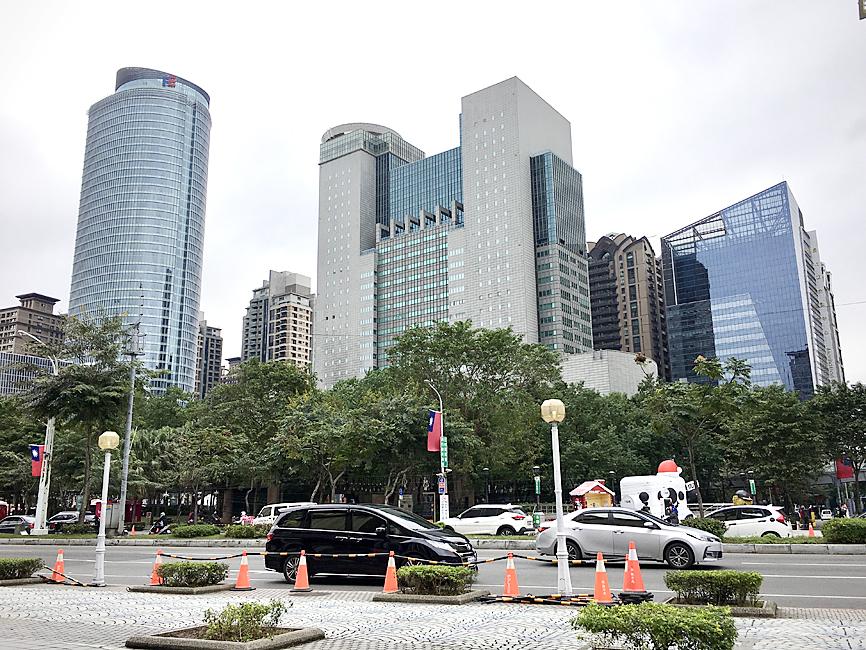
Photo: Hsu Yi-ping, Taipei Times
The credit controls aim to make house hoarding more expensive, especially for corporate buyers, said Sinyi Realty Inc (信義), the nation’s sole listed broker.
More than 13,000 companies in Taiwan own more than four houses and 50 percent of them sell properties within one year of purchasing them, according to Ministry of Interior data.
Developers and builders became the nation’s largest debtors in January, accounting for 25 percent of overall bank loans, Sinyi research manager Tseng Ching-der (增進德) said, citing government statistics.
Service providers rank a distant second, making up 12 percent of system loans, trailed by electronics makers and wholesale operators at 11 percent each, Sinyi said.
The figures show that developers and builders acquired land and launched new projects during the soft period from 2015 to 2017, when they made up 20 percent of the nation’s outstanding loans, Tseng said.
The rapid loan growth reflected an upturn in the property market, and alerted regulators about the need to step in to prevent a bubble, Tseng said.
Over the years, government agencies have learned to be effective in implementing macro-prudential measures to cool property transactions without affecting other sectors, Tseng said.
Jessica Hsu (徐佳馨), head researcher at H&B Realty Co (住商不動產), Taiwan’s largest broker by number of franchises, said the tightening measures would scare away leveraged investors now that people who own multiple homes would have to produce more than 50 percent of capital.
Investors without deep pockets might opt out, Hsu said, adding that she is pessimistic about the market.
Legislators are reviewing property tax bills that might impose property levies of 45 percent on houses resold within five years of their purchase from two years to curb short-term speculation. Some have proposed subjecting back deals to the revisions.
The Federation of the Real Estate Development Associations (不動產開發公會全聯會) said it worried that unfavorable measures could drive presale project buyers to walk out on their contracts.
Advancetek Enterprise Co (名軒開發) said it expected the presale market to shrink 30 percent this year, as investors account for 30 percent of overall transactions.
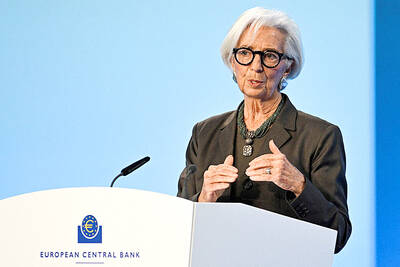
European Central Bank (ECB) President Christine Lagarde is expected to step down from her role before her eight-year term ends in October next year, the Financial Times reported. Lagarde wants to leave before the French presidential election in April next year, which would allow French President Emmanuel Macron and German Chancellor Friedrich Merz to find her replacement together, the report said, citing an unidentified person familiar with her thoughts on the matter. It is not clear yet when she might exit, the report said. “President Lagarde is totally focused on her mission and has not taken any decision regarding the end of

French President Emmanuel Macron told a global artificial intelligence (AI) summit in India yesterday he was determined to ensure safe oversight of the fast-evolving technology. The EU has led the way for global regulation with its Artificial Intelligence Act, which was adopted in 2024 and is coming into force in phases. “We are determined to continue to shape the rules of the game... with our allies such as India,” Macron said in New Delhi. “Europe is not blindly focused on regulation — Europe is a space for innovation and investment, but it is a safe space.” The AI Impact Summit is the fourth
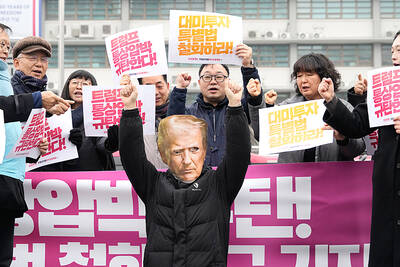
CONFUSION: Taiwan, Japan and other big exporters are cautiously monitoring the situation, while analysts said more Trump responses ate likely after his loss in court US trading partners in Asia started weighing fresh uncertainties yesterday after President Donald Trump vowed to impose a new tariff on imports, hours after the Supreme Court struck down many of the sweeping levies he used to launch a global trade war. The court’s ruling invalidated a number of tariffs that the Trump administration had imposed on Asian export powerhouses from China and South Korea to Japan and Taiwan, the world’s largest chip maker and a key player in tech supply chains. Within hours, Trump said he would impose a new 10 percent duty on US imports from all countries starting on
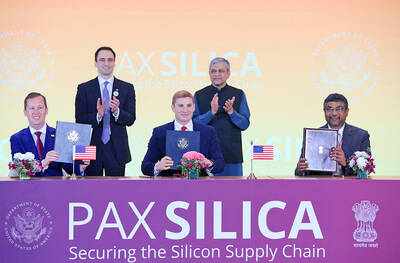
STRATEGIC ALLIANCE: The initiative is aimed at protecting semiconductor supply chain resilience to reduce dependence on China-dominated manufacturing hubs India yesterday joined a US-led initiative to strengthen technology cooperation among strategic allies in a move that underscores the nations’ warming ties after a brief strain over New Delhi’s unabated purchase of discounted Russian oil. The decision aligns India closely with Washington’s efforts to build secure supply chains for semiconductors, advanced manufacturing and critical technologies at a time when geopolitical competition with China is intensifying. It also signals a reset in relations following friction over energy trade and tariffs. Nations that have joined the Pax Silica framework include Japan, South Korea, the UK and Israel. “Pax Silica will be a group of nations


 RSS
RSS