


State-run Hua Nan Financial Holding Co (華南金控) aims to grow its earnings this year at a pace in line with the nation’s GDP growth, although the COVID-19 pandemic and low interest rates would continue to weigh on its performance, senior officials told a virtual investors’ conference yesterday.
That suggests an improvement of about 5 percent after missing its pre-tax profit target last year by 4 percent mainly due to losses at its securities arm, Hua Nan Securities Co (華南永昌證券) senior vice president and general manager Jully Chu (朱婉麗) said.
The Directorate-General of Budget, Accounting and Statistics last month raised its forecast for the nation’s GDP growth to 4.64 percent this year on surging global demand for technology products.
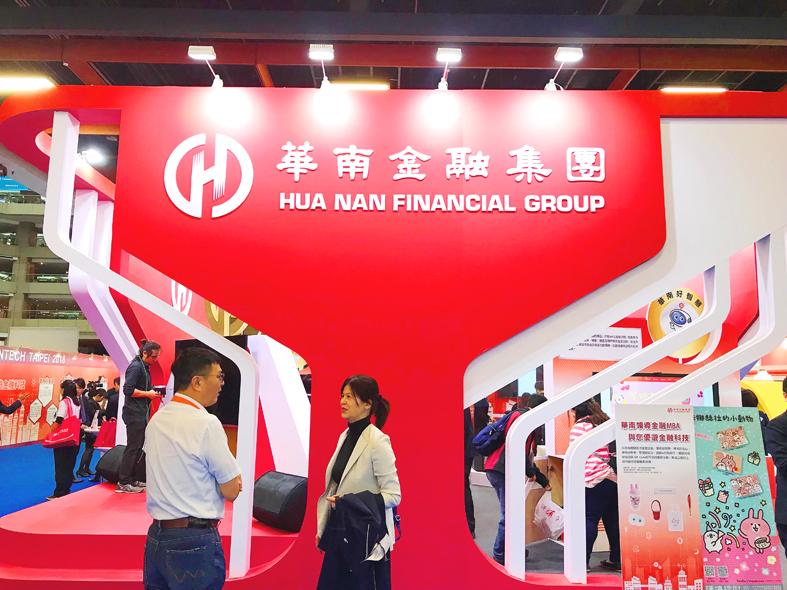
Photo: Chen Mei-ying, Taipei Times
“We are cautiously optimistic about the economy at home and abroad now that COVID-19 infections have shown signs of easing,” Chu said, adding that the pandemic nevertheless poses great uncertainty, with global central banks maintaining loose monetary policies, which are unfavorable to banking operations.
The interest spread for foreign currency banking tumbled 52 basis points to 1.35 percent last year after the US Federal Reserve cut interest rates to a range of zero to 0.25 percent, Chu said.
Likewise, the maneuvering room for local currency-based lending shed 12 basis points to 1.19 percent after the nation’s central bank lowered the rediscount rate to a record 1.125 percent to ease the financial burden on households, Chu said.
Consequently, net interest margin, a critical profitability gauge for financial institutions, shrank to 1.21 percent for foreign-currency operations and 0.83 percent for local currency loans, she said.
Hua Nan Financial said that it is looking at a flat loanbook this year, while seeking to expand its interest and fee income by growing loans to small and medium-sized enterprises, and in overseas markets, as such businesses generate higher margins.
Main subsidiary Hua Nan Commercial Bank (華南銀行) would actively take part in syndicated loans and strengthen its bancassurance business, the company said, adding that these efforts are intended to boost the interest spread and net interest margin by 4 and 2 basis points respectively this year.
The bank-focused conglomerate is to diversify its sources of income by raising earnings contributions from its stock brokerage, South China Insurance Co (華南產險), and other units, it added.
Asked about its dividend payout plan, Hua Nan Financial said that its net income slumped 48.85 percent to NT$8.66 billion (US$305.73 million) last year, or earnings per share of NT$0.67, down from NT$1.31 a year earlier.
“We will deal with the issue by referring to past practices,” the company said.


Taiwan’s foreign exchange reserves fell below the US$600 billion mark at the end of last month, with the central bank reporting a total of US$596.89 billion — a decline of US$8.6 billion from February — ending a three-month streak of increases. The central bank attributed the drop to a combination of factors such as outflows by foreign institutional investors, currency fluctuations and its own market interventions. “The large-scale outflows disrupted the balance of supply and demand in the foreign exchange market, prompting the central bank to intervene repeatedly by selling US dollars to stabilize the local currency,” Department of Foreign

Intel Corp is joining Elon Musk’s long-shot effort to develop semiconductors for Tesla Inc, Space Exploration Technologies Corp and xAI, marking a surprising twist in the chipmaker’s comeback bid. Intel would help the Terafab project “refactor” the technology in a chip factory, the company said on Tuesday in a post on X, Musk’s social media platform. That is a stage in the development process that typically helps make chips more powerful or reliable. The chipmaker’s shares jumped 4.2 percent to US$52.91 in New York trading on Tuesday. The Terafab project is a grand plan by Musk to eventually manufacture his own chips for
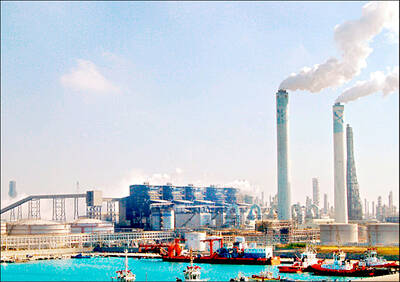
Taiwan Power Co (Taipower, 台電) yesterday said it plans to resume operations at two coal-fired power generators for three months to boost security of electricity supply as liquefied natural gas (LNG) supply risks are running high due to the Middle East conflict. The two coal-fired power generators are at Mailiao Power Plant in Yunlin County’s Mailiao Township (麥寮). The plant, operated by Formosa Plastics Group (台塑集團), supplied electricity to Taipower’s power grid until the end of last year. Taipower’s decision came about one month after Minister of Economic Affairs Kung Ming-hsin (龔明鑫) on March 10 said that the nation had no imminent

Some robotaxi passengers were left stranded in the middle of fast-moving traffic in a major Chinese city after their driverless vehicles stopped running, according to police and media reports on Wednesday. A preliminary investigation indicates more than 100 robotaxis came to a halt because of a “system malfunction,” police in the city of Wuhan said in a statement, without elaborating. No injuries were reported. One passenger told Chinese media that their robotaxi stopped after turning a corner. An instruction on a screen read: “Driving system malfunction. Staff are expected to arrive in 5 minutes.” After no one showed up, the passenger pushed


 RSS
RSS