


Global stocks fell yesterday, with Asian shares down by the most in nine months, as a rout in global bond markets sent yields flying and spooked investors amid fears the heavy losses suffered could trigger distressed selling in other assets.
MSCI’s Emerging Markets equity index suffered its biggest daily drop in nearly 10 months and was 2.7 percent lower, while European shares opened in the red, with the STOXX 600 down 0.7 percent, recovering from heavier losses earlier in the session.
The MSCI World equity index, which tracks shares in 50 countries, was 0.9 percent lower and heading for its worst week in a month.
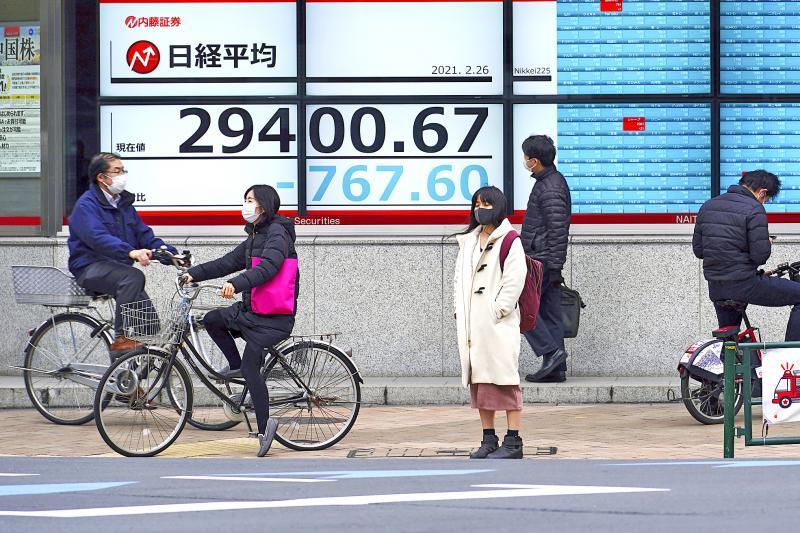
Photo: AP
Asia saw the heaviest selling, with MSCI’s broadest index of Asia-Pacific shares outside Japan sliding more than 3 percent to a one-month low, its steepest one-day percentage loss since May last year.
For the week the index is down more than 5 percent, its worst weekly showing since March last year, when the COVID-19 pandemic had sparked fears of a global recession.
“It is not the beginning of a correction in equities, more a logical consolidation as price to earnings ratios were excessive,” said Francois Savary, chief investment officer at Swiss wealth manager Prime Partners.
“What is reassuring is that Q4 2020 earnings were good and earnings per share suprisingly good, and that means down the road we should get back to growth,” he said.
Yesterday’s carnage was triggered by a whiplash in bonds.
The scale of the sell-off prompted Australia’s central bank to launch a surprise bond-buying operation to try and staunch the bleeding.
The European Central Bank (ECB) is monitoring the recent surge in government bond borrowing costs, but will not try to control the yield curve, ECB chief economist Philip Lane told a Spanish newspaper.
Ten-year German government bond yields were down nearly 4 basis points at minus-0.267 percent, and French and Austrian bonds were back in negative territory.
Yields on the 10-year US Treasury note eased back to 1.4530 percent from a one-year high of 1.614 percent on Thursday.
“Bond yields could still go higher in the short term though, as bond selling begets more bond selling,” AMP head of investment strategy Shane Oliver said.
“The longer this continues the greater the risk of a more severe correction in share markets if earnings upgrades struggle to keep up with the rise in bond yields,” he said.
Markets were hedging the risk of an earlier rate hike from the US Federal Reserve, even though officials this week vowed any move was long in the future.
Fed fund futures are now almost fully priced for a rise to 0.25 percent by January 2023, while eurodollars have it discounted for June next year.
Even the thought of an eventual end to super-cheap money sent shivers through global stock markets, which have been regularly hitting record highs and stretching valuations.
“The fixed income rout is shifting into a more lethal phase for risky assets,” Westpac head of rates strategy Damien McColough said.
“The rise in yields has long been mostly seen as a story of improving growth expectations, if anything padding risky assets, but the overnight move notably included a steep lift in real rates and a bringing forward of Fed liftoff expectations,” he said.
Japan’s Nikkei shed 4 percent, its biggest single-day fall since April last year, and Chinese blue chips joined the retreat with a drop of 2.4 percent.
Overnight, the Dow Jones Industrial Average fell 1.75 percent, while the S&P 500 lost 2.45 percent and the NASDAQ 3.52 percent, the biggest decline in almost four months for the tech-heavy index.
Tech darlings all suffered, with Apple Inc, Tesla Inc, Amazon.com Inc, Nvidia Corp and Microsoft Corp the biggest drags.
The surge in US Treasury yields caused ructions in emerging markets, which feared the better returns on offer in the US might attract funds away.

SECOND-RATE: Models distilled from US products do not perform the same as the original and undo measures that ensure the systems are neutral, the US’ cable said The US Department of State has ordered a global push to bring attention to what it said are widespread efforts by Chinese companies, including artificial intelligence (AI) start-up DeepSeek (深度求索), to steal intellectual property from US AI labs, according to a diplomatic cable. The cable, dated Friday and sent to diplomatic and consular posts around the world, instructs diplomatic staff to speak to their foreign counterparts about “concerns over adversaries’ extraction and distillation of US AI models.” Distillation is the process of training smaller AI models using output from larger, more expensive ones to lower the costs of training a powerful new

Singapore-based ride-hailing and delivery giant Grab Holdings’ planned acquisition of Foodpanda’s Taiwan operations has yet to enter the formal review stage, as regulators await supplementary documents, the Fair Trade Commission (FTC) said yesterday. Acting FTC Chairman Chen Chih-min (陳志民) told the legislature’s Economics Committee that although Grab submitted its application on March 27, the case has not been officially accepted because required materials remain incomplete. Once the filing is finalized, the FTC would launch a formal probe into the deal, focusing on issues such as cross-shareholding and potential restrictions on market competition, Chen told lawmakers. Grab last month announced that it would acquire
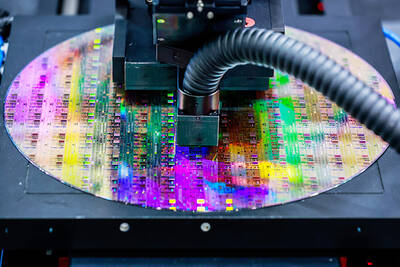
The artificial intelligence (AI) boom has triggered a seismic reshuffling of global equity markets, with Taiwan and South Korea muscling past European nations one by one. With its stock market now valued at nearly US$4.3 trillion, Taiwan surpassed the UK, Europe’s biggest market, earlier this month, data compiled by Bloomberg showed. South Korea is about US$140 billion away from doing the same. The tech-heavy Asian markets have shot past Germany and France in the past seven months. The shift is largely down to massive gains in shares of three companies that provide essential hardware for AI: Taiwan Semiconductor Manufacturing Co (TSMC, 台積電),
Shares of Taiwan Semiconductor Manufacturing Co (TSMC, 台積電) have repeatedly hit new highs, but an equity analyst said the stock’s valuation remains within a reasonable range and any pullback would likely be technical. The contract chipmaker’s historical price-to-earnings (P/E) ratio has ranged between 20 and 30, Cathay Futures Consultant Co (國泰證期) analyst Tsai Ming-han (蔡明翰) told Central News Agency. With market consensus projecting that TSMC would post earnings per share of about NT$100 (US$3.17) this year, supported by strong global demand for artificial intelligence (AI) applications, and the stock currently trading at a P/E ratio of below 25, Tsai said the valuation


 RSS
RSS