


United Renewable Energy Co (URE, 聯合再生) plans to build more than half of the nation’s solar panel modules this year, the company said yesterday.
In a statement, the nation’s biggest solar module supplier said that it has secured new government solar farm projects through open bidding.
The firm said it has secured module supply contracts for a 120 megawatt (MW) aquaculture/solar project in Tainan, a 100MW project on sunken land in Pingtung County and a 70MW project on an island off Yunlin County.
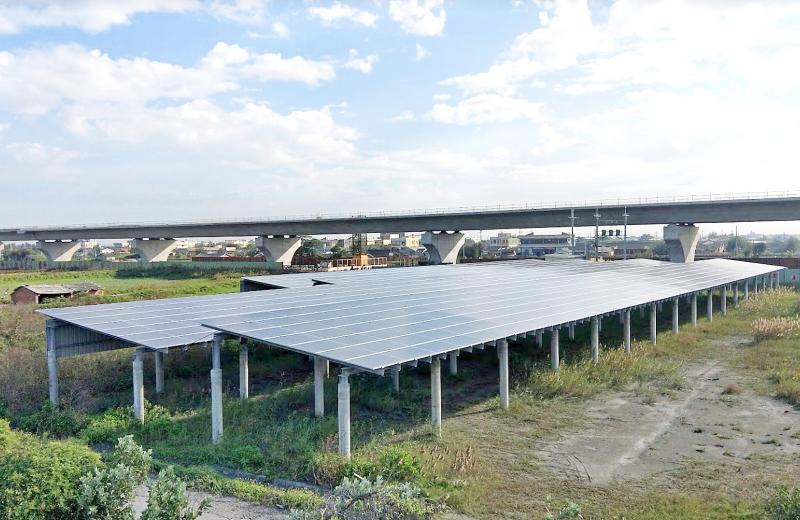
Photo copied by Chen Kuan-pei, Taipei Times
After missing the quota for increased solar capacity last year by 0.68 gigawatts (GW), the government’s new goal for new added solar capacity is 2GW.
“URE has already closed several leading projects and looks to secure 50 percent of the government’s current open project bids,” the company said in a statement yesterday.
To cope with rising demand, the company said it plans to add more than 500MW of solar module capacity this year.
URE last year seized a 40 percent share of the nation’s 1.5GW solar power market, which has helped boost its consolidated revenue to NT$12.5 billion (US$441.1 million), more than twice that of its closest rival, Taiwan Solar Energy Corp (TSEC, 元晶太陽能), it said.
URE supplied solar modules used in an operation in Tainan’s Cigu District (七股), which has an installed capacity of 195MW, making it the biggest solar project in Taiwan. Its solar modules are also used in solar projects in Pingtung, Yunlin and Chiayi counties, it said.
In addition to power generation performance, URE developed photovoltaic panels to withstand uniquely challenging conditions, the company said.
“We had to come up with products that are extremely salt-resistant and suitable for challenging conditions such as salt fields and aquaculture/solar projects,” it said, adding that it is working with the Industrial Technology Research Institute to ensure its panels do not leak toxins.

The domestic unit of the Chinese-owned, Dutch-headquartered chipmaker Nexperia BV will soon be able to produce semiconductors locally within China, according to two company sources. Nexperia is at the center of a global tug-of-war over critical semiconductor technology, with a Dutch court in February ordering a probe into alleged mismanagement at the company. The geopolitical tussle has disrupted supply chains, with some carmakers reportedly forced to cut production due to chip shortages. Local production would allow Nexperia’s domestic arm, Nexperia Semiconductors (China) Ltd (安世半導體中國), to bypass restrictions in place since October on the supply of silicon wafers — etched with tiny components to

Singapore-based ride-hailing and delivery giant Grab Holdings Ltd has applied for regulatory approval to acquire the Taiwan operations of Germany-based Delivery Hero SE's Foodpanda in a deal valued at about US$600 million. Grab submitted the filing to the Fair Trade Commission on Friday last week, with the transaction subject to regulatory review and approval, the company said in a statement yesterday. Its independent governance structure would help foster a healthy and competitive market in Taiwan if the deal is approved, Grab said. Grab, which is listed on the NASDAQ, said in the filing that US-based Uber Technologies Inc holds about 13 percent of

Taiwan Semiconductor Manufacturing Co (TSMC, 台積電) yesterday received government approval to deploy its advanced 3-nanometer (3nm) process at its second fab currently under construction in Japan, the Ministry of Economic Affairs said in a news release. The ministry green-lit the plan for the facility in Kumamoto, which is scheduled to start installing equipment and come online in 2028 with a monthly production capacity of 15,000 12-inch wafers, the ministry said. The Department of Investment Review in June 2024 authorized a US$5.26 billion investment for the facility, slated to manufacture 6- to 12nm chips, significantly less advanced than 3nm process. At a meeting with

Taiwan’s food delivery market could undergo a major shift if Singapore-based Grab Holdings Ltd completes its planned acquisition of Delivery Hero SE’s Foodpanda business in Taiwan, industry experts said. Grab on Monday last week announced it would acquire Foodpanda’s Taiwan operations for US$600 million. The deal is expected to be finalized in the second half of this year, with Grab aiming to complete user migration to its platform by the first half of next year. A duopoly between Uber Eats and Foodpanda dominates Taiwan’s delivery market, a structure that has remained intact since the Fair Trade Commission (FTC) blocked Uber Technologies Inc’s


 RSS
RSS