


Hon Hai Precision Industry Co (鴻海精密) yesterday released its first-generation electric vehicle (EV) developer tool, “Evkit,” as part of the company’s ongoing venture into the development of electric cars.
The tool, presented online, “will provide autonomous-driving developers an easily accessible interface to control the dynamics of the platform, and assist in system design and validation to vastly reduce development cost,” Jack Cheng (鄭顯聰), chief executive officer of the Hon Hai-initiated MIH Open Platform Alliance, said in an open letter to alliance members.
In addition to releasing the tool, Cheng announced that the alliance would host its first partner conference next month, while calling on more companies to join the “open and self-sustainable technology platform” set to become an “indispensable force in the global EV industry.”
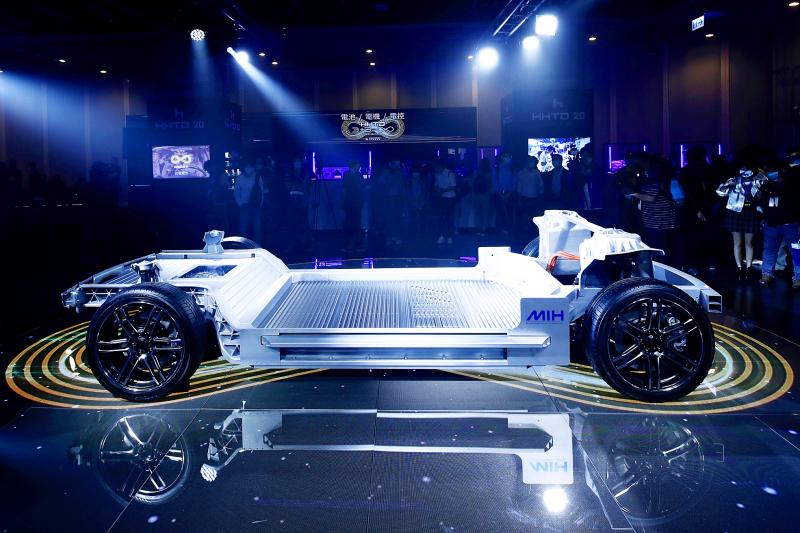
Photo: EPA-EFE
In February last year, Hon Hai announced a joint venture with the Yulon Group (裕隆集團), which is scheduled to start rolling out electric vehicles within two years.
Under the partnership, Yulon subsidiary Hua-Chuang Automobile Information Technical Center Co (華創車電) is focusing on design, while the alliance would provide hardware and software to other automakers for EV development.
Hon Hai said that the platform would become the “Android of the electric car industry.”
About 500 companies have joined the alliance, including Arm Ltd, Siemens Industry Software Ltd, GuardKnox Cyber Technologies Ltd, Drimaes Inc, the Automotive Research & Testing Center and the Industrial Technology Research Institute.
Hon Hai is hoping to hold a 10 percent share in the global electric vehicle market by 2025 to 2027.
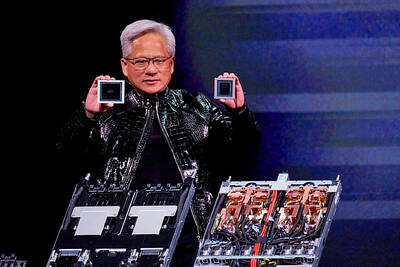
Nvidia Corp chief executive officer Jensen Huang (黃仁勳) on Monday introduced the company’s latest supercomputer platform, featuring six new chips made by Taiwan Semiconductor Manufacturing Co (TSMC, 台積電), saying that it is now “in full production.” “If Vera Rubin is going to be in time for this year, it must be in production by now, and so, today I can tell you that Vera Rubin is in full production,” Huang said during his keynote speech at CES in Las Vegas. The rollout of six concurrent chips for Vera Rubin — the company’s next-generation artificial intelligence (AI) computing platform — marks a strategic
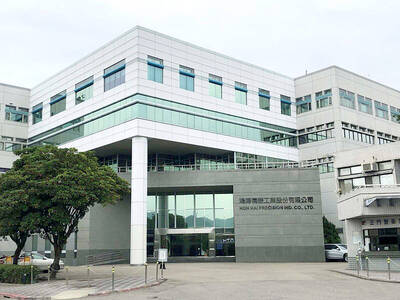
REVENUE PERFORMANCE: Cloud and network products, and electronic components saw strong increases, while smart consumer electronics and computing products fell Hon Hai Precision Industry Co (鴻海精密) yesterday posted 26.51 percent quarterly growth in revenue for last quarter to NT$2.6 trillion (US$82.44 billion), the strongest on record for the period and above expectations, but the company forecast a slight revenue dip this quarter due to seasonal factors. On an annual basis, revenue last quarter grew 22.07 percent, the company said. Analysts on average estimated about NT$2.4 trillion increase. Hon Hai, which assembles servers for Nvidia Corp and iPhones for Apple Inc, is expanding its capacity in the US, adding artificial intelligence (AI) server production in Wisconsin and Texas, where it operates established campuses. This

US President Donald Trump on Friday blocked US photonics firm HieFo Corp’s US$3 million acquisition of assets in New Jersey-based aerospace and defense specialist Emcore Corp, citing national security and China-related concerns. In an order released by the White House, Trump said HieFo was “controlled by a citizen of the People’s Republic of China” and that its 2024 acquisition of Emcore’s businesses led the US president to believe that it might “take action that threatens to impair the national security of the United States.” The order did not name the person or detail Trump’s concerns. “The Transaction is hereby prohibited,”
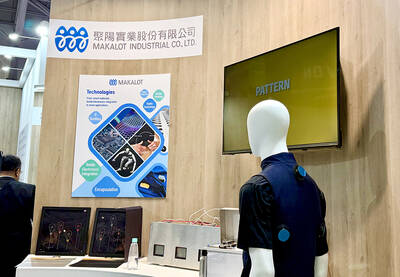
Garment maker Makalot Industrial Co (聚陽) yesterday reported lower-than-expected fourth-quarter revenue of NT$7.93 billion (US$251.44 million), down 9.48 percent from NT$8.76 billion a year earlier. On a quarterly basis, revenue fell 10.83 percent from NT$8.89 billion, company data showed. The figure was also lower than market expectations of NT$8.05 billion, according to data compiled by Yuanta Securities Investment and Consulting Co (元大投顧), which had projected NT$8.22 billion. Makalot’s revenue this quarter would likely increase by a mid-teens percentage as the industry is entering its high season, Yuanta said. Overall, Makalot’s revenue last year totaled NT$34.43 billion, down 3.08 percent from its record NT$35.52


 RSS
RSS