


Factory activity across Asia continues to gain momentum, spurred by strong demand for the region’s exports, while China’s recovery is starting to moderate.
Japan’s purchasing managers index (PMI) rose to 50 last month, its highest reading since April 2019, Jibun Bank and IHS Markit said.
Taiwan’s PMI jumped to 59.4, its highest mark in a decade, while South Korea’s remained at 52.9, its third consecutive month above the 50 level that separates contraction from expansion.
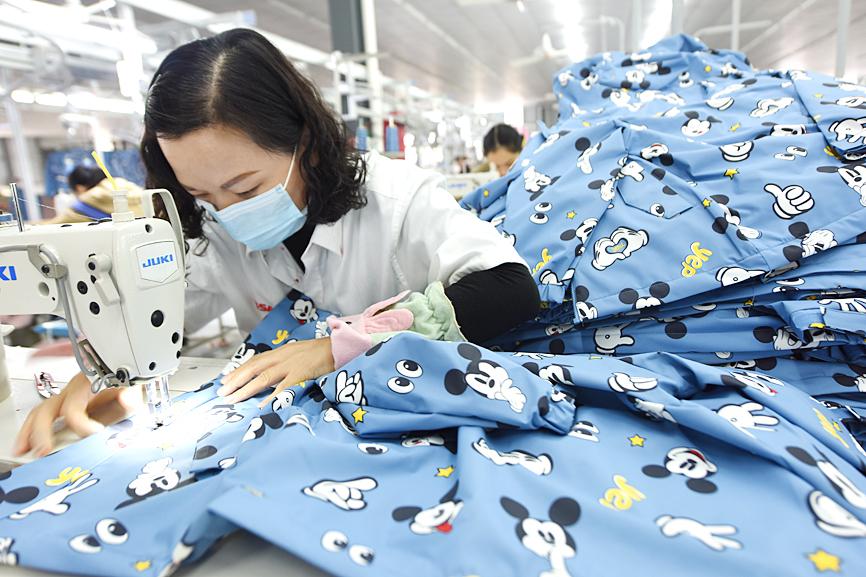
Photo: AP
Still, with China’s factory growth starting to ease after expanding strongly in the past few months, production in the rest of the region could cool going forward.
China’s official manufacturing gauge fell to 51.9 last month from a three-year high of 52.1 in the previous month, the National Bureau of Statistics said last week, while the Caixin Media and IHS Markit PMI fell to 53 from 54.9 in November, dragged down by weaker output and new orders.
South Asia’s and Southeast Asia’s economies showed mostly marginal improvement last month, with India’s gauge rising to 56.4 from 56.3 and Indonesia advancing further into expansion at 51.3 from 50.6.
Thailand’s PMI gained and Vietnam lurched back into expansion, while the Philippines slipped slightly and is still in contraction territory. Malaysia’s index rose, but remained below 50.
“Purchasing managers’ indexes for December show Asia’s manufacturing sector persevering even as the coronavirus pandemic worsened... The coming months will remain challenging as surges of infections in the region and beyond undermine demand,” Bloomberg Economics chief Asia economist Chang Shu (舒暢) said.
The data are in line with the Bloomberg Trade Tracker, which showed robust healing from the COVID-19 pandemic in the second half of last year, especially among Asian economies.
Eight of the 10 gauges on the tracker are at or above their long-run normal ranges.
As a bellwether for global trade, South Korea’s PMI reading is often held up as a gauge for future demand. Firms reported further increases in output and new orders in the latest survey period, IHS Markit economist Usamah Bhatti said.
“South Korean goods producers remained optimistic in their outlook for activity over the coming 12 months, as the pandemic fades further and new products are launched,” Bhatti wrote in a release.
Separately, Singapore’s economy continued its slow recovery from the worst slump in the country’s history, with mainstays such as trade and tourism hammered by the pandemic.
GDP last quarter grew 2.1 percent on a seasonally adjusted basis compared with the previous three months, according to advance estimates from the Singaporean Ministry of Trade and Industry released yesterday.
Driven by quarterly gains in construction and services, the increase beat the median forecast of 1.3 percent in a Bloomberg survey of economists.
Compared with a year earlier, the economy shrank 3.8 percent in the three months through last month, its fourth straight quarter of contraction. The median estimate in a survey of economists was minus-4.7 percent.
For the full year, Singapore’s economy shrank 5.8 percent.
Although better than the 6 percent decline expected by economists, it is the worst showing since independence more than a half-century ago and the first annual contraction since 2001.
The performance is “definitely encouraging, in that it came in better than expected for both the fourth quarter and also full year thanks to the third quarter’s upward revision,” said Selena Ling (林秀心), head of treasury research and strategy at Oversea-Chinese Banking Corp (華僑銀行) in Singapore.
With vaccinations underway and a further easing of restrictions late last month, “hopefully we’ll see the Singapore economy continue to stabilize and regain its footing in the first half of 2021 to allow more economic green shoots to bloom.”
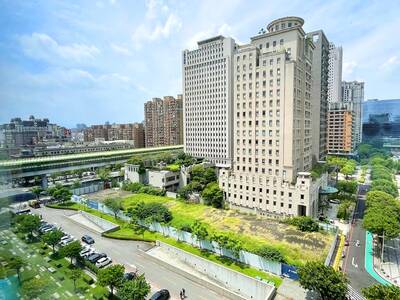
Taichung reported the steepest fall in completed home prices among the six special municipalities in the first quarter of this year, data compiled by Taiwan Realty Co (台灣房屋) showed yesterday. From January through last month, the average transaction price for completed homes in Taichung fell 8 percent from a year earlier to NT$299,000 (US$9,483) per ping (3.3m²), said Taiwan Realty, which compiled the data based on the government’s price registration platform. The decline could be attributed to many home buyers choosing relatively affordable used homes to live in themselves, instead of newly built homes in the city’s prime property market, Taiwan Realty
The government yesterday approved applications by Alphabet Inc’s Google to invest NT$27.08 billion (US$859.98 million) in Taiwan, the Ministry of Economic Affairs said in a statement. The Department of Investment Review approved two investments proposed by Google, with much of the funds to be used for data processing and electronic information supply services, as well as inventory procurement businesses in the semiconductor field, the ministry said. It marks the second consecutive year that Google has applied to increase its investment in Taiwan. Google plans to infuse NT$25.34 billion into Charter Investments Ltd (特許投資顧問) through its Singapore-based subsidiary Fructan Holdings Singapore Pte Ltd, and

JET JUICE: The war on Iran’s secondary effects have seen fuel prices skyrocket, knocking flight schedules down to earth in return as airlines struggle with costs Airline passengers should brace for more irritation in the next few months as carriers worldwide cancel flights and ground planes to cope with stratospheric increases in jet-fuel prices. Dutch flag carrier KLM is the latest company to cut its schedule, saying on Thursday that it would scrap 80 return flights at Amsterdam’s Schiphol Airport in the coming month. That puts it in the same league as United Airlines Holdings Inc, Deutsche Lufthansa AG and Cathay Pacific Airways Ltd, which have all pruned itineraries to mitigate costs. Global capacity for next month has been reduced by about 3 percentage points, with all

The US said it plans to help build a first-of-its-kind industrial hub in the Philippines to boost production of inputs crucial to US supply chains. The 4,000-acre hub is intended to be “a purpose-built platform for allied manufacturing” and “an investment acceleration hub where the specific industrial activities are shaped by market demand,” the US Department of State said on Thursday. The project — touted as an “economic security zone” — would be within the Luzon Economic Corridor, a flagship economic project backed by the US and Japan on the main Philippine island. The project was also described as “the first artificial intelligence


 RSS
RSS