


Losses associated with the Fourth Nuclear Power Plant would be recognized by Taiwan Power Co (Taipower, 台電) after a referendum next year, Minister of Economic Affairs Wang Mei-hua (王美花) said yesterday.
The power plant in New Taipei City’s Gongliao District (貢寮) has been mothballed since 2015 amid construction controversies and protests from environmentalists.
President Tsai Ing-wen (蔡英文) has pledged to make Taiwan a “nuclear-free homeland” by 2025, and Taipower has already sent the power plant’s fuel rods back to the US to be dismantled.
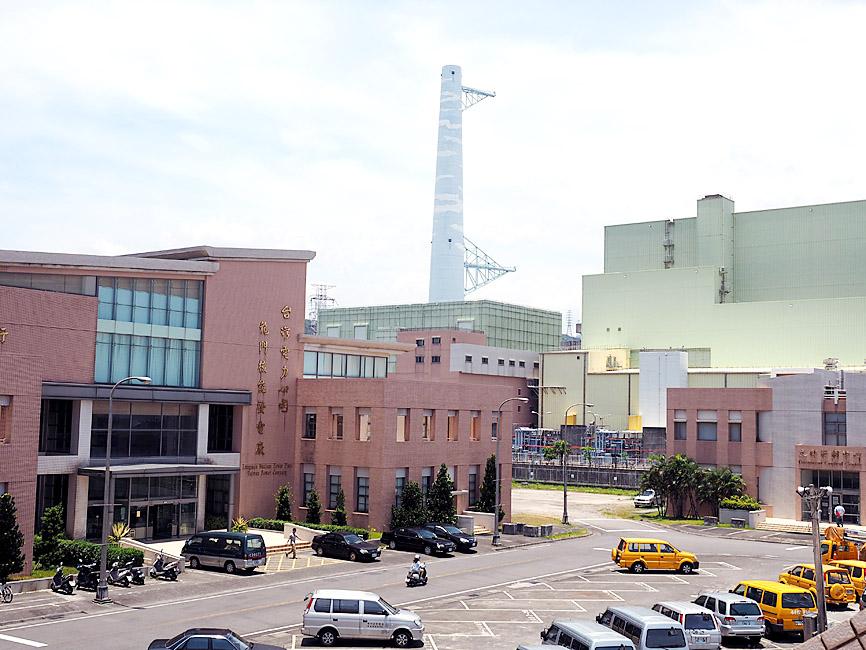
Photo: David Chang, EPA-EFE
However, it is still counted as an asset on Taipower’s books.
“There will be a referendum in August on whether to activate the Fourth Nuclear Power Plant,” Wang told reporters at the Legislative Yuan in Taipei. “We will wait for the result of that referendum before recognizing it as a loss and finding alternative ways to utilize the site.”
The losses associated with the ill-fated project are enormous. According to Taipower’s annual report, the costs associated with the power plant, including the transportation and disposal of the fuel rods, is NT$285 billion (US$9.9 billion).
Citing an unnamed source who is a “senior member of the ministry,” the Chinese-language Liberty Times (the Taipei Times’ sister paper) yesterday reported that writing off the power plant would put the state-owned utility “on the brink of bankruptcy.”
“Taipower executives are taking the easy way out, but in the process they are breaking the law,” the source told the newspaper.
Describing the power plant as “too hot to handle,” the source accused Taipower decisionmakers of “hiding the loss as an ongoing construction” and “leaving the problem for their successors,” the paper reported.
Article 71 of the Business Entities Accounting Act (商業會計法) cites “intentionally omitting accounting events and failing to record transactions thus causing financial statements to become untrue” as an offense, with penalties of up to five years in prison and a fine of up to NT$600,000.
Although a state-run company, Taipower is 6 percent privately held and its shares are traded publicly on the Taiwan Stock Exchange.
The company in a news release said that it is seeking to maximize the power plant’s remaining assets, including land, before recognizing the loss.
“We expect to maximize the asset value of the Fourth Nuclear Power Plant, then we will have a basis to figure out how to accurately recognize it in our books,” Taipower said yesterday.
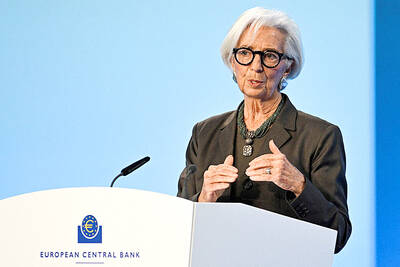
European Central Bank (ECB) President Christine Lagarde is expected to step down from her role before her eight-year term ends in October next year, the Financial Times reported. Lagarde wants to leave before the French presidential election in April next year, which would allow French President Emmanuel Macron and German Chancellor Friedrich Merz to find her replacement together, the report said, citing an unidentified person familiar with her thoughts on the matter. It is not clear yet when she might exit, the report said. “President Lagarde is totally focused on her mission and has not taken any decision regarding the end of
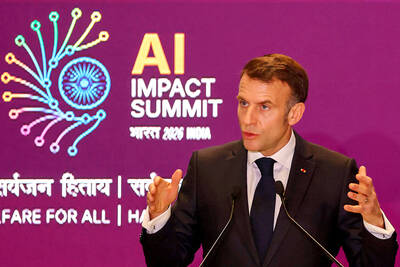
French President Emmanuel Macron told a global artificial intelligence (AI) summit in India yesterday he was determined to ensure safe oversight of the fast-evolving technology. The EU has led the way for global regulation with its Artificial Intelligence Act, which was adopted in 2024 and is coming into force in phases. “We are determined to continue to shape the rules of the game... with our allies such as India,” Macron said in New Delhi. “Europe is not blindly focused on regulation — Europe is a space for innovation and investment, but it is a safe space.” The AI Impact Summit is the fourth
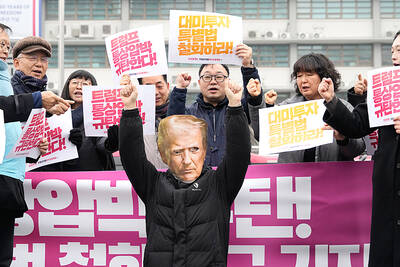
CONFUSION: Taiwan, Japan and other big exporters are cautiously monitoring the situation, while analysts said more Trump responses ate likely after his loss in court US trading partners in Asia started weighing fresh uncertainties yesterday after President Donald Trump vowed to impose a new tariff on imports, hours after the Supreme Court struck down many of the sweeping levies he used to launch a global trade war. The court’s ruling invalidated a number of tariffs that the Trump administration had imposed on Asian export powerhouses from China and South Korea to Japan and Taiwan, the world’s largest chip maker and a key player in tech supply chains. Within hours, Trump said he would impose a new 10 percent duty on US imports from all countries starting on
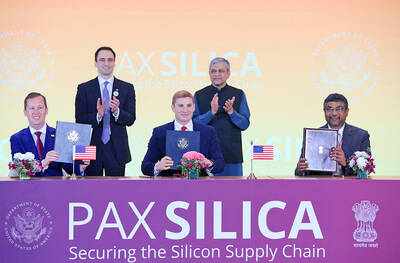
STRATEGIC ALLIANCE: The initiative is aimed at protecting semiconductor supply chain resilience to reduce dependence on China-dominated manufacturing hubs India yesterday joined a US-led initiative to strengthen technology cooperation among strategic allies in a move that underscores the nations’ warming ties after a brief strain over New Delhi’s unabated purchase of discounted Russian oil. The decision aligns India closely with Washington’s efforts to build secure supply chains for semiconductors, advanced manufacturing and critical technologies at a time when geopolitical competition with China is intensifying. It also signals a reset in relations following friction over energy trade and tariffs. Nations that have joined the Pax Silica framework include Japan, South Korea, the UK and Israel. “Pax Silica will be a group of nations


 RSS
RSS