


Tatung Co (大同) yesterday appointed Lu Ming-kuang (盧明光), former chairman of Sino-American Silicon Products Inc (中美晶), as its new chairman, following the surprise dismissal of outgoing chairman Lin Wen-yuan (林文淵) on Tuesday.
The company also appointed Chung Yi-wen (鍾依文), a former executive at Hon Hai Precision Industry Co (鴻海精密), as president.
“I’m 72, I could be retired, but I have chosen to return to this place,” Lu told a news conference in Taipei yesterday.
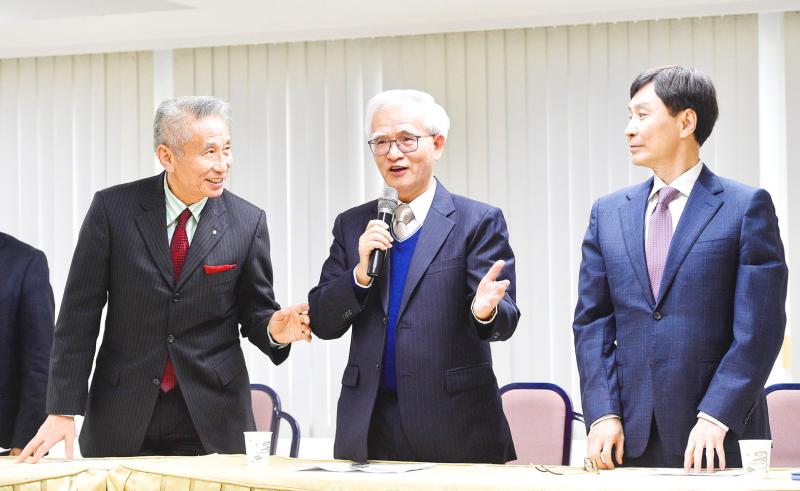
Photo: George Tsorng, Taipei Times
Lu, dubbed the “King of Acquisitions,” last worked at Tatung in 1972 as a purchasing head.
“Within two years, all our subsidiaries will be profitable, within five years, our revenues will stand at NT$100 billion (US$3.5 billion) a year, and by next year, we will be paying our shareholders a dividend,” Lu said of his plan to turn the beleaguered firm around.
It has been more than a decade since Tatung last distributed a dividend, as the once-prominent home appliance giant has tottered amid mismanagement, embezzlement scandals and unsuccessful attempts to branch away from its core business.
For years the company was embroiled in boardroom drama as the “company faction” led by former chairwoman Lin Kuo Wen-yen (林郭文艷) wrestled with the “market faction” led by Shanyuan Group (三圓建設) chairman Wang Kuang-hsiang (王光祥).
However, after Wang prevailed, Lin Kuo remained on the board and was given the title of honorary chairwoman.
“I agreed to take the position because both honorary chairwoman Lin Kuo and Wang asked me,” Lu said. “There is no market faction or company faction now ... only the Tatung faction.”
Lu added that he only intends to remain chairman for three years before handing the position to someone “professional and capable.”
Chung used to serve as president of Hon Hai’s mechatronic components business group.
His experience at the world’s largest electronics maker would help him optimize Tatung, Chung said.
“There are many business practices at Hon Hai that helped us reward high-performing employees and are worthy of consideration, but I am not turning Tatung into Hon Hai, I’m going to optimize Tatung,” he said.
As Tatung’s major shareholder, Wang said that it is time to “activate” Tatung’s considerable land assets, although he was quick to emphasize that “Tatung assets will not turn into Shanyuan assets,” referring to his construction company.
He also pledged not to sell the company’s headquarters in Taipei’s Zhongshan District (中山).
“The land [where the headquarters are situated] is a resource that needs to be developed with care,” Wang said. “The best way to monetize it is to build on it and then rent it out.”

The domestic unit of the Chinese-owned, Dutch-headquartered chipmaker Nexperia BV will soon be able to produce semiconductors locally within China, according to two company sources. Nexperia is at the center of a global tug-of-war over critical semiconductor technology, with a Dutch court in February ordering a probe into alleged mismanagement at the company. The geopolitical tussle has disrupted supply chains, with some carmakers reportedly forced to cut production due to chip shortages. Local production would allow Nexperia’s domestic arm, Nexperia Semiconductors (China) Ltd (安世半導體中國), to bypass restrictions in place since October on the supply of silicon wafers — etched with tiny components to

Singapore-based ride-hailing and delivery giant Grab Holdings Ltd has applied for regulatory approval to acquire the Taiwan operations of Germany-based Delivery Hero SE's Foodpanda in a deal valued at about US$600 million. Grab submitted the filing to the Fair Trade Commission on Friday last week, with the transaction subject to regulatory review and approval, the company said in a statement yesterday. Its independent governance structure would help foster a healthy and competitive market in Taiwan if the deal is approved, Grab said. Grab, which is listed on the NASDAQ, said in the filing that US-based Uber Technologies Inc holds about 13 percent of

Taiwan Semiconductor Manufacturing Co (TSMC, 台積電) yesterday received government approval to deploy its advanced 3-nanometer (3nm) process at its second fab currently under construction in Japan, the Ministry of Economic Affairs said in a news release. The ministry green-lit the plan for the facility in Kumamoto, which is scheduled to start installing equipment and come online in 2028 with a monthly production capacity of 15,000 12-inch wafers, the ministry said. The Department of Investment Review in June 2024 authorized a US$5.26 billion investment for the facility, slated to manufacture 6- to 12nm chips, significantly less advanced than 3nm process. At a meeting with

Taiwan’s food delivery market could undergo a major shift if Singapore-based Grab Holdings Ltd completes its planned acquisition of Delivery Hero SE’s Foodpanda business in Taiwan, industry experts said. Grab on Monday last week announced it would acquire Foodpanda’s Taiwan operations for US$600 million. The deal is expected to be finalized in the second half of this year, with Grab aiming to complete user migration to its platform by the first half of next year. A duopoly between Uber Eats and Foodpanda dominates Taiwan’s delivery market, a structure that has remained intact since the Fair Trade Commission (FTC) blocked Uber Technologies Inc’s


 RSS
RSS