


The nation’s initial public offering (IPO) activity is set to rebound next year after taking a hit from the COVID-19 pandemic this year, with technology and biotech companies expected to dominate the market, consulting firm Ernst & Young (EY) Taiwan said yesterday.
As of yesterday, there had been 10 IPOs in the nation that raised a total of NT$6.74 billion (US$236.3 million) this year, Ernst & Young Taiwan assurance head Lin Tu (涂嘉玲) told a media briefing.
That represented a 33 percent decline from last year in terms of IPOs and a 71.1 percent slump by measure of the capital raised, Tu said, attributing the lackluster performance to the COVID-19 pandemic, even though Taiwan has effectively controlled the outbreak.
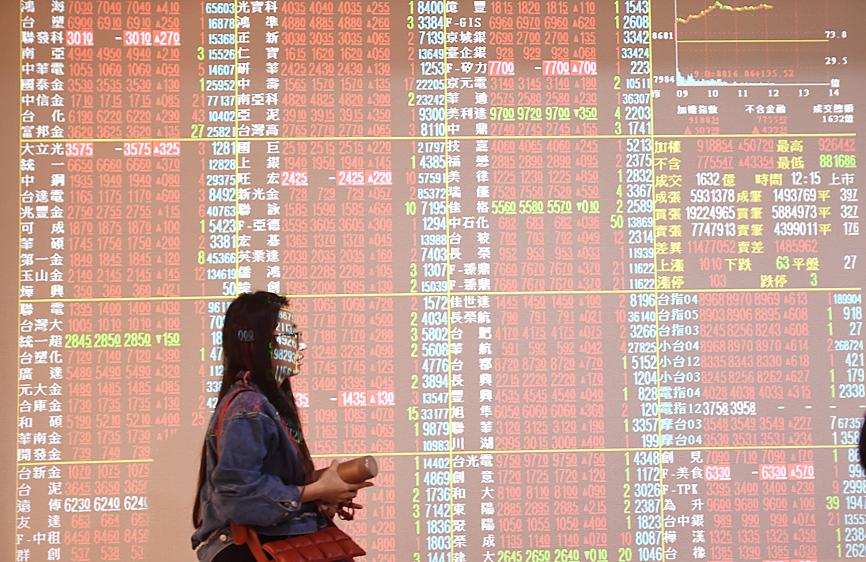
Photo: Liu Hsin-de, Taipei Times
Three companies, including VIA Labs Inc (威鋒電子), are poised for primary listing on local bourses this month, Tu said, adding that the overall showing might improve.
The number of IPOs on the Taipei Exchange dropped 20 percent from 20 last year to 16 as of yesterday, but they raised 27.8 percent more capital, thanks to a flush of liquidity that repeatedly drove the TAIEX to record highs and might continue to lend support, Tu said.
The number of IPOs could reach 50 next year, as 18 firms have already filed applications and could win listing approval next quarter, Tu said.
The Financial Supervisory Commission (FSC) has unveiled plans to create two new boards that feature companies with innovative ideas, operations or business models, but lack financial resources to demonstrate their business potential and profitability.
FSC Chairman Thomas Huang (黃天牧) has set a goal of listing 10 companies on the respective boards that would be launched in the third quarter of next year to help Taiwan identify and groom its own unicorn companies — those valued at more than US$1 billion.
The effort, coupled with an economic recovery at home and around the world, would make 50 IPOs achievable next year, Tu said, adding that technology and biotech companies would continue to be the main participants as in the past few years.
An environment of monetary easing is favorable for the capital markets, Tu said, calling the average price-to-earnings ratios of 21 times for shares listed on the Taiwan Stock Exchange and 27 times for those on the Taipei Exchange “reasonable.”
Taiwanese companies have benefited from the pandemic, which has created unprecedented demand for devices used for remote working and schooling.
Positive vaccine results would speed up the global economic recovery and boost IPO activity, Tu said.
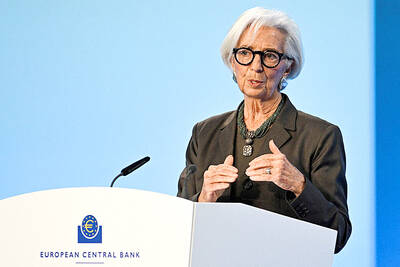
European Central Bank (ECB) President Christine Lagarde is expected to step down from her role before her eight-year term ends in October next year, the Financial Times reported. Lagarde wants to leave before the French presidential election in April next year, which would allow French President Emmanuel Macron and German Chancellor Friedrich Merz to find her replacement together, the report said, citing an unidentified person familiar with her thoughts on the matter. It is not clear yet when she might exit, the report said. “President Lagarde is totally focused on her mission and has not taken any decision regarding the end of
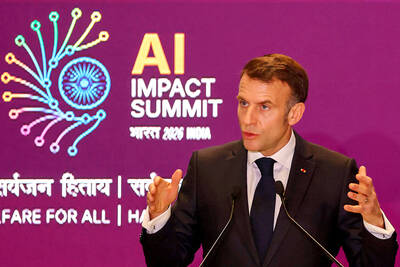
French President Emmanuel Macron told a global artificial intelligence (AI) summit in India yesterday he was determined to ensure safe oversight of the fast-evolving technology. The EU has led the way for global regulation with its Artificial Intelligence Act, which was adopted in 2024 and is coming into force in phases. “We are determined to continue to shape the rules of the game... with our allies such as India,” Macron said in New Delhi. “Europe is not blindly focused on regulation — Europe is a space for innovation and investment, but it is a safe space.” The AI Impact Summit is the fourth
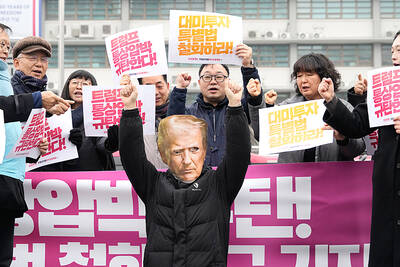
CONFUSION: Taiwan, Japan and other big exporters are cautiously monitoring the situation, while analysts said more Trump responses ate likely after his loss in court US trading partners in Asia started weighing fresh uncertainties yesterday after President Donald Trump vowed to impose a new tariff on imports, hours after the Supreme Court struck down many of the sweeping levies he used to launch a global trade war. The court’s ruling invalidated a number of tariffs that the Trump administration had imposed on Asian export powerhouses from China and South Korea to Japan and Taiwan, the world’s largest chip maker and a key player in tech supply chains. Within hours, Trump said he would impose a new 10 percent duty on US imports from all countries starting on
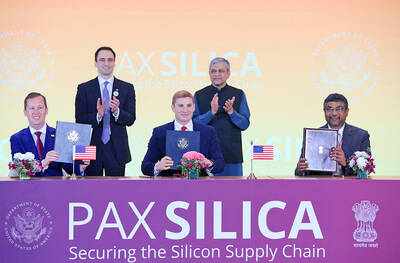
STRATEGIC ALLIANCE: The initiative is aimed at protecting semiconductor supply chain resilience to reduce dependence on China-dominated manufacturing hubs India yesterday joined a US-led initiative to strengthen technology cooperation among strategic allies in a move that underscores the nations’ warming ties after a brief strain over New Delhi’s unabated purchase of discounted Russian oil. The decision aligns India closely with Washington’s efforts to build secure supply chains for semiconductors, advanced manufacturing and critical technologies at a time when geopolitical competition with China is intensifying. It also signals a reset in relations following friction over energy trade and tariffs. Nations that have joined the Pax Silica framework include Japan, South Korea, the UK and Israel. “Pax Silica will be a group of nations


 RSS
RSS