


The Bank of Japan (BOJ) yesterday unveiled a plan to probe more effective ways to achieve its 2 percent inflation target, following in the foot steps of its US and European counterparts as a renewed spike in inflections threatened to derail a fragile recovery.
As widely expected, the central bank kept monetary policy steady and extended by six months a range of measures aimed at easing funding strains of companies hit by COVID-19.
“Given the economy and prices are projected to remain under downward pressure for a prolonged period due to the impact of COVID-19, the BOJ will conduct an assessment on further effective and sustainable monetary easing,” the central bank said in a statement on its policy decision.
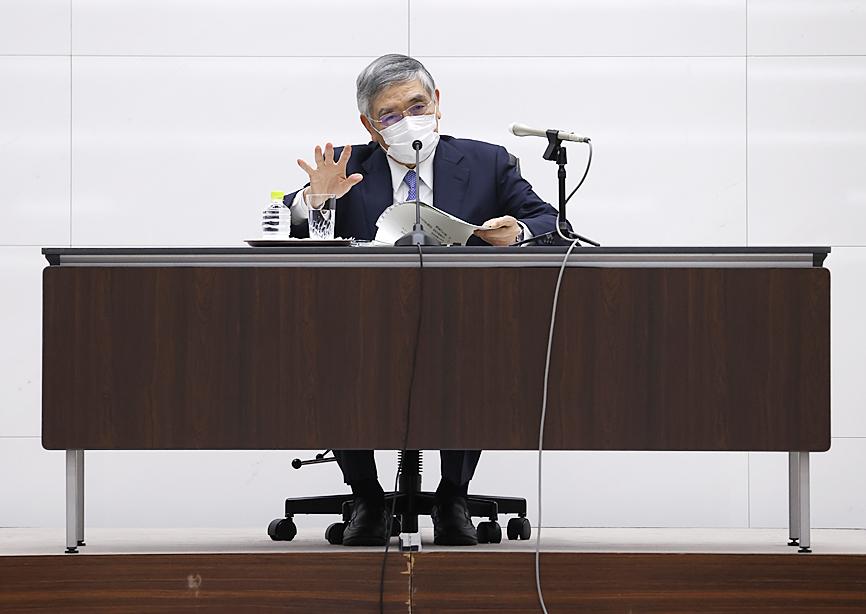
Photo: Bloomberg
The BOJ will announce the findings of the review, which it says will not lead to any changes to its yield curve control framework, in March.
The surprise move underscores the growing concern among BOJ policymakers over the diminishing return and rising cost of prolonged easing, such as the hit to bank profits from years of ultra-low rates, analysts said.
“Today’s surprise was the announcement of its plan to review its monetary easing. That would be in line with recent moves by the European Central Bank [ECB] and the [US] Federal Reserve to examine the course of monetary policy,” Mizuho Securities chief market economist Yasunari Ueno said.
“The BOJ must have thought it would be left behind in the global monetary policy trend if it did not follow suit,” he said.
At the two-day rate review ending yesterday, the BOJ kept intact its yield curve control (YCC) targets of minus-0.1 percent for short-term rates and 0 percent for 10-year bond yields.
With the pandemic still hurting the economy, the central bank decided to extend its fund-aid program, deployed in March through May to deal with the immediate hit from COVID-19, by six months.
The package includes increased purchases of corporate debt and a lending scheme to channel money via banks to small firms.
The BOJ said it is ready to extend the deadline of the package further if needed to support the economy.
Reaction in domestic financial markets was generally subdued.
Japan’s economy rebounded in July-September from its worst postwar contraction in the second quarter, though the third wave of infections is dampening prospects for a strong revival.
The pandemic has added to headaches for major central banks, including the ECB and Fed, which have conducted reviews on how to better battle a protracted low-growth, low-inflation environment with their dwindling policy ammunition.
Having conducted its own comprehensive review of its policy framework in 2016, the BOJ has said there was no need to do another examination, despite missing its 2 percent price goal for years.

Cairo’s new monorail slices across the city skyline, running above the familiar chaos of blaring horns and aging buses’ exhaust fumes that mark rush hour below. The US$4.5 billion monorail, opened this month, is among Egypt’s most prominent new transport projects, part of a debt-funded infrastructure drive criticized for sapping state finances while bringing limited benefits to most of the country’s 109 million people. “It feels like you’re in a different country,” said Ramy Sayed, a restaurant manager, aboard a driverless Innovia 300 train. “No noise, no traffic, we’re not used to this.” The eastern line runs 56km from the bustling middle-class

Taiwanese firms have increased investment in the Philippines in recent years as Manila’s ties with Washington deepen and global supply chains continue to shift away from China, an expert at the Chung-Hua Institution for Economic Research (CIER, 中華經濟研究院) said yesterday. The Philippines had not been among Taiwanese investors’ top choices in Southeast Asia, CIER Taiwan ASEAN Studies Center director Kristy Hsu (徐遵慈) said at a seminar in Taipei. However, Taiwan’s investment in the country has grown significantly since the COVID-19 pandemic, reaching US $257 million last year, a high in recent years, she said. Although Taiwan’s total investment in the Philippines still lags
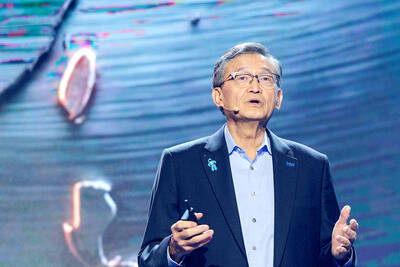
Intel Corp regards Taiwan Semiconductor Manufacturing Co (TSMC, 台積電) as a longstanding partner, as the US chipmaker would continue outsourcing production of advanced chips to TSMC, Intel chief executive officer Lip-Bu Tan (陳立武) said yesterday. “I don’t look at people as competitors. I look at the collaboration... Nvidia is also, you know, a good friend,” Tan told a news conference following his keynote speech at the Computex trade show in Taipei. “It’s a very trusted partnership for us... We are a big, top customer for them, and we’re going to continue doing that,” he said, referring to TSMC, the world’s largest foundry

Artificial intelligence (AI) agents would supplant smartphones as the center of people’s digital lives, fundamentally reshaping personal devices and driving a major computing upgrade cycle, Qualcomm Inc CEO Cristiano Amon said yesterday. In his keynote speech for this year’s Computex trade show in Taipei, Amon said that the rise of "agentic AI" — AI systems capable of reasoning, planning and carrying out tasks autonomously — would transform how people interact with technology across phones, PCs, vehicles and wearable devices. Describing the technology as the next major evolution in computing, Amon said that "2026 is the year of agents.” For decades, smartphones have sat


 RSS
RSS