


Taichung-based Full Wang International Development Co (富旺國際開發) yesterday said that its business outlook remains upbeat for next year, as low interest rates and ample liquidity would continue to support the property market despite the central bank tightening credit controls.
Property development would require twice as much capital after the central bank set the loan-to-value ratios at 50 to 60 percent, from 80 percent previously, Full Wang chairman Lin Cheng-hsiung (林正雄) said.
“The measures would deal a serious blow to small builders and developers without sufficient capital on hand, but that will not affect Full Wang because the company has two earnings engines: developing and selling residential, as well as industrial, properties,” Lin told an online investors’ conference.
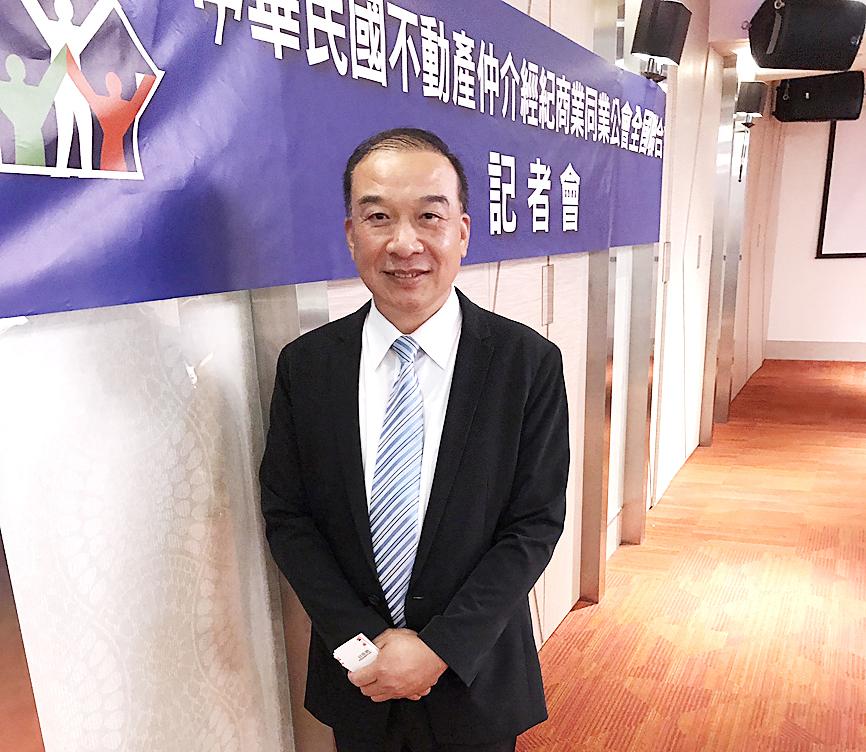
Photo: Hsu Yi-ping, Taipei Times
Sales of residential properties and industrial plots have contributed to 74 and 25 percent of the company’s revenue respectively, Full Wang data showed.
The company has acquired enough land lots to build new properties for the next four years in Taiwan, Lin said.
New residential buildings are being built in central Taichung to take advantage of the forthcoming MRT rail system, and construction is under way at industrial parks in Taoyuan and Kaohsiung to cater to companies that are reshoring, he said.
The company said that it has sold 82 percent of a 172-unit residential complex near the Taichung High Speed Rail Station.
Full Wang expects the operating environment to remain favorable next year, as global central banks would still maintain record-low interest rates and more companies would invest in Taiwan to cope with US-China trade tensions.
Housing transactions next year would likely remain the same as this year at 320,000 units, Lin said.
However, analysts said that it is better to avoid property-related shares that took a hard hit from the central bank’s credit controls.
The sector might continue to underperform, although some companies have reported decent earnings, Capital Investment Management Corp (群益投顧) said.
Full Wang’s net income for the first three quarters fell 65 percent year-on-year to NT$31.15 million (US$1.09 million), or earnings per share of NT$0.2, while cumulative revenue in the first 11 months rose 58.25 percent to NT$2.16 billion.
The company’s shares yesterday closed down 4.72 percent at NT$17.15.
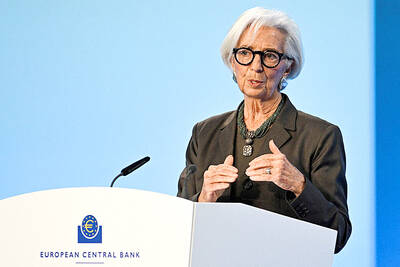
European Central Bank (ECB) President Christine Lagarde is expected to step down from her role before her eight-year term ends in October next year, the Financial Times reported. Lagarde wants to leave before the French presidential election in April next year, which would allow French President Emmanuel Macron and German Chancellor Friedrich Merz to find her replacement together, the report said, citing an unidentified person familiar with her thoughts on the matter. It is not clear yet when she might exit, the report said. “President Lagarde is totally focused on her mission and has not taken any decision regarding the end of
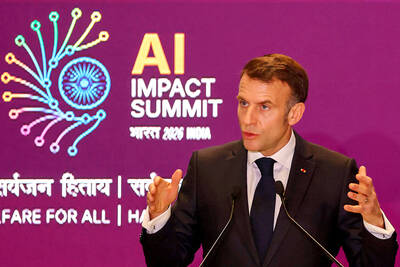
French President Emmanuel Macron told a global artificial intelligence (AI) summit in India yesterday he was determined to ensure safe oversight of the fast-evolving technology. The EU has led the way for global regulation with its Artificial Intelligence Act, which was adopted in 2024 and is coming into force in phases. “We are determined to continue to shape the rules of the game... with our allies such as India,” Macron said in New Delhi. “Europe is not blindly focused on regulation — Europe is a space for innovation and investment, but it is a safe space.” The AI Impact Summit is the fourth
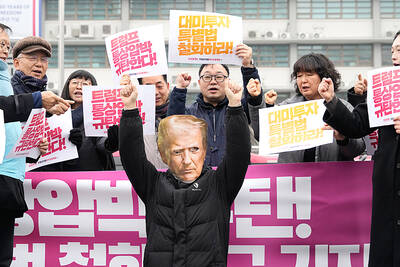
CONFUSION: Taiwan, Japan and other big exporters are cautiously monitoring the situation, while analysts said more Trump responses ate likely after his loss in court US trading partners in Asia started weighing fresh uncertainties yesterday after President Donald Trump vowed to impose a new tariff on imports, hours after the Supreme Court struck down many of the sweeping levies he used to launch a global trade war. The court’s ruling invalidated a number of tariffs that the Trump administration had imposed on Asian export powerhouses from China and South Korea to Japan and Taiwan, the world’s largest chip maker and a key player in tech supply chains. Within hours, Trump said he would impose a new 10 percent duty on US imports from all countries starting on
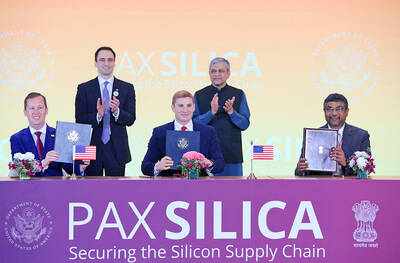
STRATEGIC ALLIANCE: The initiative is aimed at protecting semiconductor supply chain resilience to reduce dependence on China-dominated manufacturing hubs India yesterday joined a US-led initiative to strengthen technology cooperation among strategic allies in a move that underscores the nations’ warming ties after a brief strain over New Delhi’s unabated purchase of discounted Russian oil. The decision aligns India closely with Washington’s efforts to build secure supply chains for semiconductors, advanced manufacturing and critical technologies at a time when geopolitical competition with China is intensifying. It also signals a reset in relations following friction over energy trade and tariffs. Nations that have joined the Pax Silica framework include Japan, South Korea, the UK and Israel. “Pax Silica will be a group of nations


 RSS
RSS