


The Taiwan Stock Exchange (TWSE) and the Taipei Exchange (TPEx) are to launch two new trading boards in July at the earliest to help local and foreign start-ups, as well as biotech companies with great potential, raise capital and gain public awareness, the Financial Supervisory Commission (FSC) said yesterday.
The move is expected to encourage companies that have considered going public on foreign stock exchanges to stay in the home market and is supported by relaxed listing requirements, FSC Chairman Thomas Huang (黃天牧) told a news conference in New Taipei City.
The TWSE would set up the Taiwan Innovation Board (TIB) to welcome start-ups focused on Internet of Things or artificial intelligence, biotech firms that have conducted Phase 1 clinical trial for experimental products, and firms with key component technologies, TWSE president Chien Lih-chung (簡立忠) said.
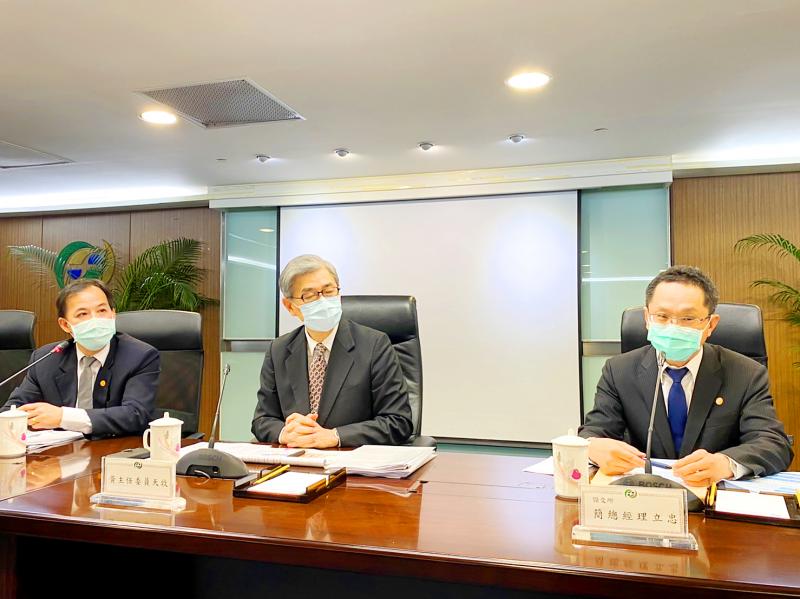
Photo: Kao Shih-ching, Taipei Times
Start-ups applying to list on the TIB would be reviewed primarily by their market capitalization, instead of profitability performance, Chien said, adding that the minimum requirement for market capitalization would be NT$1.5 billion (US$52.32 million).
Biotech firms would not need a recommendation letter from the Ministry of Economic Affairs to list and there would be no revenue requirements, he said.
However, the exchange would favor start-ups that have used the Series C funding process, as they are more mature and their market capitalization has been assessed by professional institutional investors, Chien said.
Examples of candidates that would qualify for the TIB include electric scooter maker Gogoro Inc (睿能創意) and KKBOX (願境網訊), Taiwan’s largest cloud-based music service provider, Chien said.
If the share price of a TIB-listed firm remains below NT$3 for 30 days in a row, they would be delisted, he said.
STRATEGIC BOARD
The TPEX is to launch its Strategic Board, with companies allowed to apply to list if they receive recommendations from two securities brokers, TPEX chief executive officer Edith Lee (李愛玲) said.
Securities brokers would be punished by the TPEX if they help applicants hide information or give false statements in a public prospectus, Lee said.
The two new boards would be limited to institutional investors such as banks and insurance companies, and individuals with net assets of NT$10 million, as they have higher risk tolerance, Securities and Futures Bureau Deputy Director Sam Chang (張振山) said.
The FSC aims to have 10 companies listed on each of the two boards within a year of their launches, Chang said.
After several years flying high as Asia’s best Nvidia Corp proxy, Taiwan Semiconductor Manufacturing Co (TSMC, 台積電) is increasingly vying with other artificial intelligence (AI) stocks for investor attention. Stock traders are chasing a wider array of beneficiaries as mainstream usage of AI creates demand for hardware beyond the most-advanced chips TSMC makes for Nvidia. Subthemes from the deepening memory crunch to advances in robotics are also luring bids. At the same time, investment caps on single stocks are pushing funds to diversify, while retail investors long familiar with TSMC through its US depositary receipts are being offered a broader set of

Netherlands-based semiconductor equipment supplier ASML Holding NV yesterday said that it is planning to hire an additional 1,000 people in Taiwan this year in response to growing demand from clients. ASML had previously planned to recruit 600 people this year, but that the plan has been adjusted upward, ASML vice president and ASML Taiwan general manager Grace Wang (汪佳慧) told reporters. ASML has a workforce of more than 4,500 in Taiwan, accounting for about 10 percent of its global total, Wang said. This year’s recruitment campaign would focus on adding people in the customer support, manufacturing and supply chain domains to assist ASML

UNDER MICROSCOPE: Taiwan detained three people who allegedly conspired to buy servers in Taiwan and export them using fraudulent documentation, prosecutors said Nvidia Corp chief executive officer Jensen Huang (黃仁勳) on Saturday urged Super Micro Computer Inc to tighten up on compliance after Taiwan detained three people this week for allegedly making fraudulent declarations about artificial intelligence (AI) servers made by its US partner. The development marked the nation’s first crackdown on semiconductor smuggling, which grew after the US slapped restrictions on exports of high-end chips such as Nvidia AI accelerators to China. Nvidia is “rigorous” in explaining regulations to all of its partners, Huang told reporters after arriving in Taipei. “Ultimately Super Micro has to run their own company,” he said in response to

Nvidia Corp yesterday announced that CEO Jensen Huang (黃仁勳) would attend an employee meeting in Taipei tomorrow to celebrate the launch of the company’s Taiwan headquarters project. Huang would attend a gathering at the site of Nvidia’s planned headquarters in Beitou Shilin Technology Park (北投士林科技園區), the company said in a statement. After arriving in Taiwan on Saturday last week, Huang told reporters that he plans to meet with Quanta Computer Inc (廣達) chairman Barry Lam (林百里) and Taiwan Semiconductor Manufacturing Co (TSMC, 台積電) chairman C.C. Wei (魏哲家), and would attend the groundbreaking ceremony for Nvidia’s Taiwan headquarters tomorrow. Nvidia has not yet applied


 RSS
RSS