


SinoPac Financial Holdings Co (永豐金控) yesterday said that its banking unit’s profit grew annually in the third quarter of this year, as rising loans with higher interest rates offset the negative impact of interest rate cuts and the COVID-19 pandemic.
At an investors’ conference in Taipei, the conglomerate said that Bank SinoPac’s (永豐銀行) net profit increased 25 percent annually in the third quarter to NT$2.85 billion (US$99.1 million).
In the first two quarters of this year, the banking unit’s net profit fell 15 percent from a year earlier due to less interest income and investment losses caused by market volatility.
Photo: Kelson Wang, Taipei Times
Its net interest income rose 15 percent annually to NT$4.42 billion last quarter, as it focused on loans with higher margins, such as green loans, personal loans and lending to small and medium-sized enterprises (SME).
The outstanding balance of Bank SinoPac’s lending totaled NT$1.15 trillion as of Sept. 30, up 1.2 percent from a quarter earlier and 8 percent from a year earlier, while outstanding SME loans rose 6.7 percent quarterly and 19 percent annually, company data showed.
Its net interest margin, a profitability gauge, rebounded to 1.01 percent as of the end of September, from 0.96 percent at the end of June and 1 percent at the end of March, while its loan-to-deposit ratio stood at 73.1 percent as of Sept. 30, slightly down from 74 percent a quarter earlier, the data showed.
Overall, Bank SinoPac’s cumulative net profit dropped 3.2 percent year-on-year to NT$7.63 billion for the first three quarters, its parent company said.
However, SinoPac Financial’s securities arm, SinoPac Securities Co (永豐金證券), saw its net profit jump 72 percent year-on-year to NT$1.01 billion last quarter, as its capital gains and net fee income increased.
SinoPac Securities reported fee income of NT$2.01 billion last quarter, up 60 percent year-on-year, as more people opened accounts to trade stocks, which boosted SinoPac Financial’s cumulative net fee income to NT$11.12 billion for the first three quarters, up 30 percent from a year earlier and a record high, the company said.
SinoPac Financial’s assets totaled NT$2.03 trillion as of the end of September, the first time it has surpassed NT$2 trillion, company president Stanley Chu (朱士廷) said.
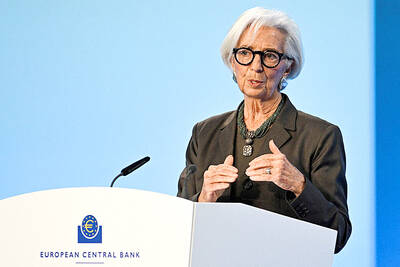
European Central Bank (ECB) President Christine Lagarde is expected to step down from her role before her eight-year term ends in October next year, the Financial Times reported. Lagarde wants to leave before the French presidential election in April next year, which would allow French President Emmanuel Macron and German Chancellor Friedrich Merz to find her replacement together, the report said, citing an unidentified person familiar with her thoughts on the matter. It is not clear yet when she might exit, the report said. “President Lagarde is totally focused on her mission and has not taken any decision regarding the end of
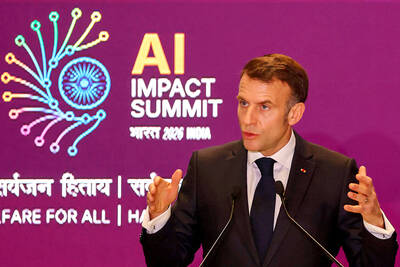
French President Emmanuel Macron told a global artificial intelligence (AI) summit in India yesterday he was determined to ensure safe oversight of the fast-evolving technology. The EU has led the way for global regulation with its Artificial Intelligence Act, which was adopted in 2024 and is coming into force in phases. “We are determined to continue to shape the rules of the game... with our allies such as India,” Macron said in New Delhi. “Europe is not blindly focused on regulation — Europe is a space for innovation and investment, but it is a safe space.” The AI Impact Summit is the fourth
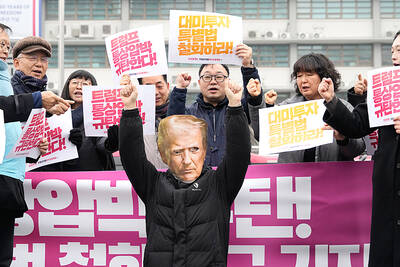
CONFUSION: Taiwan, Japan and other big exporters are cautiously monitoring the situation, while analysts said more Trump responses ate likely after his loss in court US trading partners in Asia started weighing fresh uncertainties yesterday after President Donald Trump vowed to impose a new tariff on imports, hours after the Supreme Court struck down many of the sweeping levies he used to launch a global trade war. The court’s ruling invalidated a number of tariffs that the Trump administration had imposed on Asian export powerhouses from China and South Korea to Japan and Taiwan, the world’s largest chip maker and a key player in tech supply chains. Within hours, Trump said he would impose a new 10 percent duty on US imports from all countries starting on
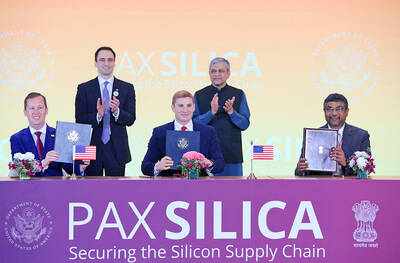
STRATEGIC ALLIANCE: The initiative is aimed at protecting semiconductor supply chain resilience to reduce dependence on China-dominated manufacturing hubs India yesterday joined a US-led initiative to strengthen technology cooperation among strategic allies in a move that underscores the nations’ warming ties after a brief strain over New Delhi’s unabated purchase of discounted Russian oil. The decision aligns India closely with Washington’s efforts to build secure supply chains for semiconductors, advanced manufacturing and critical technologies at a time when geopolitical competition with China is intensifying. It also signals a reset in relations following friction over energy trade and tariffs. Nations that have joined the Pax Silica framework include Japan, South Korea, the UK and Israel. “Pax Silica will be a group of nations


 RSS
RSS