


The number of manufacturers seeking COVID-19-related government assistance declined sharply in the third quarter thanks to improving exports, Minister of Economic Affairs Wang Mei-Hua (王美花) said yesterday.
Speaking before a meeting in the Legislative Yuan’s Economics Committee, Wang said that while there is “sharp improvement” in the manufacturing sector, the conference and exhibition industry still needs government support, probably through the first quarter of next year.
“We predict that the conference and exhibition industry will continue to be affected by the COVID-19 conditions worldwide,” Wang said.
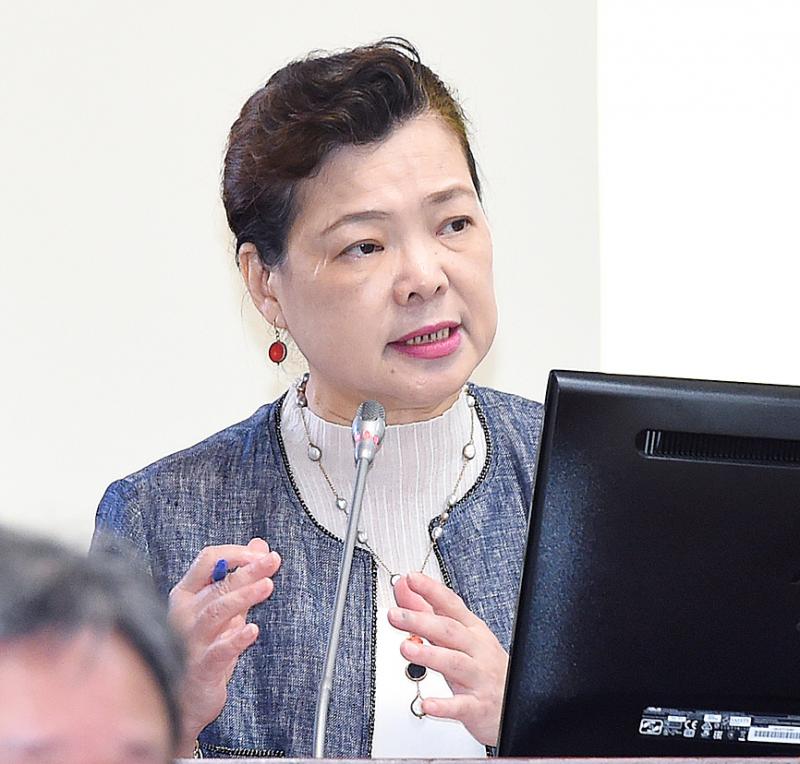
Photo: Liao Chen-huei, Taipei Times
“If we have money left over from stimulus programs, we will use them in the first quarter of 2021 to keep supporting this industry,” she added.
The ministry has been supporting local businesses affected by the COVID-19 pandemic by subsidizing their wages and operating expenses.
The first two waves of government relief covered all businesses, but “Stimulus 3.0” assistance, which started in September, was limited to manufacturing and the conference and exhibition sectors, while retail and restaurants recovered thanks to competent disease prevention measures.
With improving exports, some funds remain of the NT$15.6 billion (US$542.46 million) relief budget earmarked for the third quarter, the ministry said, adding that another NT$15.6 billion is earmarked for the fourth quarter.
“The ministry just began to accept applications for fourth-quarter assistance on Nov. 16, so we don’t know if there will be funds leftover — but we are optimistic,” Wang said.
Under the terms of the relief package, the ministry would subsidize up to 40 percent of companies’ full-time payroll, with a cap of NT$20,000 per month per employee.
The companies would also receive a one-time payment of NT$10,000 per full-time employee, unless they have received a similar payment under a previous stimulus program.
To be eligible, publicly traded companies must have negative earnings per share in the first half of the year or in the third quarter.
If there is money left in the program, support for the conference and exhibition industry would continue in accordance with the same terms in the first quarter of next year, she said, adding that the ministry would ask for more funds from the Executive Yuan if necessary.
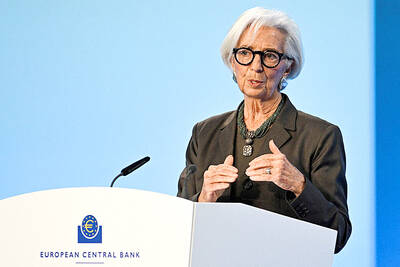
European Central Bank (ECB) President Christine Lagarde is expected to step down from her role before her eight-year term ends in October next year, the Financial Times reported. Lagarde wants to leave before the French presidential election in April next year, which would allow French President Emmanuel Macron and German Chancellor Friedrich Merz to find her replacement together, the report said, citing an unidentified person familiar with her thoughts on the matter. It is not clear yet when she might exit, the report said. “President Lagarde is totally focused on her mission and has not taken any decision regarding the end of
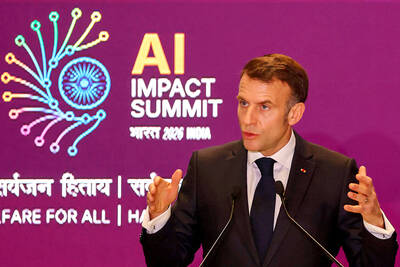
French President Emmanuel Macron told a global artificial intelligence (AI) summit in India yesterday he was determined to ensure safe oversight of the fast-evolving technology. The EU has led the way for global regulation with its Artificial Intelligence Act, which was adopted in 2024 and is coming into force in phases. “We are determined to continue to shape the rules of the game... with our allies such as India,” Macron said in New Delhi. “Europe is not blindly focused on regulation — Europe is a space for innovation and investment, but it is a safe space.” The AI Impact Summit is the fourth
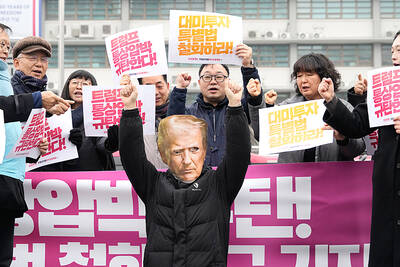
CONFUSION: Taiwan, Japan and other big exporters are cautiously monitoring the situation, while analysts said more Trump responses ate likely after his loss in court US trading partners in Asia started weighing fresh uncertainties yesterday after President Donald Trump vowed to impose a new tariff on imports, hours after the Supreme Court struck down many of the sweeping levies he used to launch a global trade war. The court’s ruling invalidated a number of tariffs that the Trump administration had imposed on Asian export powerhouses from China and South Korea to Japan and Taiwan, the world’s largest chip maker and a key player in tech supply chains. Within hours, Trump said he would impose a new 10 percent duty on US imports from all countries starting on
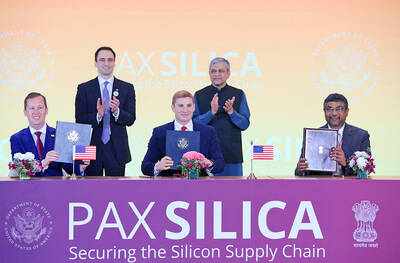
STRATEGIC ALLIANCE: The initiative is aimed at protecting semiconductor supply chain resilience to reduce dependence on China-dominated manufacturing hubs India yesterday joined a US-led initiative to strengthen technology cooperation among strategic allies in a move that underscores the nations’ warming ties after a brief strain over New Delhi’s unabated purchase of discounted Russian oil. The decision aligns India closely with Washington’s efforts to build secure supply chains for semiconductors, advanced manufacturing and critical technologies at a time when geopolitical competition with China is intensifying. It also signals a reset in relations following friction over energy trade and tariffs. Nations that have joined the Pax Silica framework include Japan, South Korea, the UK and Israel. “Pax Silica will be a group of nations


 RSS
RSS