


Taiwan’s economy is forecast to grow 1.99 percent this year and further expand by 3.33 percent next year, Australia and New Zealand Banking Group (ANZ) said yesterday, as the nation has fully emerged from the COVID-19 pandemic.
“Taiwan has come out of the virus shock after clocking 3.3 percent growth last quarter, meaning its economy has recovered to the pre-pandemic level,” the foreign banking group said.
The impressive showing merited a growth upgrade of 0.8 percentage points from its previous forecast for this year, but it masked a diverging path for its two growth engines — external demand and domestic consumption, ANZ said.
From January to September, private consumption contracted 2.67 percent from a year earlier, while net external demand expanded 9.15 percent, it said, citing government statistics.
Private consumption accounts for half of GDP, and its growth rate has stayed at about 2 to 3 percent in the past five years, ANZ said.
More than half of private consumption is spent on housing, utilities, food, transport, restaurants and hotels, it said.
Taiwan has not imposed lockdowns to curb virus infections, but travel restrictions and the absence of foreign tourists slowed some sectors, it said.
On the other hand, the pandemic has been a tailwind for exports of technology products, such as chips, camera lenses, touch panels, battery packs, casings, printed circuit boards and passive components.
The launches of 5G-enabled devices by global technology brands placed Taiwan’s high-end fabrication facilities at the center of tech-driven gains, it said.
Additionally, remote-working requirements boosted demand for computers and related applications, it said.
The twists present Taiwanese policymakers with a unique challenge as they seek to support the economy, ANZ said.
Inflation has been structurally low for nearly a decade, given that the core consumer price index has not risen above the 2 percent target since 2010, it said.
The consumer price index has been in negative territory for the past nine months.
The government has rolled out fiscal packages and the central bank has cut its policy rate to an all-time low, ANZ said.
The tech sector’s solid performance has driven up the local currency against the US dollar and its recent appreciation to its highest level since 2011 is adding disinflationary pressure, the bank said.
Taiwan needs structural measures to address this dual-track economic path, as weak private consumption and structurally low inflation are concerning, it said.
Policymakers will need to focus on structural measures, instead of conventional stimulus, to tackle the challenge, it said.

DAMAGE REPORT: Global central banks are assessing war-driven inflation risks as the law of unintended consequences careens around the world, spiking oil prices Central banks from Washington to London and from Jakarta to Taipei are about to make their first assessments of economic damage after more than two weeks of conflict between the US and Iran. Decisions this week encompassing every member of the G7 and eight of the world’s 10 most-traded currency jurisdictions are likely to confirm to investors that the specter of a new inflation shock is already worrying enough to prompt heightened caution. The US Federal Reserve is widely expected to do exactly what everyone anticipated weeks ahead of its March 17-18 policy gathering: hold rates steady. The narrative surrounding that
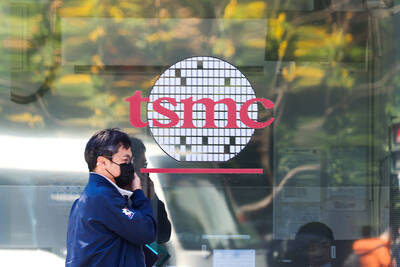
Taiwan Semiconductor Manufacturing Co’s (TSMC, 台積電) share of the global foundry market rose to almost 70 percent last year amid booming demand for artificial intelligence (AI), market information advisory firm TrendForce Corp (集邦科技) said on Thursday. The contract chipmaker posted US$122.54 billion in revenue, up 36.1 percent from a year earlier, accounting for 69.9 percent of the global market, TrendForce said. Its share was up from 64.4 percent in 2024, it said. TSMC’s closest rival, Samsung Electronics, was a distant second, posting US$12.63 billion in sales, down 3.9 percent from a year earlier, for a 7.2 percent share of the global market. In the

At a massive shipyard in North Vancouver, Canadian workers grind metal beams for a powerful new icebreaker crucial to cementing the country’s presence in the increasingly contested arctic. Icebreakers are specialized, expensive vessels able to navigate in the frozen far north. And “this is the crown jewel,” said Eddie Schehr, vice president of production at the Seaspan shipyard. For Canadian Prime Minister Mark Carney, who heads to Norway next Friday to observe arctic defense drills involving troops from 14 NATO states, Canada’s extreme north has emerged as a strategic priority. “Canada is and forever will be an Arctic nation,” he said ahead of

Chinese entrepreneur Frank Gao used to spend long hours running his social media accounts but now outsources the chore to artificial intelligence (AI) agent tool OpenClaw, which is taking China by storm despite official warnings over cybersecurity. OpenClaw, created in November by an Austrian coder, differs from bots such as ChatGPT because it can execute real-life tasks such as sending e-mails, organizing files or even booking flight tickets. “Since January, I’ve spent hours on the lobster every day,” Gao said in an interview, referring to OpenClaw’s red crustacean mascot. “We’re family.” After downloading OpenClaw, users connect it to artificial intelligence models of their


 RSS
RSS