


Medigen Vaccine Biologics Corp (高端疫苗) yesterday said it would be ready to manufacture 20 million doses of its experimental COVID-19 vaccine next year if it gains emergency use authorization from the government by June.
“That would be our maximum annual vaccine production capacity at our cell-culture manufacturing facility with GMP certification in Hsinchu,” Medigen spokesman Leo Lee (李思賢) told the Taipei Times by telephone.
Twenty million doses would be enough to vaccinate 10 million people, as each person would need two doses, Lee said.
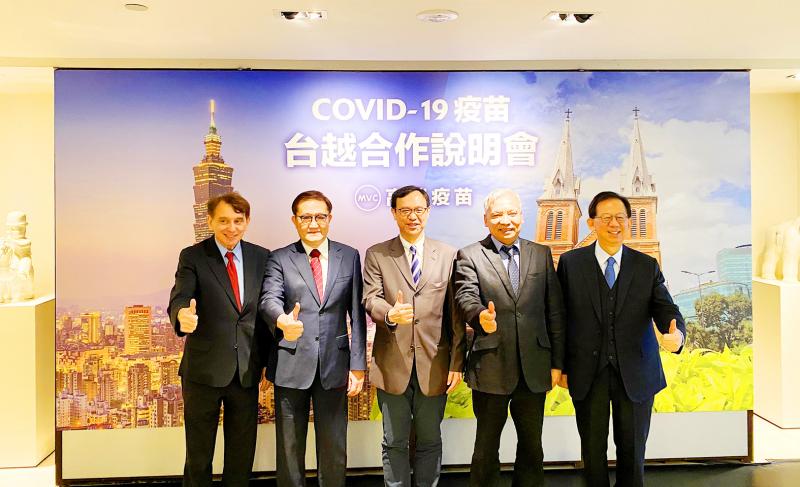
Photo: CNA
Medigen on Friday signed a memorandum of understanding with Vietnam’s National Institute of Hygiene and Epidemiology to provide 3 million to 10 million vaccine doses to help Vietnam fight the COVID-19 pandemic, the company told a news conference in Taipei on Monday.
According to the memorandum, the phase 2 trial of Medigen’s COVID-19 vaccine would begin early next year and include 3,000 participants in Taiwan and Vietnam, Medigen chief executive officer Charles Chen (陳燦堅) told the news conference.
Lee yesterday said the phase 2 trial would be conducted simultaneously in Taiwan and Vietnam, and participants would include at least 1,300 in Taiwan.
The company plans to apply to the Food and Drug Administration and the Vietnamese regulator next month, he added.
Although the pandemic has been controlled in Taiwan, vaccines and drugs are deemed essential in fighting the disease. Some locally developed vaccine candidates, including those by Medigen, Adimmune Corp (國光生技) and United Biomedical Inc (聯亞生技), have undergone phase 1 human trials.
Medigen has enrolled 45 participants aged 20 to 50 for its phase 1 trial in Taiwan.
They have been divided into three groups that receive low, medium or high doses, the company said.
“We have not seen any serious adverse reactions among the enrolled people,” Lee said.
The company’s decision to expand the scope of its human trials in Vietnam follows its ongoing phase 3 trials for its enterovirus 71 vaccine there, which has laid a firm foundation, Lee said.
There are also strong trade ties between Taiwan and Vietnam, where many Taiwanese companies operate, he said.
In related news, TTY Biopharm Co (台灣東洋藥品) yesterday said it has terminated a bid to gain Bio-NTech SE’s authorization to sell its mRNA-based COVID-19 vaccine in Taiwan.
TTY Biopharm last month announced its intention to negotiate with Bio-NTech over the mRNA-based vaccine, but said that the two sides had failed to reach an agreement on the authorization terms, the company said in a filing with the Taiwan Stock Exchange.
The company did not elaborate.

Singapore-based ride-hailing and delivery giant Grab Holdings Ltd has applied for regulatory approval to acquire the Taiwan operations of Germany-based Delivery Hero SE's Foodpanda in a deal valued at about US$600 million. Grab submitted the filing to the Fair Trade Commission on Friday last week, with the transaction subject to regulatory review and approval, the company said in a statement yesterday. Its independent governance structure would help foster a healthy and competitive market in Taiwan if the deal is approved, Grab said. Grab, which is listed on the NASDAQ, said in the filing that US-based Uber Technologies Inc holds about 13 percent of

The domestic unit of the Chinese-owned, Dutch-headquartered chipmaker Nexperia BV will soon be able to produce semiconductors locally within China, according to two company sources. Nexperia is at the center of a global tug-of-war over critical semiconductor technology, with a Dutch court in February ordering a probe into alleged mismanagement at the company. The geopolitical tussle has disrupted supply chains, with some carmakers reportedly forced to cut production due to chip shortages. Local production would allow Nexperia’s domestic arm, Nexperia Semiconductors (China) Ltd (安世半導體中國), to bypass restrictions in place since October on the supply of silicon wafers — etched with tiny components to

Taiwan Semiconductor Manufacturing Co (TSMC, 台積電) yesterday received government approval to deploy its advanced 3-nanometer (3nm) process at its second fab currently under construction in Japan, the Ministry of Economic Affairs said in a news release. The ministry green-lit the plan for the facility in Kumamoto, which is scheduled to start installing equipment and come online in 2028 with a monthly production capacity of 15,000 12-inch wafers, the ministry said. The Department of Investment Review in June 2024 authorized a US$5.26 billion investment for the facility, slated to manufacture 6- to 12nm chips, significantly less advanced than 3nm process. At a meeting with

Taiwan’s food delivery market could undergo a major shift if Singapore-based Grab Holdings Ltd completes its planned acquisition of Delivery Hero SE’s Foodpanda business in Taiwan, industry experts said. Grab on Monday last week announced it would acquire Foodpanda’s Taiwan operations for US$600 million. The deal is expected to be finalized in the second half of this year, with Grab aiming to complete user migration to its platform by the first half of next year. A duopoly between Uber Eats and Foodpanda dominates Taiwan’s delivery market, a structure that has remained intact since the Fair Trade Commission (FTC) blocked Uber Technologies Inc’s


 RSS
RSS