


State-run First Financial Holding Co (第一金控) plans to boost lending to small and medium-sized enterprises (SMEs) to support the government’s policy, newly installed chairwoman Chiou Ye-chin (邱月琴) said yesterday.
Chiou made known her intentions after taking over the chairmanship at the bank-focused conglomerate.
The position had been vacant since July after Jason Liao (廖燦昌) stepped down amid allegations that he pressured bank executives to approve loans to the now-defunct Far Eastern Air Transport Corp (遠東航空) against their professional judgement during his stint in 2009 as Taiwan Cooperative Bank (合庫銀行) chairman, prosecutors said at the time.
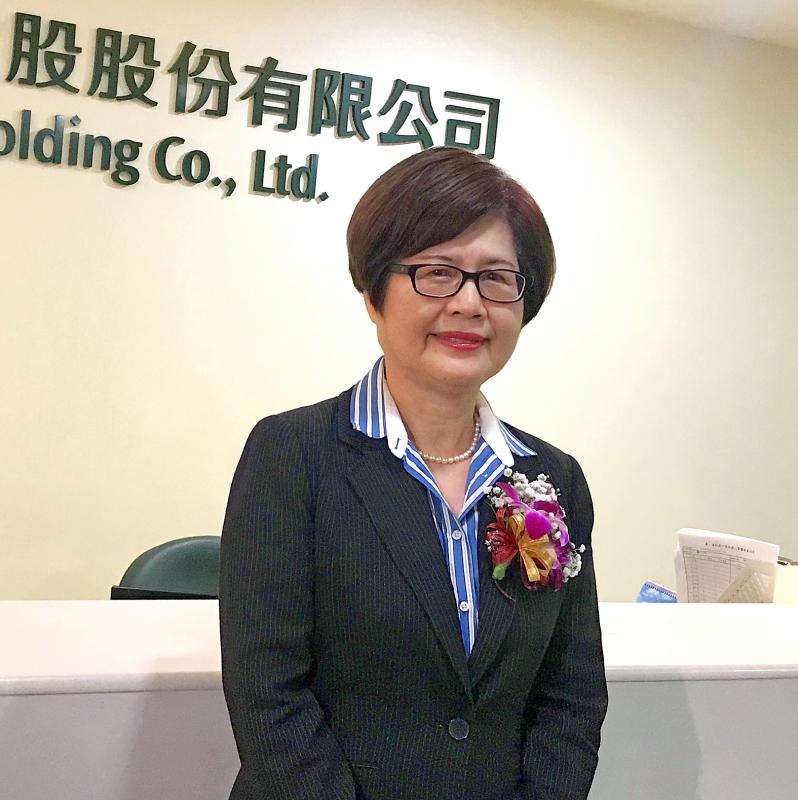
Photo: Chen Mei-ying, Taipei Times
Chiou, a former president at state-owned Bank of Taiwan (台灣銀行), said that under her leadership, First Financial would seek to emulate Mega Financial Holding Co (兆豐金控), the most profitable state-run financial conglomerate.
Toward that aim, First Financial would strengthen ties with small and medium-sized enterprises, an area in which Chiou has demonstrated professional prowess while working at the Bank of Taiwan.
First Financial would also facilitate expansion in Southeast Asian markets where Taiwanese businesspeople are building up a presence to take advantage of the region’s fast-growing economy and cope with US-China trade tensions, Chiou said.
First Financial would not rule out merger and acquisition opportunities to grow its assets after losing the competition for Prudential Life Insurance Co of Taiwan (保德信人壽) to Taishin Financial Holding Co (台新金控) in August, Chiou said.
It would groom talent and step up legal compliance while pursuing profit growth against industry headwinds from the COVID-19 pandemic, she said.
With a bachelor’s degree in economics from National Taiwan University, Chiou has served at different positions at Bank of Taiwan for the past 37 years.
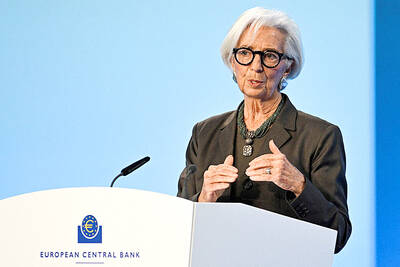
European Central Bank (ECB) President Christine Lagarde is expected to step down from her role before her eight-year term ends in October next year, the Financial Times reported. Lagarde wants to leave before the French presidential election in April next year, which would allow French President Emmanuel Macron and German Chancellor Friedrich Merz to find her replacement together, the report said, citing an unidentified person familiar with her thoughts on the matter. It is not clear yet when she might exit, the report said. “President Lagarde is totally focused on her mission and has not taken any decision regarding the end of
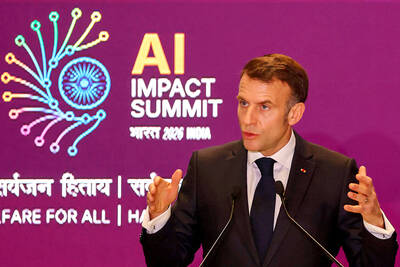
French President Emmanuel Macron told a global artificial intelligence (AI) summit in India yesterday he was determined to ensure safe oversight of the fast-evolving technology. The EU has led the way for global regulation with its Artificial Intelligence Act, which was adopted in 2024 and is coming into force in phases. “We are determined to continue to shape the rules of the game... with our allies such as India,” Macron said in New Delhi. “Europe is not blindly focused on regulation — Europe is a space for innovation and investment, but it is a safe space.” The AI Impact Summit is the fourth
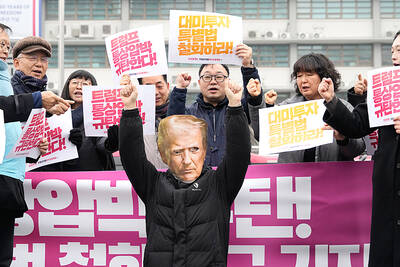
CONFUSION: Taiwan, Japan and other big exporters are cautiously monitoring the situation, while analysts said more Trump responses ate likely after his loss in court US trading partners in Asia started weighing fresh uncertainties yesterday after President Donald Trump vowed to impose a new tariff on imports, hours after the Supreme Court struck down many of the sweeping levies he used to launch a global trade war. The court’s ruling invalidated a number of tariffs that the Trump administration had imposed on Asian export powerhouses from China and South Korea to Japan and Taiwan, the world’s largest chip maker and a key player in tech supply chains. Within hours, Trump said he would impose a new 10 percent duty on US imports from all countries starting on
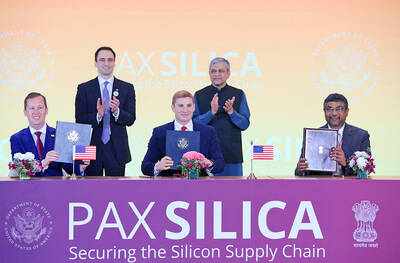
STRATEGIC ALLIANCE: The initiative is aimed at protecting semiconductor supply chain resilience to reduce dependence on China-dominated manufacturing hubs India yesterday joined a US-led initiative to strengthen technology cooperation among strategic allies in a move that underscores the nations’ warming ties after a brief strain over New Delhi’s unabated purchase of discounted Russian oil. The decision aligns India closely with Washington’s efforts to build secure supply chains for semiconductors, advanced manufacturing and critical technologies at a time when geopolitical competition with China is intensifying. It also signals a reset in relations following friction over energy trade and tariffs. Nations that have joined the Pax Silica framework include Japan, South Korea, the UK and Israel. “Pax Silica will be a group of nations


 RSS
RSS