


Vaccine maker Adimmune Corp (國光生技) yesterday tried to allay investors’ concerns about rising risks from flu vaccinations after seven people died after receiving a flu shot, saying there is no direct link between the vaccine and deaths.
Among the seven who passed away a few days after being vaccinated earlier last month, four of them received vaccines made by Sanofi SA, two by Adimmune and one by TTY Biopharm Co (台灣東洋藥品), the Centers for Disease Control (CDC) said.
As of Friday, 192 claims of adverse reactions to flu shots had been reported to the CDC, including 116 cases in which people received a flu shot manufactured by Adimmiune, the center said.

Photo: CNA
“The CDC’s advisory specialist panel has preliminarily determined that the causes of the deaths were likely the people’s underlying health conditions,” Adimmune spokesman Pan Fei (潘飛) told the Taipei Times by telephone.
“From our point of view, given that some of the seven died of cardiovascular complications, such as myocardial infarction, and that our egg-based flu vaccine is an inactivated vaccine, in which the virus has been disrupted by a detergent, it seems unlikely that our flu vaccines are to blame for the incidents,” Pan said.
The deaths have raised public concern, with many wondering if they should still take flu vaccines if they have health conditions or chronic diseases.
“We used to warn people allergic to the ingredients in the vaccines, such as egg allergies, not to get flu shots, in addition to those who have experienced serious adverse reactions after being vaccinated or those who have a fever. Now, we urge people to talk to doctors first before getting a flu shot,” Pan said.
Adimmune has supplied the government with 3.7 million flu vaccines for this year — or 60 percent of all government-funded flu shots — but the ratio of people having an adverse reaction to the vaccine is very low at 116 cases, he added.
Adimmune yesterday reported record-high sales of NT$614 million (US$21.24 million) for last month, 2.75 times higher than a year earlier.
Revenue received a boost as the firm last month booked sales from all 3.7 million flu vaccines, Pan said, adding that it finished supplying all the vaccines to the government last month as people urgently wanted to get them.
For the first 10 months of the year, its revenue surged 98 percent year-on-year to NT$1.66 billion.
The company reported a net loss of NT$159 million for the first six months of the year, or a loss per share of NT$0.41, company data showed.
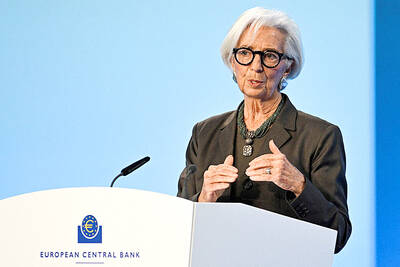
European Central Bank (ECB) President Christine Lagarde is expected to step down from her role before her eight-year term ends in October next year, the Financial Times reported. Lagarde wants to leave before the French presidential election in April next year, which would allow French President Emmanuel Macron and German Chancellor Friedrich Merz to find her replacement together, the report said, citing an unidentified person familiar with her thoughts on the matter. It is not clear yet when she might exit, the report said. “President Lagarde is totally focused on her mission and has not taken any decision regarding the end of

French President Emmanuel Macron told a global artificial intelligence (AI) summit in India yesterday he was determined to ensure safe oversight of the fast-evolving technology. The EU has led the way for global regulation with its Artificial Intelligence Act, which was adopted in 2024 and is coming into force in phases. “We are determined to continue to shape the rules of the game... with our allies such as India,” Macron said in New Delhi. “Europe is not blindly focused on regulation — Europe is a space for innovation and investment, but it is a safe space.” The AI Impact Summit is the fourth
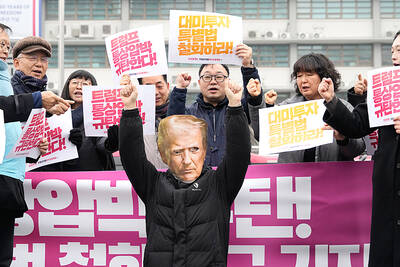
CONFUSION: Taiwan, Japan and other big exporters are cautiously monitoring the situation, while analysts said more Trump responses ate likely after his loss in court US trading partners in Asia started weighing fresh uncertainties yesterday after President Donald Trump vowed to impose a new tariff on imports, hours after the Supreme Court struck down many of the sweeping levies he used to launch a global trade war. The court’s ruling invalidated a number of tariffs that the Trump administration had imposed on Asian export powerhouses from China and South Korea to Japan and Taiwan, the world’s largest chip maker and a key player in tech supply chains. Within hours, Trump said he would impose a new 10 percent duty on US imports from all countries starting on
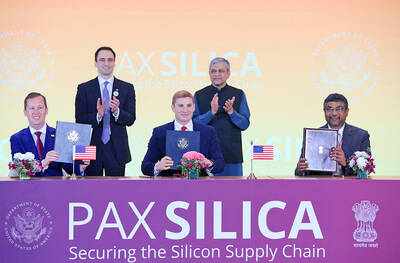
STRATEGIC ALLIANCE: The initiative is aimed at protecting semiconductor supply chain resilience to reduce dependence on China-dominated manufacturing hubs India yesterday joined a US-led initiative to strengthen technology cooperation among strategic allies in a move that underscores the nations’ warming ties after a brief strain over New Delhi’s unabated purchase of discounted Russian oil. The decision aligns India closely with Washington’s efforts to build secure supply chains for semiconductors, advanced manufacturing and critical technologies at a time when geopolitical competition with China is intensifying. It also signals a reset in relations following friction over energy trade and tariffs. Nations that have joined the Pax Silica framework include Japan, South Korea, the UK and Israel. “Pax Silica will be a group of nations


 RSS
RSS