


Yang Ming Marine Transport Corp (陽明海運) plans to prioritize boosting its profitability over expanding its fleet size, chairman and CEO Cheng Chen-mount (鄭貞茂) said yesterday, adding that the firm would seek to attract foreign institutional investors with healthy financial portfolios.
Among local container shippers, Yang Ming ranks second by fleet size, with 90 vessels and an operating capacity of 621,951 twenty-foot-equivalent units (TEUs) — only Evergreen Marine Corp (長榮海運), with its 190 vessels and 1.25 million TEUs, ranks higher, the companies’ data showed.
Yang Ming has secured a 2.6 percent share of the world’s liner fleet, data compiled by Alphaliner, a France-based maritime consultant, showed.
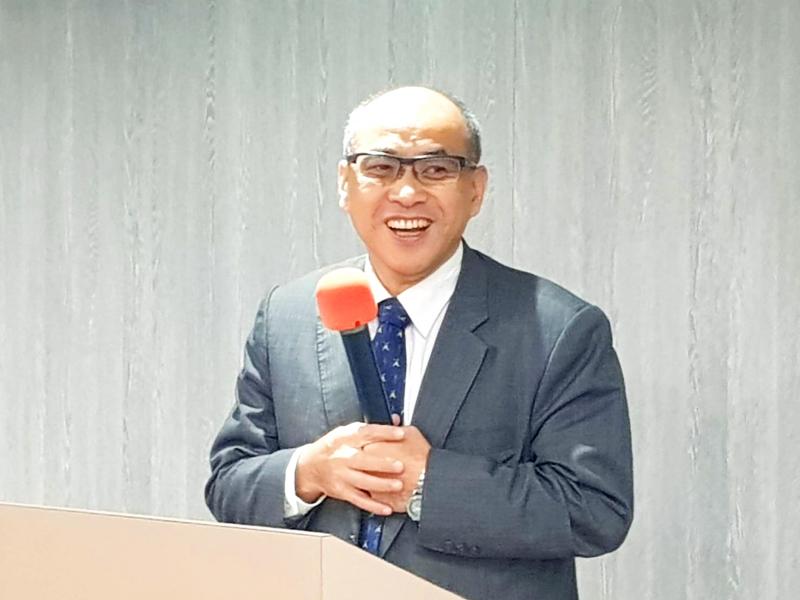
Photo: Wang Yi-hung, Taipei Times
“We used to focus on enlarging our capacity and would order new vessels in a bid to retain our market share, but it also resulted in capital expenditures that were too high. In the future, we will order new vessels under the premise that the new vessels could help gain new profit momentum,” Cheng told an investors’ conference in Taipei.
Yang Ming aims to lower its debt-to-asset ratio, which stood at 90 percent as of the end of June, Cheng said.
Institutional investors and foreign investors hold a combined 5 percent stake in Yang Ming, a figure that Cheng said he hopes to push higher.
Yang Ming would also like to hold earnings conferences quarterly, he said.
With a net loss of NT$885 million (US$30.61 million) in the first six months of the year, the shipper stayed in the red, but the loss narrowed from NT$1.94 billion a year earlier, thanks to rising freight rates and falling oil prices, the firm said.
The shipper holds an upbeat outlook for this quarter given excess demand in the market, Yang Ming spokesperson Shih Mei-chi (史美琦) said.
Although the fourth quarter is usually the slow season for sea shipping, it is not the case this year, as a shortage of containers has led to limited supply and driven up international freight rates, Shih said.
The freight rates for routes from Asia to the US are expected to remain high until the Lunar New Year holiday next year, he said.
The shipper had feared that sea cargo demand might drop at the beginning of the COVID-19 pandemic, but it turned out that with more people working from home, orders for exercise equipment and home entertainment products have picked up — and all of those goods need to be transported by container ships, Shih said.
With the rise in freight rates and volumes, Yang Ming’s third-quarter revenue reached NT$38.85 billion, its second-highest revenue for a single quarter, it said.

Cairo’s new monorail slices across the city skyline, running above the familiar chaos of blaring horns and aging buses’ exhaust fumes that mark rush hour below. The US$4.5 billion monorail, opened this month, is among Egypt’s most prominent new transport projects, part of a debt-funded infrastructure drive criticized for sapping state finances while bringing limited benefits to most of the country’s 109 million people. “It feels like you’re in a different country,” said Ramy Sayed, a restaurant manager, aboard a driverless Innovia 300 train. “No noise, no traffic, we’re not used to this.” The eastern line runs 56km from the bustling middle-class

Taiwanese firms have increased investment in the Philippines in recent years as Manila’s ties with Washington deepen and global supply chains continue to shift away from China, an expert at the Chung-Hua Institution for Economic Research (CIER, 中華經濟研究院) said yesterday. The Philippines had not been among Taiwanese investors’ top choices in Southeast Asia, CIER Taiwan ASEAN Studies Center director Kristy Hsu (徐遵慈) said at a seminar in Taipei. However, Taiwan’s investment in the country has grown significantly since the COVID-19 pandemic, reaching US $257 million last year, a high in recent years, she said. Although Taiwan’s total investment in the Philippines still lags
Intel Corp regards Taiwan Semiconductor Manufacturing Co (TSMC, 台積電) as a longstanding partner, as the US chipmaker would continue outsourcing production of advanced chips to TSMC, Intel chief executive officer Lip-Bu Tan (陳立武) said yesterday. “I don’t look at people as competitors. I look at the collaboration... Nvidia is also, you know, a good friend,” Tan told a news conference following his keynote speech at the Computex trade show in Taipei. “It’s a very trusted partnership for us... We are a big, top customer for them, and we’re going to continue doing that,” he said, referring to TSMC, the world’s largest foundry

Artificial intelligence (AI) agents would supplant smartphones as the center of people’s digital lives, fundamentally reshaping personal devices and driving a major computing upgrade cycle, Qualcomm Inc CEO Cristiano Amon said yesterday. In his keynote speech for this year’s Computex trade show in Taipei, Amon said that the rise of "agentic AI" — AI systems capable of reasoning, planning and carrying out tasks autonomously — would transform how people interact with technology across phones, PCs, vehicles and wearable devices. Describing the technology as the next major evolution in computing, Amon said that "2026 is the year of agents.” For decades, smartphones have sat


 RSS
RSS