


Dutch microchip machine maker ASML Holding NV yesterday reported better-than-expected third-quarter sales, with the tech sector still fueling demand despite the COVID-19 pandemic.
The company is the world’s leading provider of systems used by the semiconductor industry to manufacture the chips that go in products from mobile phones to cars, and its performance is seen as a bellwether for the information technology industry.
“We have seen no major disruptions due to COVID-19 during the last quarter,” ASML president Peter Wennink said in an earnings statement.
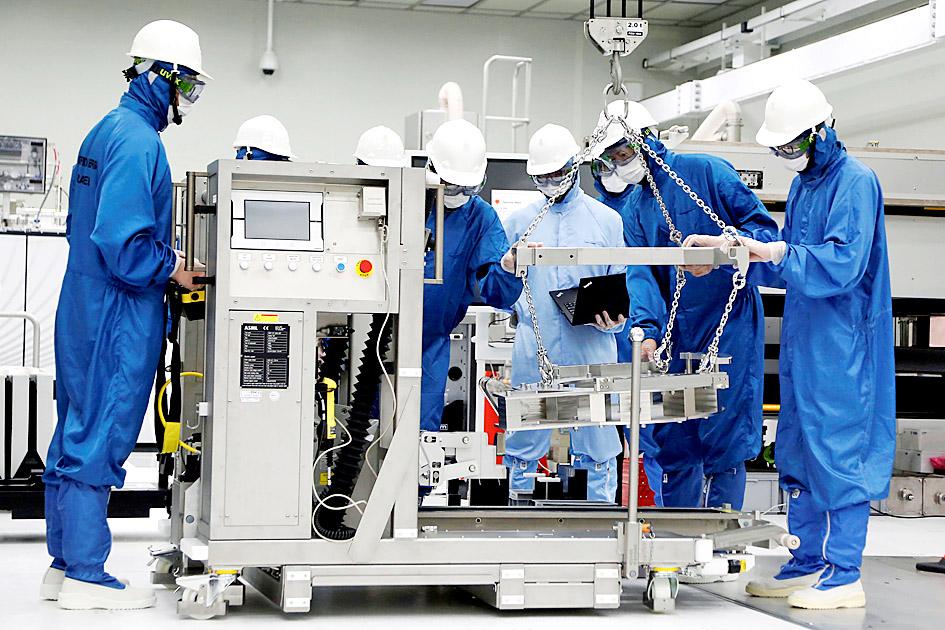
Photo: Reuters
Sales rose 33 percent from the same quarter last year to 4 billion euros (US$4.7 billion) — which Wennink said was “above our guidance” — and 19 percent from the second quarter.
Net profit also rose 69 percent to 1.1 billion euros from last year and 41 percent from the second quarter.
The company shipped 10 of its top-level extreme ultraviolet (EUV) machines, its top-end product used to print chips for mobile phones and computers, Wennink said.
The machines, which cost about 120 million euros each, make it possible to produce smaller, faster and higher capacity microprocessors.
ASML forecasts sales to be slightly lower in the fourth quarter at between 3.6 billion and 3.8 billion euros, but said that would confirm its outlook for the whole of this year.
Wennink said the company expects “low double-digit growth” next year.
“There are of course uncertainties due to the macro environment, including the economic impact of COVID-19 and geopolitical developments,” he said.
However, the tech factors driving ASML’s growth, such as the 5G network that Apple Inc’s new iPhones will rely on, are “still in place” and would “fuel demand,” he said.

SECOND-RATE: Models distilled from US products do not perform the same as the original and undo measures that ensure the systems are neutral, the US’ cable said The US Department of State has ordered a global push to bring attention to what it said are widespread efforts by Chinese companies, including artificial intelligence (AI) start-up DeepSeek (深度求索), to steal intellectual property from US AI labs, according to a diplomatic cable. The cable, dated Friday and sent to diplomatic and consular posts around the world, instructs diplomatic staff to speak to their foreign counterparts about “concerns over adversaries’ extraction and distillation of US AI models.” Distillation is the process of training smaller AI models using output from larger, more expensive ones to lower the costs of training a powerful new

Micron Technology Inc is a driving force pushing the US Congress to pass legislation that would put new export restrictions on equipment its Chinese competitors use to make their chips, according to people familiar with the matter. A US House of Representatives panel yesterday was to vote on the “MATCH Act,” a bill designed to close gaps in restrictions on chipmaking equipment. It would also pressure foreign companies that sell equipment to Chinese chipmaking facilities to align with export curbs on US companies like Lam Research Corp and Applied Materials Inc. The bill targets facilities operated by China’s ChangXin Memory Technologies Inc

Singapore-based ride-hailing and delivery giant Grab Holdings’ planned acquisition of Foodpanda’s Taiwan operations has yet to enter the formal review stage, as regulators await supplementary documents, the Fair Trade Commission (FTC) said yesterday. Acting FTC Chairman Chen Chih-min (陳志民) told the legislature’s Economics Committee that although Grab submitted its application on March 27, the case has not been officially accepted because required materials remain incomplete. Once the filing is finalized, the FTC would launch a formal probe into the deal, focusing on issues such as cross-shareholding and potential restrictions on market competition, Chen told lawmakers. Grab last month announced that it would acquire

Alphabet Inc CEO Sundar Pichai is deepening a push into enterprise software, signaling to investors at Google’s annual cloud conference that artificial intelligence (AI) agents — human-like digital assistants — are a lynchpin of its strategy to monetize AI. At the three-day conference in Las Vegas that started yesterday, Pichai and key Google executives aim to position the company’s AI tools as production-ready infrastructure for enterprise customers who are emerging as the industry’s most reliable revenue stream. Mountain View, California-based Google yesterday announced that it was unifying a set of AI products under the name “Gemini Enterprise.” Most notably, that involves rebranding and


 RSS
RSS