


The central bank yesterday kept its policy interest rate at a record low of 1.125 percent for the second consecutive quarter and slightly raised its forecast for GDP growth this year from 1.52 percent to 1.6 percent.
“The board extended the loose monetary policy to help stabilize consumer prices and support the economy,” central bank Governor Yang Chin-long (楊金龍) said after its quarterly board meeting.
Although Taiwan’s economy has resumed growth and might improve further, a negative output gap might remain, meaning growth of supply would outpace demand.
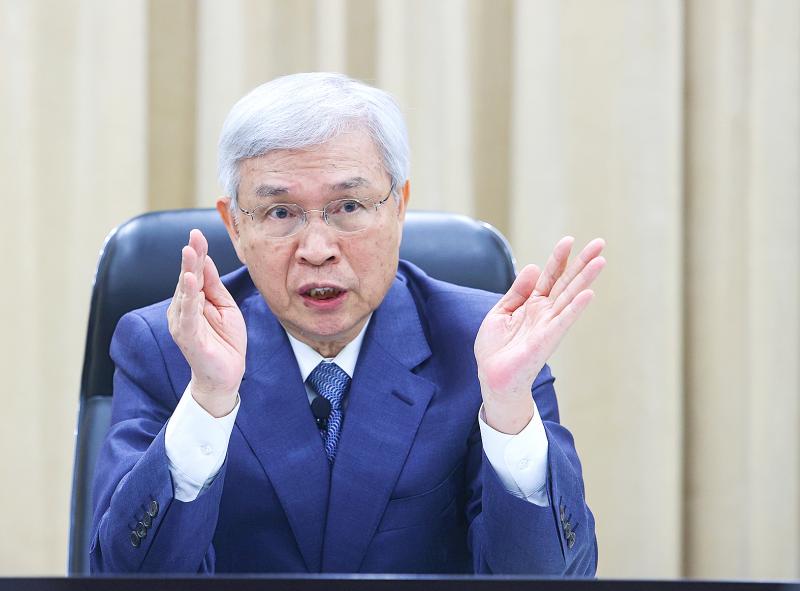
Photo: CNA
Local tech firms have benefited from a boom in technology products sustaining a low-contact economy, while domestic tourism has staged a V-shaped recovery after the COVID-19 pandemic was brought under control in May, the bank said, after raising its growth projection by 0.08 percentage points based on government spending and private investment as supply chains relocate from China.
Low-interest rates help bolster consumer prices, which might contract 0.2 percent this year, Yang said.
Deflation is not a concern, as the core consumer price index, a more reliable tracker because it excludes volatile items, would increase 0.24 percent, he said.
Taiwan does not need to follow the US Federal Reserve, which overnight indicated that it would keep policy rates near zero for at least another three years, Yang said.
However, Taiwan would not take a different path if other central banks maintain an accommodative stance, he said.
The bank reiterated the need to regulate the currency market when it spots massive capital movements.
It said that the New Taiwan dollar is stable and its ongoing appreciation moderate.
As of yesterday, the NT dollar had picked up 2.64 percent against the US greenback this year, less than the Chinese yuan and other counterparts, Yang said.
The governor disputed media reports that said the central bank restricted sales of US dollars in large amounts by currency traders to ease appreciation pressure on the NT dollar.
“It is inaccurate to characterize a goodwill suggestion as intervention,” Yang said.
The central bank is investigating suspect currency trading by eight grain merchants and four banks, he said.
The probe is not yet conclusive, but the transactions appear out of sync with the firms’ business needs, Yang said, adding that it is a tough task to track foreign capital flows.
The local bourse reported capital inflows in July and outflows last month, while the NT dollar has consistently gained value.
A strong NT dollar is unfavorable for local exporters and life insurers, which face foreign exchange and portfolio losses.

NEW IDENTITY: Known for its software, India has expanded into hardware, with its semiconductor industry growing from US$38bn in 2023 to US$45bn to US$50bn India on Saturday inaugurated its first semiconductor assembly and test facility, a milestone in the government’s push to reduce dependence on foreign chipmakers and stake a claim in a sector dominated by China. Indian Prime Minister Narendra Modi opened US firm Micron Technology Inc’s semiconductor assembly, test and packaging unit in his home state of Gujarat, hailing the “dawn of a new era” for India’s technology ambitions. “When young Indians look back in the future, they will see this decade as the turning point in our tech future,” Modi told the event, which was broadcast on his YouTube channel. The plant would convert

Nanya Technology Corp (南亞科技) yesterday said the DRAM supply crunch could extend through 2028, as the artificial intelligence (AI) boom has led the world’s major memory makers to dramatically reduce production of standard DRAM and allocate a significant portion of their capacity for high-bandwidth memory (HBM) chips. The most severe supply constraints would stretch to the first half of next year due to “very limited” increases in new DRAM capacity worldwide, Nanya Technology president Lee Pei-ing (李培瑛) told a news briefing. The company plans to increase monthly 12-inch wafer capacity to 20,000 in the first half of 2028 after a

Property transactions in the nation’s six special municipalities plunged last month, as a lengthy Lunar New Year holiday combined with ongoing credit tightening dampened housing market activity, data compiled by local land administration offices released on Monday showed. The six cities recorded a total of 10,480 property transfers last month, down 42.5 percent from January and marking the second-lowest monthly level on record, the data showed. “The sharp drop largely reflected seasonal factors and tighter credit conditions,” Evertrust Rehouse Co (永慶房屋) deputy research manager Chen Chin-ping (陳金萍) said. The nine-day Lunar New Year holiday fell in February this year, reducing

Zimbabwe’s ban on raw lithium exports is forcing Chinese miners to rethink their strategy, speeding up plans to process the metal locally instead of shipping it to China’s vast rechargeable battery industry. The country is Africa’s largest lithium producer and has one of the world’s largest reserves, according to the US Geological Survey (USGS). Zimbabwe already banned the export of lithium ore in 2022 and last year announced it would halt exports of lithium concentrates from January next year. However, on Wednesday it imposed the ban with immediate effect, leaving unclear what the lithium mining sector would do in the


 RSS
RSS