


Two factions at war over the control of household appliance maker Tatung Co (大同) held separate news conferences yesterday, with the faction made up of rebel shareholders urging the Ministry of Economic Affairs to allow an extraordinary shareholders’ meeting as soon as possible, while the faction belonging to the company accused the other of receiving funds from Chinese investors.
The controversy was sparked by a board meeting on June 30, when the company barred several shareholders who collectively hold a 53 percent stake in the company from voting. The ministry refused to recognize the new board, saying Tatung had improperly stripped some shareholders of their voting rights.
“This unprecedented violation of shareholder rights by a publicly traded company has made Taiwan a laughingstock of global capital markets,” said Shanyuan Group (三圓建設) chairman Wang Kuang-hsiang (王光祥), who leads the so-called “market faction.”
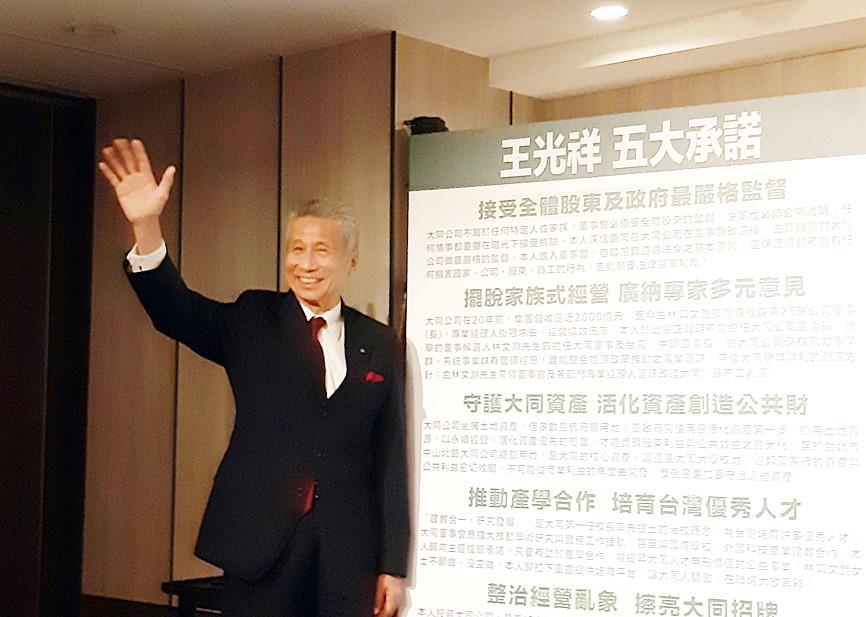
Photo: CNA
Wang called on the ministry to take action by allowing them to organize an extraordinary shareholders’ meeting at which a new board can be elected.
Wang said that once the market faction takes control, he would recommend former Taiwan Power Co (台電) chairman Lin Wen-yuan (林文淵) as Tatung chairman with the aim of freeing the company from the influence of the founding Lin (林) family and revitalizing its tarnished brand.
Meanwhile, Tatung lawyer Chao An (趙安), speaking at the news conference held by the so-called “company faction,” questioned the source of funds for Wang’s investment in Tatung and demanded that authorities conduct a thorough investigation before allowing an extraordinary shareholders’ meeting.
The company has long alleged that Wang and several other shareholders represent Chinese capital, in contravention of the Business Mergers and Acquisitions Act (企業併購法) and the Act Governing Relations Between the People of the Taiwan Area and the Mainland Area (兩岸人民關係條例).
The ministry did not immediately comment on the news conferences.
Minister of Economic Affairs Wang Mei-hua (王美花) last week said the ministry would reach a final decision this week on whether to allow the market faction to hold an extraordinary shareholders’ meeting.
Founded in 1918, Tatung was one of Taiwan’s most venerable and successful companies.
However, the company has been embroiled in boardroom drama and corporate scandals for almost a decade. Former Tatung chairman Lin Wei-shan (林蔚山) is serving an eight-year prison sentence for embezzling corporate funds. Tatung chairwoman Lin Kuo Wen-yen (林郭文艷) is the wife of Lin Wei-shan.

The domestic unit of the Chinese-owned, Dutch-headquartered chipmaker Nexperia BV will soon be able to produce semiconductors locally within China, according to two company sources. Nexperia is at the center of a global tug-of-war over critical semiconductor technology, with a Dutch court in February ordering a probe into alleged mismanagement at the company. The geopolitical tussle has disrupted supply chains, with some carmakers reportedly forced to cut production due to chip shortages. Local production would allow Nexperia’s domestic arm, Nexperia Semiconductors (China) Ltd (安世半導體中國), to bypass restrictions in place since October on the supply of silicon wafers — etched with tiny components to

Singapore-based ride-hailing and delivery giant Grab Holdings Ltd has applied for regulatory approval to acquire the Taiwan operations of Germany-based Delivery Hero SE's Foodpanda in a deal valued at about US$600 million. Grab submitted the filing to the Fair Trade Commission on Friday last week, with the transaction subject to regulatory review and approval, the company said in a statement yesterday. Its independent governance structure would help foster a healthy and competitive market in Taiwan if the deal is approved, Grab said. Grab, which is listed on the NASDAQ, said in the filing that US-based Uber Technologies Inc holds about 13 percent of

Taiwan Semiconductor Manufacturing Co (TSMC, 台積電) yesterday received government approval to deploy its advanced 3-nanometer (3nm) process at its second fab currently under construction in Japan, the Ministry of Economic Affairs said in a news release. The ministry green-lit the plan for the facility in Kumamoto, which is scheduled to start installing equipment and come online in 2028 with a monthly production capacity of 15,000 12-inch wafers, the ministry said. The Department of Investment Review in June 2024 authorized a US$5.26 billion investment for the facility, slated to manufacture 6- to 12nm chips, significantly less advanced than 3nm process. At a meeting with

Taiwan’s food delivery market could undergo a major shift if Singapore-based Grab Holdings Ltd completes its planned acquisition of Delivery Hero SE’s Foodpanda business in Taiwan, industry experts said. Grab on Monday last week announced it would acquire Foodpanda’s Taiwan operations for US$600 million. The deal is expected to be finalized in the second half of this year, with Grab aiming to complete user migration to its platform by the first half of next year. A duopoly between Uber Eats and Foodpanda dominates Taiwan’s delivery market, a structure that has remained intact since the Fair Trade Commission (FTC) blocked Uber Technologies Inc’s


 RSS
RSS