


Novatek Microelectronics Corp (聯詠) yesterday reported that net profit last quarter reached another record high, benefiting from strong demand for display drivers used in laptops, tablets and gaming monitors as people under COVID-19 lockdowns learn and work from home.
Second-quarter net profit grew 20 percent annually and 15.63 percent quarterly to NT$2.56 billion (US$86.77 million) from NT$2.13 billion last year and NT$2.21 billion in the first quarter.
Earnings per share jumped to NT$4.2 from NT$3.5 last year and NT$3.63 in the first quarter.
The Hsinchu-based chip supplier expects work-from-home and remote learning to continue trending as COVID-19 lockdowns resume around the world.
The trend should help boost Novatek’s revenue this quarter by more than 10 percent on a quarterly basis to between NT$20 billion and NT$20.6 billion, from a high of NT$18.61 billion for last quarter, Novatek president and vice chairman Steven Wang (王守仁) told investors during a teleconference.
Novatek expects gross margin this quarter to fall to between 31.5 and 33.5 percent from 33.48 percent in the second quarter.
“Due to continuing lockdowns, people still need to work from home and students have to study online, so the momentum behind the sale of driver ICs for large displays should extend from the second quarter into the third,” Wang said.
Demand for system-on-a-chip solutions for TVs is also picking up as the industry enters its peak season this quarter, Wang added.
With demand for smartphones rebounding, shipments for Novatek’s advanced touch controllers with display driver integration (TDDI) for handset displays should increase significantly during this quarter, Wang said.
“We are seeing mobile phone demand bounce back for the end of July,” Wang said.
To reduce manufacturing costs, more mobile phone makers this year have adopted LCD panels — instead of high-definition, but pricey OLED panels — for new 5G phones, which has helped propel demand for Novatek’s TDDI, he said.
Novatek said that it has made progress on under-display fingerprint chips for OLED panels used in mobile phones, with the first batch shipping by the end of the year.
Separately yesterday, Novatek reported that revenue last month increased 25 percent year-on-year and 15.21 percent quarter-on-quarter to NT$6.74 billion from NT$5.41 billion and NT$5.85 billion respectively — setting an all-time high for the company.
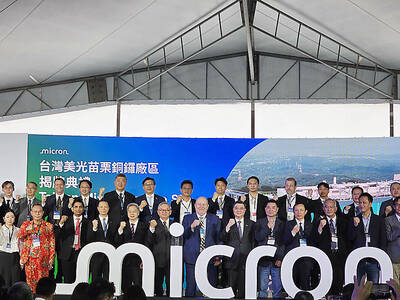
UNPRECEDENTED PACE: Micron Technology has announced plans to expand manufacturing capabilities with the acquisition of a new chip plant in Miaoli Micron Technology Inc unveiled a newly acquired chip plant in Miaoli County yesterday, as the company expands capacity to meet growing demand for advanced DRAM chips, including high-bandwidth memory chips amid the artificial intelligence boom. The plant in Miaoli County’s Tongluo Township (銅鑼), which Micron acquired from Powerchip Semiconductor Manufacturing Corp (力積電) for US$1.8 billion, is expected to make a sizeable capacity contribution to the company from fiscal 2028, the company said in a statement. It would be an extended production site of Micron’s large-scale manufacturing hub in Taichung, the company said. As the global semiconductor industry is racing to reach US$1 trillion

Singapore-based ride-hailing and delivery giant Grab Holdings Ltd has applied for regulatory approval to acquire the Taiwan operations of Germany-based Delivery Hero SE's Foodpanda in a deal valued at about US$600 million. Grab submitted the filing to the Fair Trade Commission on Friday last week, with the transaction subject to regulatory review and approval, the company said in a statement yesterday. Its independent governance structure would help foster a healthy and competitive market in Taiwan if the deal is approved, Grab said. Grab, which is listed on the NASDAQ, said in the filing that US-based Uber Technologies Inc holds about 13 percent of

Taiwan’s food delivery market could undergo a major shift if Singapore-based Grab Holdings Ltd completes its planned acquisition of Delivery Hero SE’s Foodpanda business in Taiwan, industry experts said. Grab on Monday last week announced it would acquire Foodpanda’s Taiwan operations for US$600 million. The deal is expected to be finalized in the second half of this year, with Grab aiming to complete user migration to its platform by the first half of next year. A duopoly between Uber Eats and Foodpanda dominates Taiwan’s delivery market, a structure that has remained intact since the Fair Trade Commission (FTC) blocked Uber Technologies Inc’s

Memory chip stocks extended their losses yesterday after Alphabet Inc’s Google publicized research that could allow more efficient use of the storage needed for artificial intelligence (AI) development. SK Hynix Inc and Samsung Electronics Co, South Korean leaders in the market, fell more than 6 percent and about 5 percent respectively in Seoul. In the US, Micron Technology Inc, Western Digital Corp and Sandisk Corp slid more than 2 percent in pre-market trading, after they all closed lower on Wednesday. Memory companies have been on a tear in recent months as the rapid development of AI infrastructure triggered a spike in chip


 RSS
RSS